 Magyar
 Română
 Lietuviškai
 Latviešu valoda
 Eesti
Eesti Polski
 Slovenčina
 Slovenščina
 Italiano
 Čeština
 Deutsch
What EN 13164 Is and Why It Exists
EN 13164:2012+A1:2015 is the harmonised European standard that defines the requirements, test methods, and performance classification system for factory-made extruded polystyrene (XPS) thermal insulation boards intended for use in buildings. It sits under the EU Construction Products Regulation (CPR, 305/2011), which means compliance with it is a legal precondition for placing XPS boards on the European single market with CE marking.
The standard does four things simultaneously:
Specifies the properties that must be determined (e.g. thermal resistance, compressive strength, water absorption).
Prescribes the exact test method for each property (referenced EN test standards).
Defines alphanumeric classification codes so that declared values are unambiguous across manufacturers and countries.
Requires the manufacturer to issue a Declaration of Performance (DoP) listing those values publicly.
PNP Orange Kft. states EN 13164:2012+A1:2015 as the governing standard for all PNP XPS products.
How the Test Method Works: From Sample to Declared Value
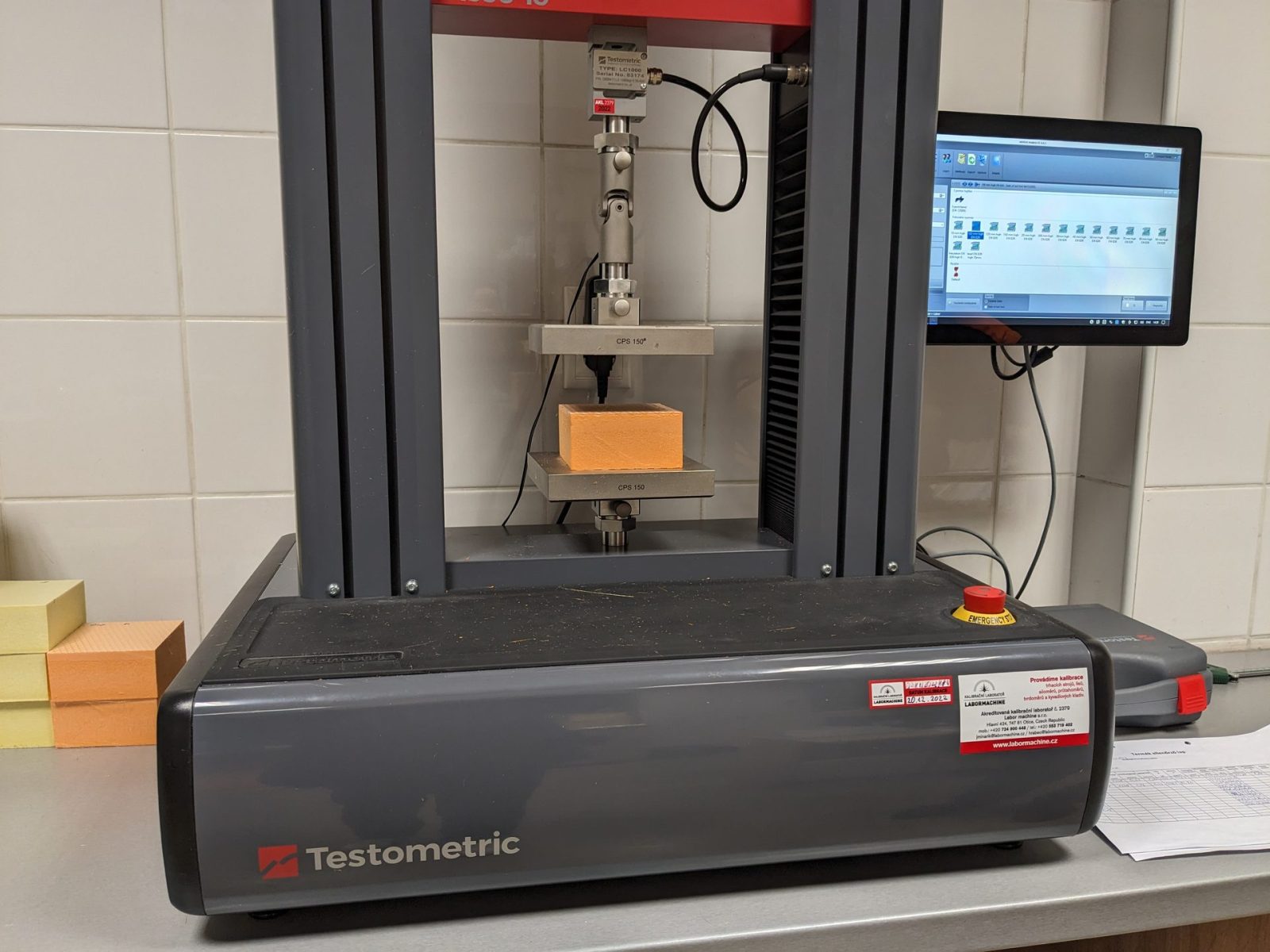
Under EN 13164, each property is determined using a specific referenced test standard applied to production samples. The measured results are then converted into a declared value — a statistically conservative figure that the manufacturer is legally accountable for across the entire production run, not just a single batch.
Key properties and their classification codes used across PNP XPS products include:
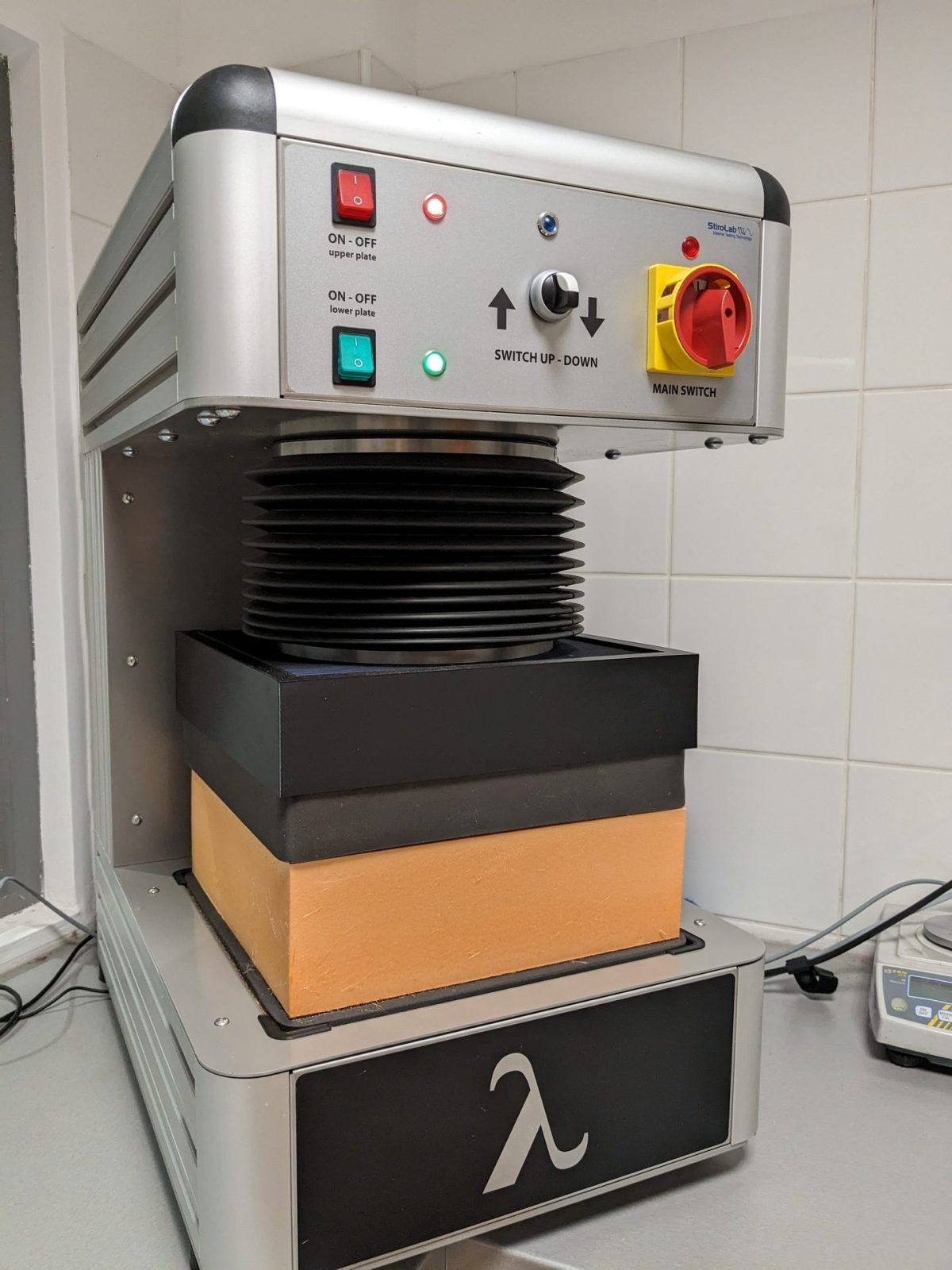
Thermal conductivity (λD) — declared in W/(m·K); for PNP XPS boards this is 0.034 W/(m·K) (thicknesses 20–100 mm) or 0.035 W/(m·K) (thicknesses 120–150 mm) depending on the product.
Compressive strength CS(10\Y) — the load in kPa at 10 % deformation or yield (EN 826). PNP XPS products range from CS(10\Y)150 (≥ 150 kPa) to CS(10\Y)700 (≥ 700 kPa).
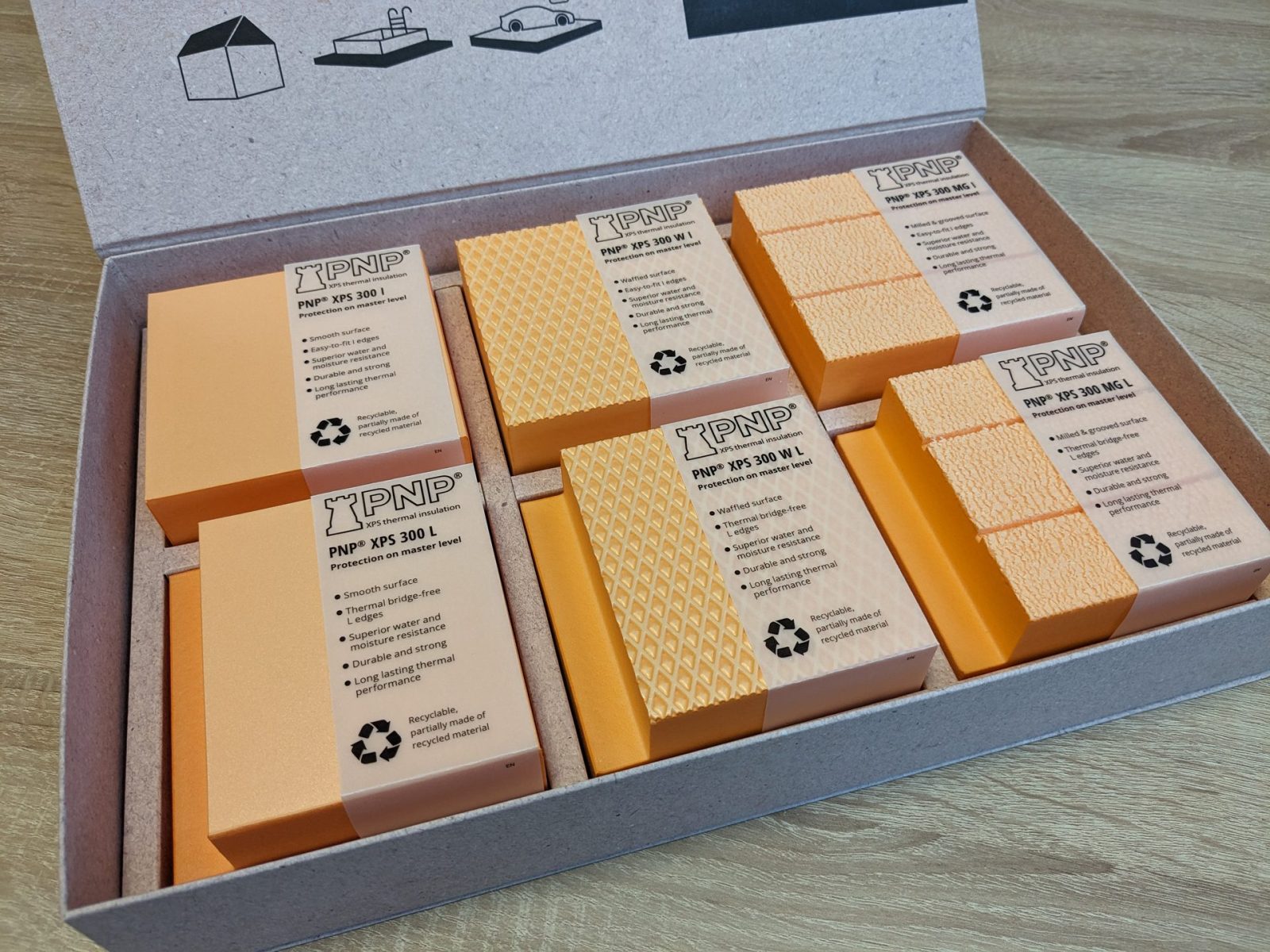
Long-term water absorption by immersion WL(T) — maximum volume percentage after long-term immersion. Smooth and waffled-surface boards are typically rated WL(T)0.7 (≤ 0.7 Vol.-%), while milled-and-grooved surfaces carry WL(T)3 (≤ 3.0 Vol.-%) due to the open surface texture.
Water absorption by diffusion WD(V) — declared where tested; several PNP products carry WD(V)3 (≤ 3.0 Vol.-%).
Dimensional stability DS(70,90) — stability at 70 °C and 90 % relative humidity.
Tensile strength perpendicular to faces TR — TR 200 or TR 400 depending on product.
Freeze–thaw resistance FTCD — FTCD 1 (≤ 1 Vol.-%) where declared.
Compressive creep CC(2/1.5/50) — long-term creep limit in kPa over 50 years at 2 % deformation, declared for structural products (e.g. CC(2/1.5/50)130 for XPS 300, CC(2/1.5/50)210 for XPS 700).
Reaction to fire Euroclass — Euroclass E for higher-strength products (XPS 300, 400, 500, 700) and Euroclass F for lower-strength products (XPS 150, 200 families).
The test showed the values listed above; these appear in each product's DoP and technical data sheet (TDS). A qualified designer must confirm which properties are relevant to the specific application and local regulation — the standard itself does not prescribe minimum in-service performance levels for any particular building element.
What the DoP and CE Marking Formally Confirm
The Declaration of Performance (DoP) is the legal document issued by PNP Orange Kft. under CPR 305/2011 for each product. It states:
The unique product identification and intended use.
The harmonised technical specification (EN 13164:2012+A1:2015).
The declared performance for each essential characteristic.
The manufacturer's name and registered production plant (Várpalota, Hungary).
CE marking on the board, packaging or delivery documentation signals that a DoP exists and that the product was manufactured under a factory production control (FPC) system audited to the requirements of EN 13164. This allows the declared values to be used directly in calculations and specifications across all EU and EEA member states without re-testing at the border.
What CE marking does prove: that the declared values were obtained by the methods in EN 13164, that an FPC system is in place, and that the manufacturer takes legal responsibility for those values.
What CE marking alone does not prove: that any specific thickness or product is fit for a particular design situation. Fitness for purpose — including load calculations, thermal design, dew-point analysis, fire strategy, and drainage — requires a qualified designer to apply the declared values to the project conditions and the regulations of the country of use. Always consult the current TDS and DoP, and engage a qualified engineer for design decisions.
Declared Values Across the PNP XPS Range
The table below summarises the declared values stated in the DoPs and TDS documents for published PNP XPS products. All boards conform to EN 13164:2012+A1:2015.
Product | CS(10\Y) kPa | λD W/(m·K) | WL(T) Vol.-% | Fire class | Creep CC(2/1.5/50) |
|---|---|---|---|---|---|
100–150 | 0.034–0.035 | ≤ 0.7 | F | not declared | |
200–300 | 0.034–0.035 | ≤ 0.7 | E | 130 kPa (>30 mm) | |
200–300 | 0.034–0.035 | ≤ 0.7 | E | 130 kPa (>30 mm) | |
500 | 0.034–0.035 | ≤ 0.7 | E | 150 kPa | |
700 | 0.034–0.035 | ≤ 0.7 | E | 210 kPa | |
300 | see current TDS | see current TDS | see current TDS | see current TDS |
For products not listed above or for TB-format thicknesses, refer to the current TDS and DoP available at the documentation page.
What the Evidence Does and Does Not Prove
EN 13164 certification and CE marking provide a strong, legally grounded evidence base for specifiers. The evidence supports the following conclusions:
The declared λD, CS, WL(T), TR, DS, FTCD and CC values are determined by standardised, reproducible test methods and are legally accountable.
Factory production control means that boards supplied from the Várpalota plant are manufactured to maintain those declared values across production runs.
The DoP enables direct cross-border specification without re-testing, supporting procurement across the 16 markets PNP XPS supplies.
However, this alone does not prove the following:
Design adequacy for any specific project. Compressive strength class, required thermal resistance (RD), and moisture management must be calculated for the actual assembly by a qualified designer.
Fire performance in an assembly. Euroclass E or F applies to the board in isolation. System fire performance depends on the full assembly, cladding and use category, and must be assessed under the fire regulations applicable in the country of use.
Compliance with national energy codes. EN 13164 declares product properties; national building regulations determine minimum RD values for each element and climate zone.
For all design decisions, consult the current TDS and DoP for the selected product and engage a qualified structural engineer or building physicist.
Where to Find the DoPs and TDS Documents
Every PNP XPS product has a DoP issued under CPR 305/2011 and a technical data sheet. Both documents are available for download at pnpinsulation.com/documentation/. Product pages list the specific document filenames and update dates for each SKU.
For questions about specific projects or declared values, contact PNP Orange Kft. at pnpinsulation.com/contact/ or by email at sales@pnpinsulation.com.
Related knowledge articles:
Sources
EN 13164:2012+A1:2015 — Thermal insulation products for buildings: factory-made products of extruded polystyrene foam (XPS)
EU Construction Products Regulation 305/2011 (CPR)
DoP PNP XPS 150_en (U).pdf (updated 2025-10-14)
DoP PNP XPS X-Grip_en (U).pdf (updated 2026-06-24)
DoP PNP XPS 150W_en (U).pdf (updated 2025-10-14)
DoP PNP XPS 200_en (U).pdf (updated 2025-08-14)
DoP PNP XPS 200 W_en (U).pdf (updated 2025-08-14)
DoP PNP XPS 300 EMI_en (U).pdf (updated 2025-10-14)
DoP PNP XPS 300 W EMI_en (U).pdf (updated 2025-10-13)
DoP PNP XPS 500_en (U).pdf (updated 2025-07-22)
DoP PNP XPS 700_eng.pdf (updated 2025-03-17)
DoP PNP 300 SLOPE A2-B2_en.pdf (updated 2025-03-17)
DoP PNP 300 SLOPE A1-B1_en.pdf (updated 2025-03-17)
DoP PNP XPS 150 MG 20 mm_eng.pdf (updated 2025-03-17)
DoP PNP XPS 150 MG (30-150 mm)_eng.pdf (updated 2025-03-17)
DoP PNP XPS 200 MG_eng.pdf (updated 2025-03-17)
DoP PNP XPS 300 MG_eng.pdf (updated 2025-03-17)
DoP PNP XPS 400_en (U).pdf (updated 2026-04-10)
TDS pnp_xps300-300TB_600x1250_techcard_en(20.07.2026).pdf (updated 2026-07-22)
TDS pnp_xps500-500TB_600x1250_techcard_en(20.07.2026).pdf (updated 2026-07-22)
TDS pnp_xps700_600x1250_techcard_en (21.07.2023).pdf (updated 2025-03-17)
PNP Orange Kft. company data (brand: PNP XPS, plant: Várpalota, Hungary)