 Magyar
 Română
 Lietuviškai
 Latviešu valoda
 Eesti
Eesti Polski
 Slovenčina
 Slovenščina
 Italiano
 Čeština
 Deutsch
The Short Answer
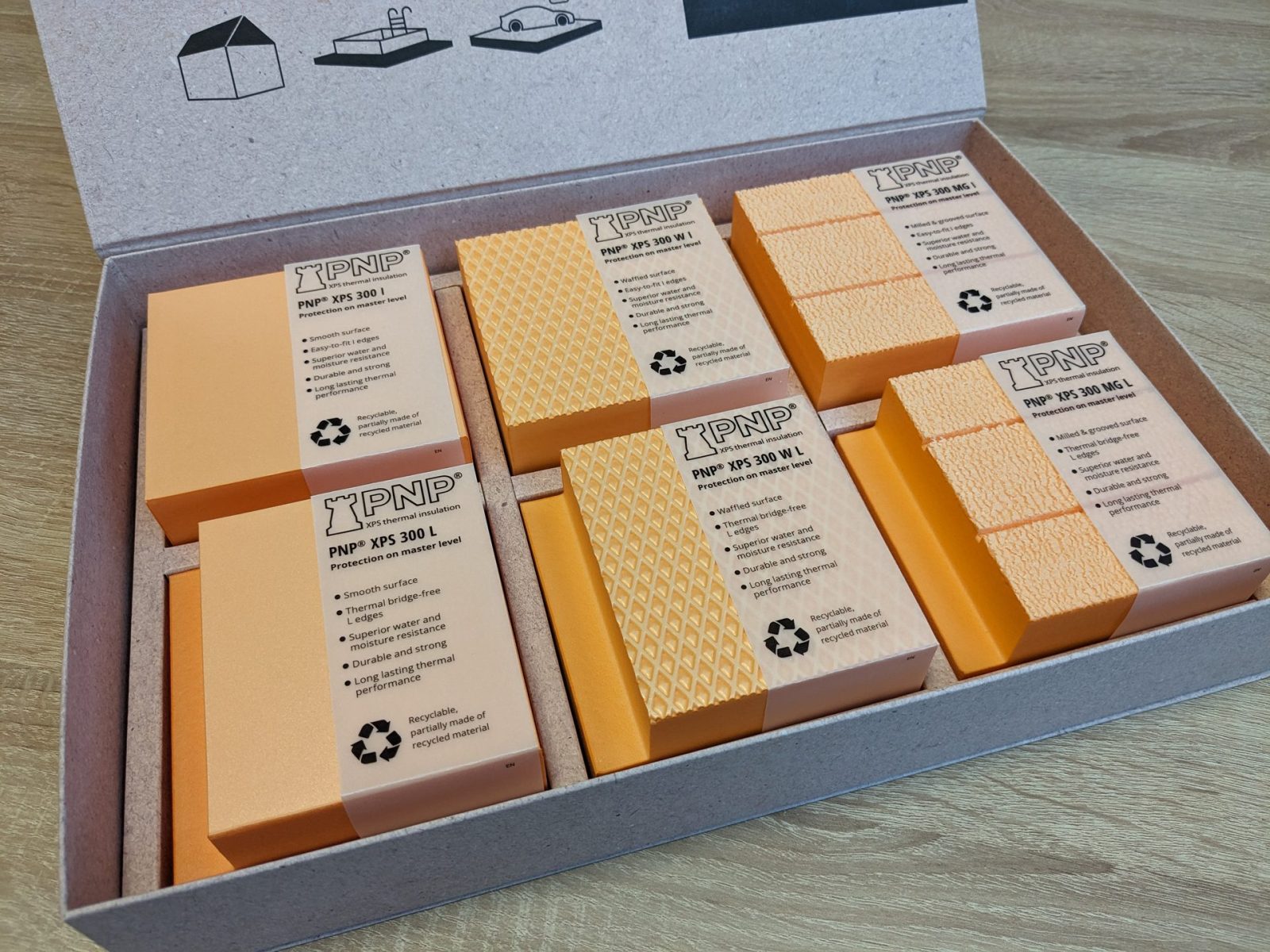
XPS can accept plaster, render, and tile adhesive directly — provided the board face presents sufficient mechanical key. PNP XPS offers two surface types engineered for this purpose:
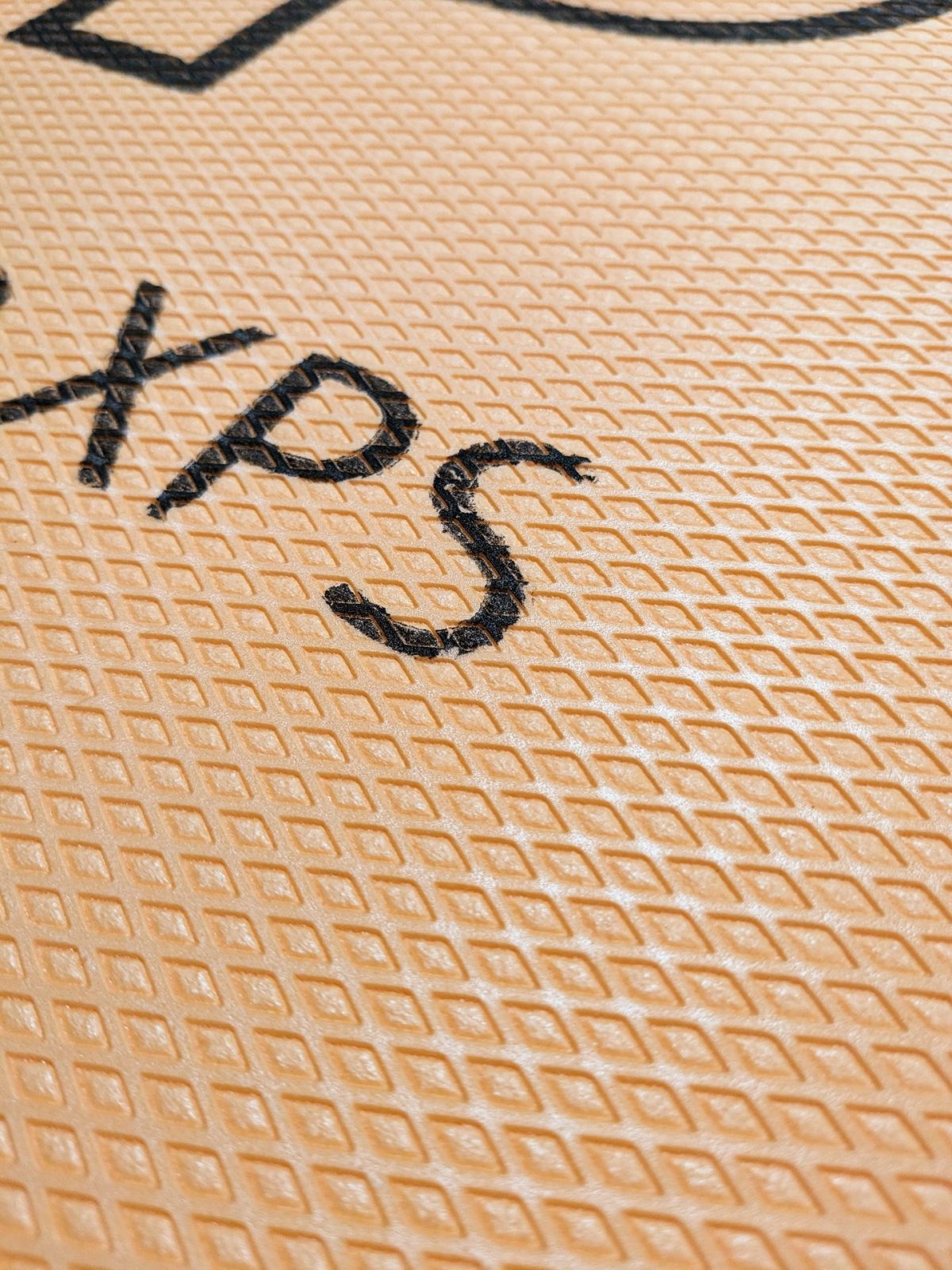
W (waffled) — an embossed waffle pattern that interlocks with adhesive and base-coat compounds.
MG (milled and grooved) — a roughened face with cut grooves that significantly improves adhesion of plaster and adhesive compounds.
Smooth-skin boards (XPS 150, XPS 200, XPS 300, XPS 400, XPS 500, XPS 700) are not suitable for direct plaster or render application. PNP product documentation explicitly excludes smooth boards from plaster and render systems.
Why Surface Type Matters
Standard XPS is manufactured with a dense, closed-cell extruded skin. This skin is thermally efficient and highly water-resistant, but it gives adhesive and cementitious compounds almost nothing to grip. Even with a compatible adhesive, pull-off strength on a smooth surface is unreliable, and long-term durability of the render layer cannot be assured.
Waffled and milled-and-grooved surfaces break through or remove the extruded skin, exposing the open-cell structure beneath and creating a physical interlock — a mechanical key — for the base coat and reinforcing mesh. This is the same principle as scratching plaster backgrounds before applying a finish coat.
Note also that MG boards carry a higher long-term water absorption by immersion rating (WL(T)3, ≤ 3.0 Vol.-%) compared to smooth or waffled boards (WL(T)0.7, ≤ 0.7 Vol.-%), because the open surface allows more moisture ingress. This is accounted for in correctly designed ETICS systems and does not affect thermal performance when the system is intact.
PNP Products Suitable for Direct Rendering
The following PNP XPS boards are listed for ETICS, plaster, render, and tile-adhesive applications in their product documentation:
Product | Surface | Compressive strength | λD (W/m·K) | Typical use |
|---|---|---|---|---|
Waffled | 100–150 kPa | 0,034–0,035 | Facades, walls, ETICS, balconies | |
Waffled | 200 kPa | 0,034–0,035 | Vertical walls, floors, facades | |
Waffled | 200–300 kPa | 0,034–0,035 | Facades, accessible roofs, podium decks | |
Milled and grooved | 100–150 kPa | 0,034–0,035 | ETICS, facades, tile adhesive systems | |
Milled and grooved | 200 kPa | 0,034–0,035 | ETICS, facades, plinths | |
Milled and grooved | 300 kPa | 0,034–0,035 | Structural facades, ETICS under high load |
For most standard residential and commercial ETICS facades, XPS 150 W X-Grip or XPS 150 MG are the typical starting point. Where higher compressive resistance is required — for example, at ground-floor plinths, accessible areas, or under heavy tile finishes — the 200 or 300 kPa variants should be considered. A qualified designer should confirm the appropriate grade for each application.
How a Rendered XPS Facade System Is Built
The PNP solutions catalogue describes the ETICS plaster system layer sequence as follows:
Wall substrate
Adhesive compound
PNP XPS boards with waffled or milled-and-grooved surface
Mechanical fasteners
Base reinforcing layer with glass-fibre mesh
Plaster primer
Decorative plaster (render)
The same sequence — with a primer and tile adhesive in place of the render — applies to clinker tile facade systems. Mechanical fasteners supplement adhesive bonding and are standard practice in ETICS; fixing pattern, type, and quantity are a design decision that depends on substrate, height, wind load zone, and local regulations. Consult a qualified designer and refer to the current TDS and DoP for each board.
Boards That Must Not Be Rendered Directly
The following smooth-surface products are explicitly listed as excluding plaster and render systems in PNP product documentation:
XPS 150 — listed applications exclude plaster/render systems
XPS 200 — listed applications exclude plaster/render systems
XPS 300 — smooth surface; intended for foundations, floors, roofs
XPS 500 — industrial and high-compression applications only
XPS 700 — civil engineering and extreme-load applications only
Using a smooth board in a rendered system this alone does not prove the finish will fail immediately, but it creates a foreseeable adhesion risk that a correct product selection eliminates entirely.
Sources
XPS 150 W X-Grip product description and TDS (pnp_xpsX-Grip_X-GripTB_600x1250_techcard_en, updated 2026-07-22)
XPS 150 MG product description and TDS (pnp_xps150MG_600x1250_techcard_en, updated 2025-03-17)
XPS 200 W product description and TDS (pnp_xps200W-200WTB_600x1250_techcard_en, updated 2026-07-22)
XPS 200 MG product description and TDS (pnp_xps200MG_600x1250_techcard_en, updated 2025-03-17)
XPS 300 W product description and TDS (pnp_xps300W-300WTB_600x1250_techcard_en, updated 2026-07-22)
XPS 300 MG product description and TDS (pnp_xps300MG_600x1250_techcard_en, updated 2025-03-17)
XPS 150 product description (applications note: excluding plaster/render systems)
XPS 200 product description (applications note: excluding plaster/render systems)
XPS 300 product description (smooth surface, foundations/floors/roofs)
PNP solutions catalogue — ETICS plaster systems layer sequence
PNP solutions catalogue — Facade clinker tile system layer sequence
EN 13164:2012+A1:2015 (product standard referenced in all PNP XPS DoPs)