What the Two Products Have in Common
XPS 300 and XPS 300 W are both rigid extruded polystyrene (XPS) thermal insulation boards manufactured by PNP Orange Kft. at the Várpalota plant and conforming to EN 13164:2012+A1:2015. Their declared performance values are identical in every structural and thermal category:
Compressive strength: CS(10\Y) 200 (≥ 200 kPa) at 20–30 mm; CS(10\Y) 300 (≥ 300 kPa) above 30 mm
Declared thermal conductivity (λD): 0.034 W/(m·K) for 20–100 mm; 0.035 W/(m·K) for 120–150 mm
Reaction to fire: Euroclass E
Long-term water absorption by immersion: WL(T) 0.7 (≤ 0.7 Vol.-%)
Water absorption by diffusion: WD(V) 3 (≤ 3.0 Vol.-%)
Tensile strength perpendicular to faces: TR 400
Compressive creep (boards > 30 mm): CC(2/1.5/50)130
Freeze–thaw resistance: FTCD 1 (≤ 1 Vol.-%)
Dimensional stability: DS(70,90)
Deformation under load and temperature: DLT(2)5
Thickness tolerance: T1
Operating temperature range: −70 … +75 °C
Board size: 1250 × 600 mm; L-edge; transport dimensions 615 × 1265 mm
Available thicknesses: 20, 30, 40, 50, 60, 80, 100, 120, 150 mm
Both products are REACH-compliant and contain no HBCDD or other substances of very high concern.
The One Difference: Surface Texture
The entire product selection decision reduces to a single question: will a subsequent layer be bonded directly to the insulation board?
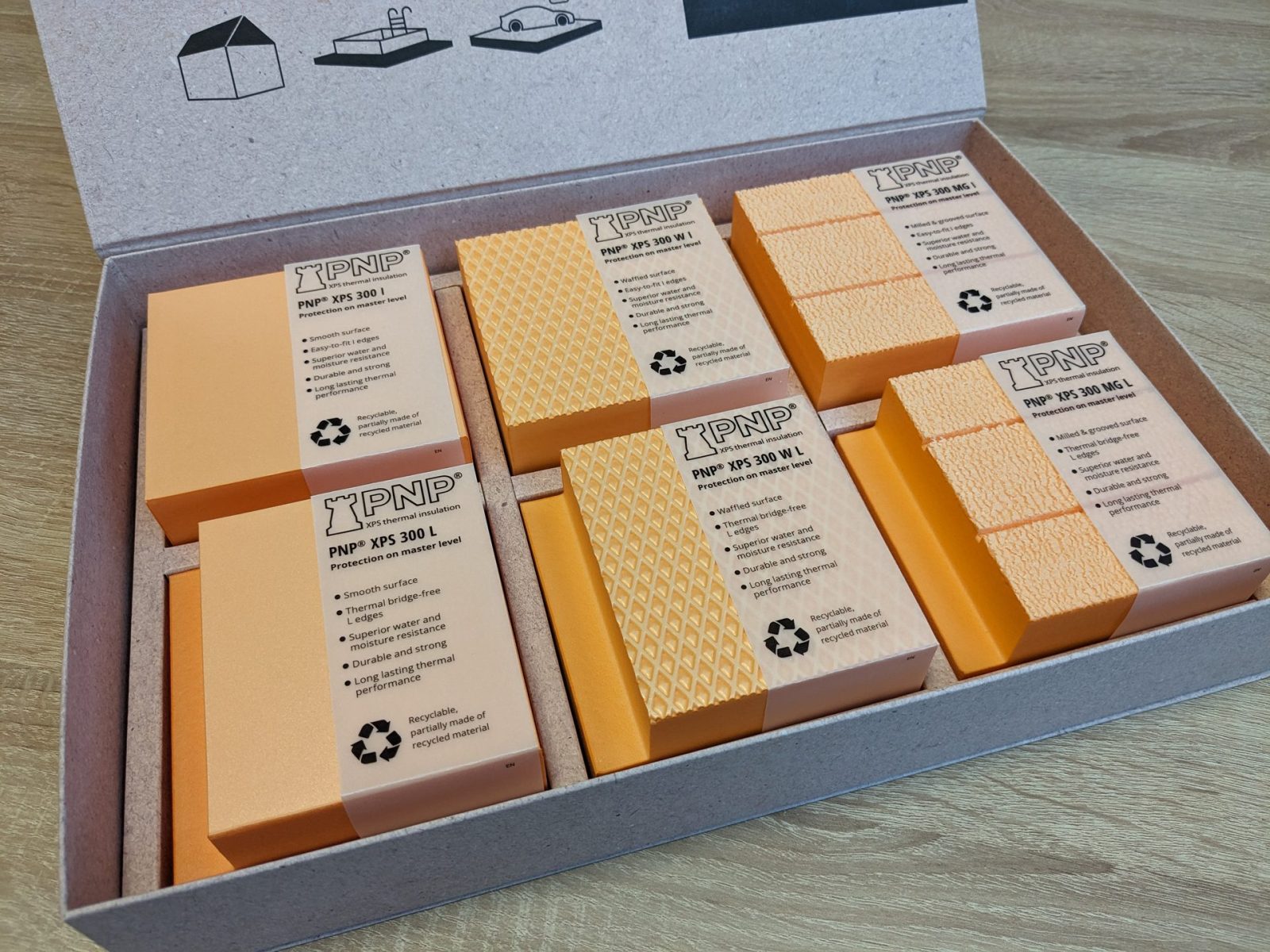
XPS 300 has a smooth extruded skin. The intact skin provides the board's lowest water-vapour permeability and the cleanest mechanical interface for loose-laid or mechanically fastened assemblies. It is the right choice when nothing needs to adhere to the board face.
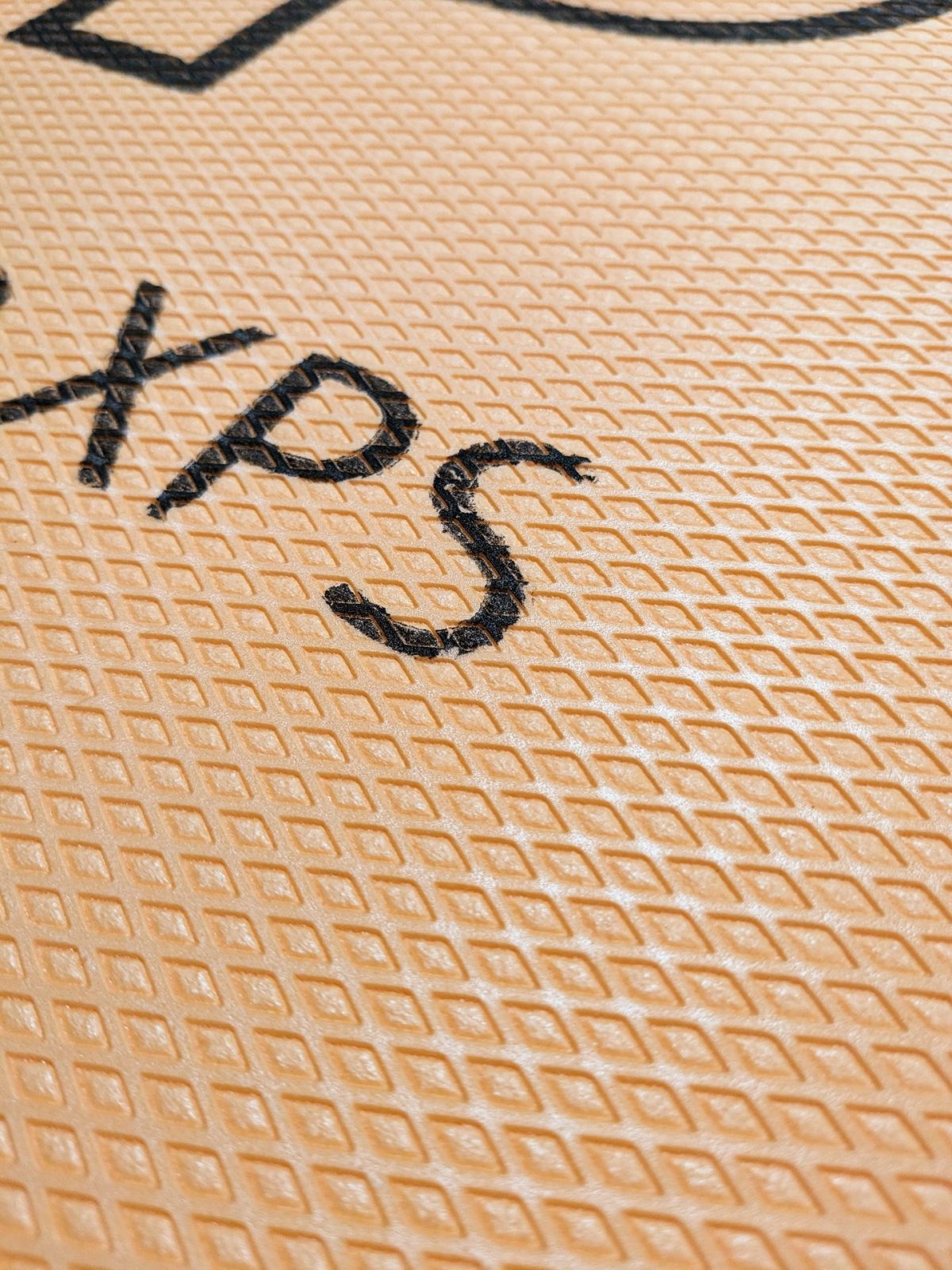
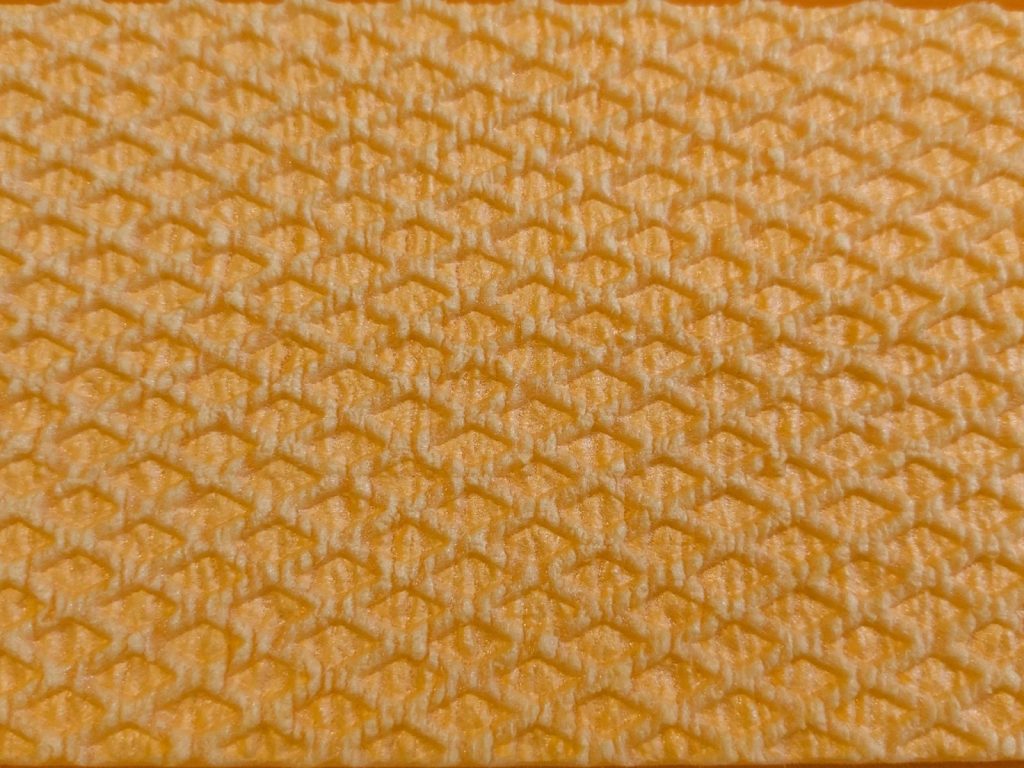
XPS 300 W has a waffled (embossed) surface — the PNP "W" designation used across the range. The waffled texture creates a regular pattern of peaks and recesses that give adhesive compounds, render basecoats and polymer-modified mortars the mechanical key they need to achieve reliable bond. This makes XPS 300 W the correct choice for any assembly where a bonded layer is applied directly to the insulation face.
The waffled surface does result in a slightly higher declared long-term water absorption compared to smooth boards in some XPS product families, but in the XPS 300 / XPS 300 W pair the data show both products carry the same WL(T) 0.7 rating, so water resistance is not a differentiating factor here.
Declared Performance Comparison Table
PropertyXPS 300 (smooth)XPS 300 W (waffled)Surface typeSmoothWaffledSuitable for bonded systemsNoYesλD 20–100 mm, W/(m·K)0.0340.034λD 120–150 mm, W/(m·K)0.0350.035Compressive strength 20–30 mmCS(10\Y) 200 (≥ 200 kPa)CS(10\Y) 200 (≥ 200 kPa)Compressive strength > 30 mmCS(10\Y) 300 (≥ 300 kPa)CS(10\Y) 300 (≥ 300 kPa)Reaction to fireEEWL(T) long-term water absorption≤ 0.7 Vol.-%≤ 0.7 Vol.-%WD(V) water absorption by diffusion≤ 3.0 Vol.-%≤ 3.0 Vol.-%Tensile strength TRTR 400TR 400Compressive creep (> 30 mm)CC(2/1.5/50)130CC(2/1.5/50)130Freeze–thaw FTCDFTCD 1FTCD 1Dimensional stabilityDS(70,90)DS(70,90)Edge profileL-edgeL-edgeThickness range (mm)20–15020–150
Typical Applications for XPS 300 (Smooth)
XPS 300 is suited to applications where the board is not bonded to an applied finish layer:
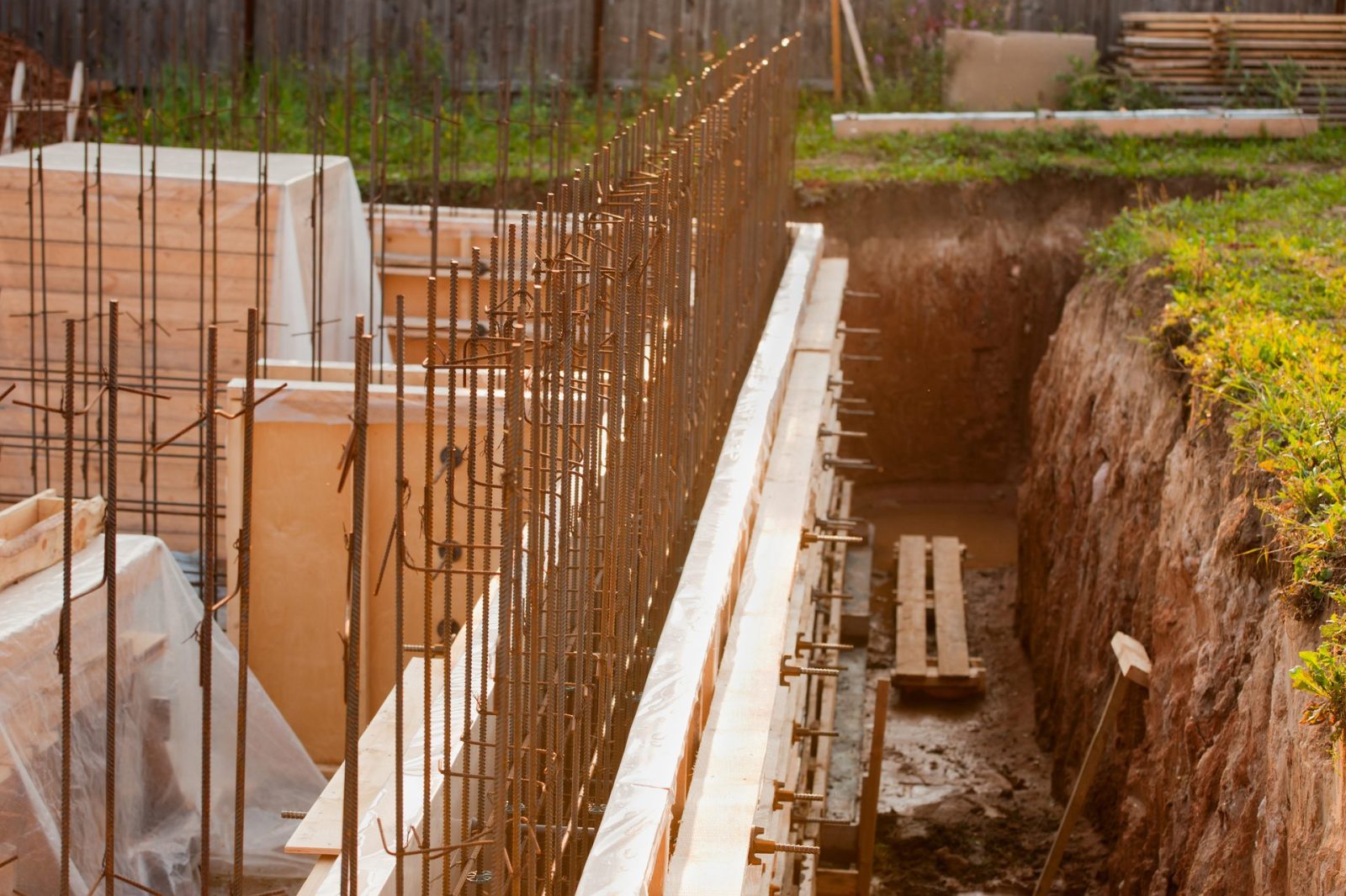
Thermal insulation of foundations and foundation slabs
Floor insulation in load-bearing assemblies (below screed, floating floor systems)
Inverted and accessible flat roofs where the board lies under ballast, pavers or drainage layers
Stylobates and paving systems
Insulation beneath heavy-duty surface finishes in trafficked areas
Expansion joint filling
In these details, the smooth skin is not a limitation — it is functionally appropriate because no adhesive bond to the board face is required.
Typical Applications for XPS 300 W (Waffled)
XPS 300 W is suited to applications where a render, mortar, adhesive or coating must bond to the insulation surface:
Exterior insulation composite systems (ETICS) where basecoat render is applied directly to the board
Facade insulation under tile-adhesive or clinker-tile systems
Floor insulation beneath adhesive-bonded floor finishes
Accessible roofs and podium decks where membranes or coatings bond to the board
Horizontal building elements requiring a high-bond substrate surface
Perimeter and plinth insulation where a finish coat is applied
The waffled surface supports the adhesion demand in these assemblies. A qualified designer should confirm bond-strength requirements and system compatibility for the specific ETICS or adhesive system being used — the TDS and DoP for XPS 300 W provide the declared values needed for that assessment.
Thick-Board (TB) Variants
Both XPS 300 and XPS 300 W are available in a TB (thick-board) format covering thicknesses from 100 mm to 200 mm — useful where high thermal resistance is required in a single layer. Confirm available TB thicknesses and λD values for the TB range in the current technical data sheet, as values above 150 mm are not reproduced in the standard product summary.
Decision Guide: Which Board to Specify
Use this checklist to make the selection:
Is a render, adhesive, mortar or coating applied directly to the board face? → Specify XPS 300 W.
Is the board loose-laid, mechanically fastened, or placed under ballast, screed or pavers without direct bonding? → Specify XPS 300.
Do you need compressive strength above 300 kPa (e.g. industrial floors, road construction)? → Consider XPS 500 or XPS 700.
Do you need a waffled surface with lower compressive strength (non-structural facade or wall application)? → Consider XPS 150 W X-Grip.
For any load calculation, dew-point analysis, fire strategy or country-specific compliance, consult the current TDS and DoP and engage a qualified structural or building-physics designer.
Further reading: What Does '300 kPa' Compressive Strength Mean?
Sources
XPS 300 technical data sheet: pnp_xps300-300TB_600x1250_techcard_en(20.07.2026).pdf (updated 2026-07-22)
XPS 300 Declaration of Performance: DoP PNP XPS 300 EMI_en (U).pdf (updated 2025-10-14)
XPS 300 W technical data sheet: pnp_xps300W-300WTB_600x1250_techcard_en(20.07.2026).pdf (updated 2026-07-22)
XPS 300 W Declaration of Performance: DoP PNP XPS 300 W EMI_en (U).pdf (updated 2025-10-13)
EN 13164:2012+A1:2015 — Factory made products of extruded polystyrene foam (XPS) — Specification
PNP XPS product data (company DATA block, retrieved 2026-09-18)