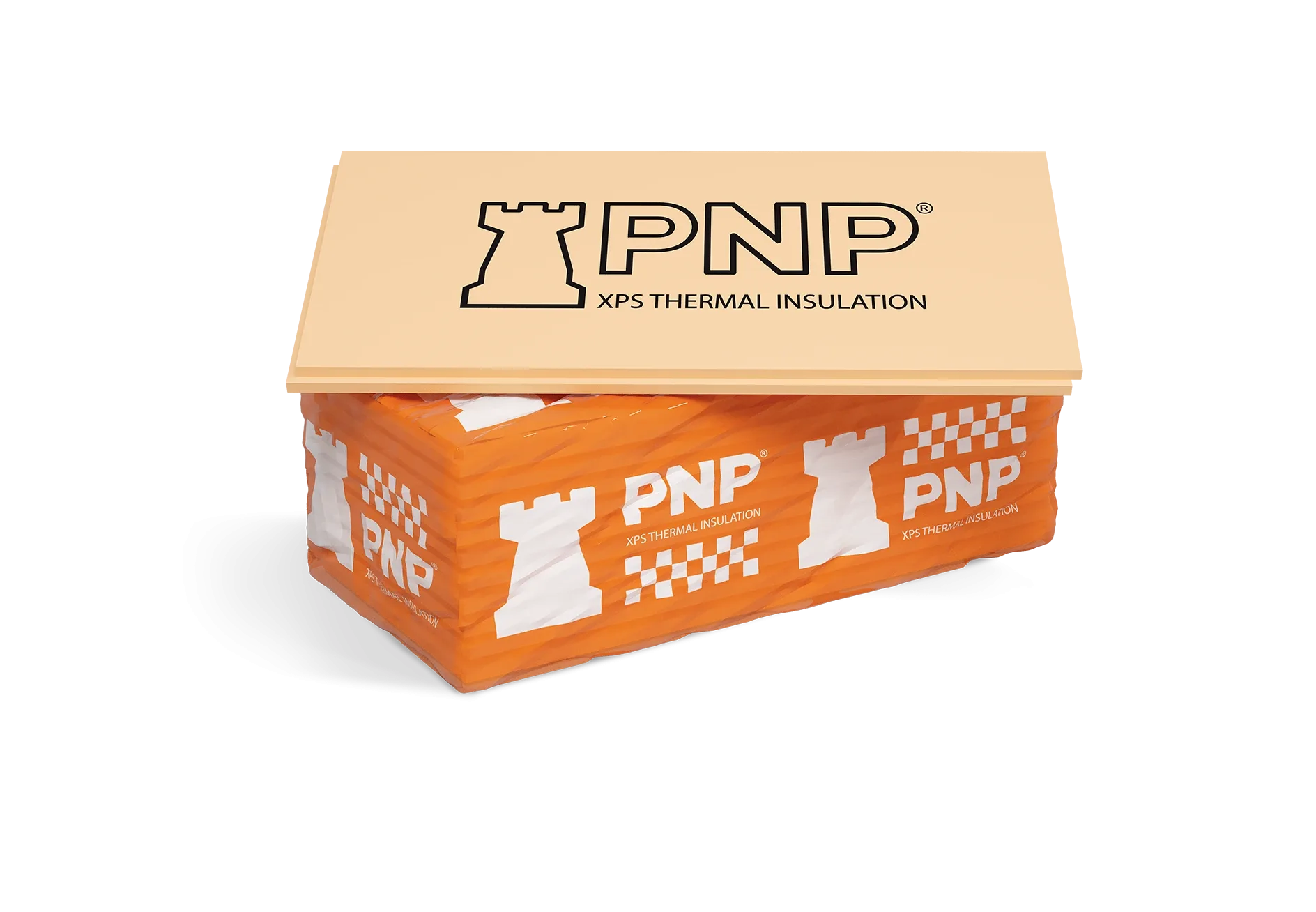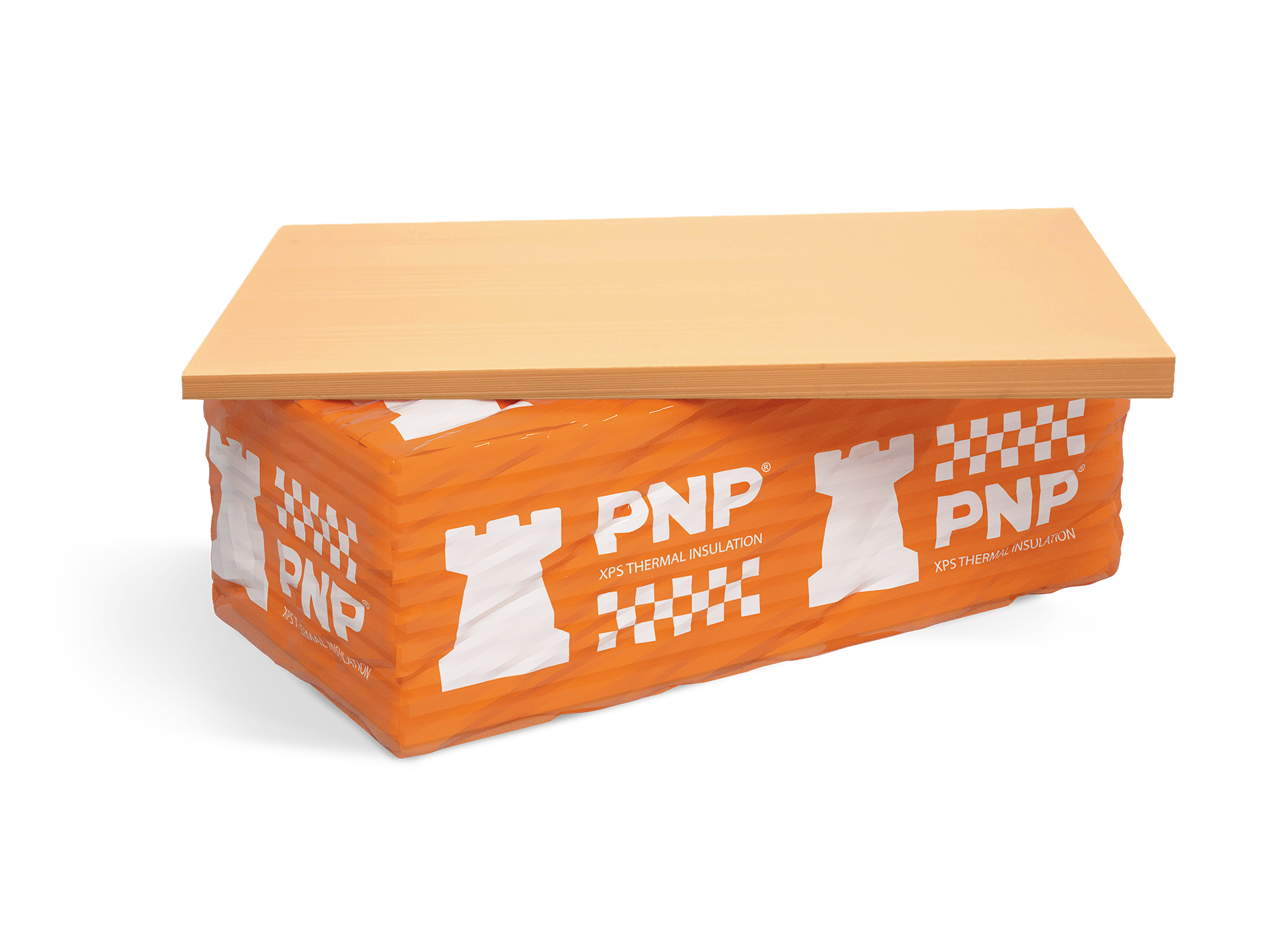


XPS 500 — Industrial & High Compression Thermal Insulation

Use XPS 500 where heavy static and dynamic loads demand maximum compression resistance, including industrial floors, parking decks, and road construction.

Compressive strength, kPa:
500
Declared thermal conductivity λD, W/(m·K):
0,034–0,035
Reaction to fire, class:
E
Board size (length × width), mm:
1250 × 600
Nominal thickness, mm:
40–120
Surface type:
Smooth
Edge type:
Straight edge (I) / L-shaped edge (L)
Product standard:
EN 13164:2012+A1:2015

A heavy-duty rigid extruded polystyrene board engineered for thermal insulation in structures subject to exceptional compressive loads, including industrial floors and road construction. PNP XPS 500 is available in thicknesses from 40 mm to 200 mm (and beyond on request in the TB format), delivering consistently low thermal conductivity alongside a compressive strength of ≥ 500 kPa.

Description

PNP XPS 500 is a high-performance thermal insulation material (latest generation XPS) manufactured from general-purpose polystyrene. It features a smooth surface and a homogeneous closed-cell structure, with a declared thermal conductivity (λD) of 0.034 W/m·K for thicknesses of 40–100 mm and 0.035 W/m·K for 120 mm (standard format); the TB variant maintains λD 0.034 W/m·K from 100–200 mm and 0.035 W/m·K from 210–290 mm and 330–360 mm. Compressive strength meets CS(10\Y) 500 (≥ 500 kPa), tensile strength perpendicular to faces is TR 400, and long-term water absorption by total immersion is rated WL(T) 0.7 (≤ 0.7 Vol.-%). The boards conform to EN 13164:2012+A1:2015 and are fully REACH-compliant, containing no HBCDD or other substances of very high concern.

Applications

  • Industrial floors and heavily loaded floor slabs requiring high compressive resistance
  • Road and infrastructure construction where elevated load-bearing performance is specified
  • Flat-roof and inverted-roof insulation under traffic or plant loads
  • Cold-store and refrigeration facility floors and walls
  • Foundation and basement perimeter insulation subject to high ground pressure

Advantages

  • Exceptional compressive strength — CS(10\Y) ≥ 500 kPa, suited to the most demanding structural applications
  • Consistently low thermal conductivity (λD 0.034–0.035 W/m·K) across the full thickness range
  • Virtually zero water absorption — homogeneous sealed closed-cell structure (WL(T) ≤ 0.7 Vol.-%)
  • Absolute biostability and proven long-term durability
  • REACH-compliant and environmentally responsible — no ozone-depleting blowing agents used in production
  • Wide operating temperature range: −70 °C to +75 °C
XPS 500 — Industrial & High Compression Thermal Insulation — Technical
PropertyThickness range / conditionDeclared value
Compressive strength / compressive stress at 10% deformation, CS(10\Y)CS(10\Y)500 (≥500 kPa)
Reaction to fire, classE
Declared thermal conductivity λD, W/(m·K)40–100 mm0,034 W/m·K
Declared thermal conductivity λD, W/(m·K)120 mm0,035 W/m·K
Long-term water absorption by total immersion, WL(T)WL(T)0,7 (≤ 0,7 [Vol.-%])
Long-term water absorption by diffusion, WD(V)WD(V)3 (≤ 3,0 [Vol-%])
Dimensional stability under specified conditions, DSDS(70,90)
Compressive creep, CCCC(2/1,5/50)150
Tensile strength perpendicular to faces, TRTR 400
Freeze–thaw resistance, FTCDFTCD1 (≤1 [Vol-%])
Deformation under specified compressive load and temperature conditionsDLT(2)5
Thickness tolerance, classT1
Operating temperature, °C−70 … +75 °C
Surface typeSmooth
Edge typeL-edge
Product standardEN 13164:2012+A1:2015

Values according to the current technical data sheet.

XPS 500 — Industrial & High Compression Thermal Insulation — Packaging
Nominal thickness, mmDeclared thermal resistance RD, m²·K/WBoards per pack, pcsPack area, m²Pack volume, m³
401,15107,500,3000
501,4586,000,3000
601,7564,500,2700
802,3553,750,3000
1002,9043,000,3000
1203,4032,250,2700

Transport dimensions for boards with L-edge: 615×1265 mm.

XPS 500 — Industrial & High Compression Thermal Insulation

Technical data sheet

pnp_xps500-500TB_600x1250_techcard_en(20.07.2026).pdf

PDF · EN

XPS 500 — Industrial & High Compression Thermal Insulation

Declaration of Performance

DoP PNP XPS 500_en (U).pdf

PDF · EN

XPS 500 — Industrial & High Compression Thermal Insulation: is it the right board?

When to use it

  • The floor slab or pavement must carry static or dynamic loads that require a certified compressive strength of 500 kPa (CS(10\Y)500), such as industrial production floors, logistics-hall slabs, or heavy-racking warehouse floors.
  • An inverted or warm flat roof will be trafficked by vehicles, service plant, or heavy access equipment, where 300 kPa boards would be under-specified.
  • Road or infrastructure construction requires thermally insulating the subgrade against frost heave on heavily loaded carriageways or access roads.
  • Cold-store and refrigeration facility floors must simultaneously resist high point loads from racking or forklift traffic and maintain thermal performance over the life of the facility.
  • A foundation slab or basement floor is subject to concentrated equipment loads or column reactions that exceed the capacity of XPS 300 or XPS 400.
  • Long-term creep deformation must be controlled to ≤ 2 % over 50 years at 1.5 % strain: the declared CC(2/1,5/50)150 value of XPS 500 supports this requirement (verify load versus creep limit with the TDS and a qualified structural engineer).
  • The project specification explicitly calls for EN 13164 class CS(10\Y)500 insulation board and the smooth surface and L-edge profile are compatible with the assembly detail.

When not to use it

  • The application is a standard residential or commercial floor slab where design loads do not justify CS(10\Y)500, because XPS 300 or XPS 400 already covers the structural requirement at lower cost.
  • The insulation board will be bonded or rendered directly (ETICS, plaster, tile adhesive), because XPS 500 has a smooth skin that does not provide the mechanical key required for adhesion systems.
  • A factory-formed roof drainage fall is needed, because XPS 500 is not available in a tapered SLOPE format.
  • The project requires boards thinner than 40 mm or in the 130–150 mm range in the standard format, as the published thickness range for XPS 500 is 40–120 mm (TB format available on request — see current TDS for exact range).
  • The budget or specification requires only Euroclass F reaction-to-fire, because XPS 500 is classified Euroclass E; if a lower fire class is acceptable, a lower-strength grade avoids potential over-specification.

Choose instead

  • For standard residential or light commercial floors where 500 kPa is not required, choose XPS 300 (300 kPa, Euroclass E) or XPS 400 (400 kPa, Euroclass E).
  • For ETICS, plaster, render or tile-adhesive facade and wall systems requiring a keyed surface, choose XPS 300 W (waffled, 300 kPa) or XPS 150 W X-Grip (waffled, 150 kPa) depending on the structural requirement.
  • For flat roofs or terraces where a built-in drainage fall is needed, choose XPS 300 SLOPE (factory-tapered, 300 kPa).
  • For applications needing boards below 40 mm or thicknesses outside the XPS 500 standard range, choose XPS 300 (available from 20 mm) or XPS 700 (available from 20 mm) if higher strength is required at thinner sections.
  • For extreme civil-engineering or infrastructure loads exceeding 500 kPa, choose XPS 700 (700 kPa, CC(2/1,5/50)210).

When do you really need 500 kPa?

XPS 500 sits between XPS 400 (400 kPa) and XPS 700 (700 kPa) in the PNP range. Its declared compressive strength of CS(10\Y)500 — meaning ≥ 500 kPa at 10 % deformation or yield per EN 826 — is certified under EN 13164:2012+A1:2015 and confirmed in the DoP. This figure represents the load at which the board deforms by 10 % of its thickness, not a safety working stress; the actual design value used in calculations depends on load duration, safety factors, and the applicable national standard. A qualified structural or geotechnical engineer must verify that XPS 500 is the appropriate grade for any specific assembly.

The key differentiator versus XPS 300 is the compressive creep class: XPS 500 is rated CC(2/1,5/50)150, meaning long-term creep deformation remains within 2 % over 50 years at a sustained stress of 150 kPa. This supports its use beneath industrial floor slabs and road sub-bases where decades of continuous load must not cause measurable settlement in the insulation layer. XPS 300 carries CC(2/1,5/50)130 — adequate for most building floors, but lower than XPS 500 in both short-term capacity and creep limit.

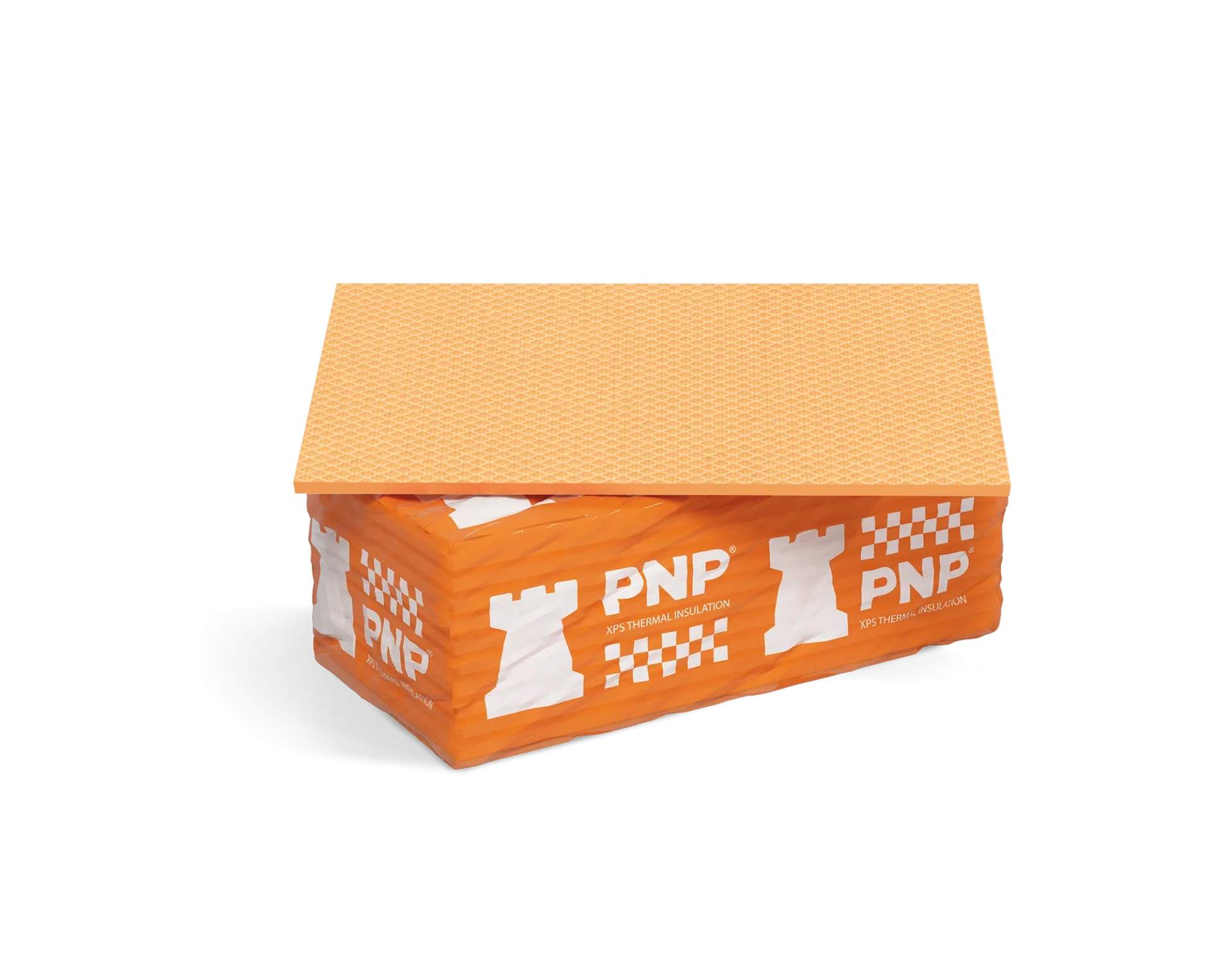
XPS 500 is produced with a smooth skin and L-edge profile, in thicknesses of 40–120 mm in the standard format (TB format for greater thicknesses — see current TDS). The smooth surface is well-suited to load-bearing assemblies where the board sits beneath a screed, concrete slab, or road base layer, but it is not intended for direct adhesive or render bonding. λD is 0.034 W/(m·K) for 40–100 mm and 0.035 W/(m·K) for 120 mm, so thermal performance is essentially identical to other PNP XPS grades — the selection criterion is structural, not thermal.

In practice, XPS 500 is most commonly specified for industrial logistics floors, vehicle-trafficked inverted roofs, cold-store floors under racking loads, and frost-protection layers in road construction. For loads beyond 500 kPa, XPS 700 is the next step in the PNP range. For any application where loads are at or just above the XPS 300 or XPS 400 threshold, confirm the governing design load, safety factor, and creep requirement with the project engineer before upgrading grades.

XPS 500 — Industrial & High Compression Thermal Insulation — frequently asked questions

What does CS(10\Y)500 actually mean on the XPS 500 data sheet?

It means the board has a certified compressive strength of ≥ 500 kPa measured at 10 % deformation or at yield — whichever comes first — in accordance with EN 826. This is a characteristic value; the design stress used in structural calculations must be derived by a qualified engineer applying the appropriate partial factors and load-duration corrections for the project.

Can XPS 500 be used directly under a render or ETICS system?

No. XPS 500 has a smooth skin that does not provide the mechanical key required for plaster, render, or tile-adhesive systems. For bonded or rendered facades use a waffled-surface board such as XPS 300 W, or a milled-and-grooved board such as XPS 300 MG.

How does XPS 500 compare to XPS 700 for road insulation?

XPS 500 is rated CS(10\Y)500 with a creep class of CC(2/1,5/50)150, while XPS 700 is rated CS(10\Y)700 with CC(2/1,5/50)210. XPS 700 is appropriate where design loads or national road-construction specifications require the higher class; the choice between them must be confirmed by a qualified designer against the project-specific load model.

What thickness range is XPS 500 available in?

The standard format is available in 40, 50, 60, 80, 100, and 120 mm. A TB (thick-board) format extends the range further — see the current TDS for the exact TB thickness steps, as these are subject to production scheduling.

Is XPS 500 suitable for cold-store and freezer-room floors?

Yes — the data sheet lists cold-store and refrigeration facility floors and walls as a stated application. The closed-cell structure gives a long-term water absorption by immersion of WL(T)0,7 (≤ 0.7 Vol.-%), which supports durability in permanently cold and potentially damp conditions; thermal and structural design must be confirmed with the TDS and a specialist engineer.

What is the declared thermal conductivity of XPS 500?

λD is 0.034 W/(m·K) for boards in the 40–100 mm thickness range and 0.035 W/(m·K) for the 120 mm board (standard format). For TB-format thicknesses, consult the current TDS.

What reaction-to-fire class does XPS 500 carry, and does it meet project fire requirements?

XPS 500 is classified Euroclass E under EN 13164:2012+A1:2015. Whether this satisfies the fire requirements of a specific project depends on national building regulations, the application detail, and any system-level fire classification — this must be verified by a qualified fire or building-control specialist.

Where can I find the Declaration of Performance and full technical data for XPS 500?

The DoP (DoP PNP XPS 500_en (U), updated 2025-07-22) and TDS (pnp_xps500-500TB_600x1250_techcard_en, updated 2026-07-20) are available via the PNP documentation library at /documentation/. For project-specific queries contact sales@pnpinsulation.com.

See also

XPS 300 — Structural Foundation & Flooring Thermal Insulation

Smooth · 300 kPa

XPS 300 — Structural Foundation & Flooring Thermal Insulation

Use XPS 300 where heavy loads demand reliable thermal insulation, including foundations, floor slabs, and accessible roofs.

More details

XPS 300 W — High-Adhesion Structural Thermal Insulation

W (Waffle) · 300 kPa

XPS 300 W — High-Adhesion Structural Thermal Insulation

Use XPS 300 W on accessible roofs or podium decks where load-bearing performance and maximum adhesion for membranes or coatings are critical.

More details

XPS 300 SLOPE — Tapered Roof Drainage Thermal Insulation

Slope · 300 kPa

XPS 300 SLOPE — Tapered Roof Drainage Thermal Insulation

Use XPS 300 SLOPE on flat roofs, terraces and green roofs where a single-layer solution must create drainage fall and provide lasting thermal insulation.

More details

XPS 700 — Extreme Loads & Civil Engineering Thermal Insulation

Smooth · 700 kPa

XPS 700 — Extreme Loads & Civil Engineering Thermal Insulation

Use XPS 700 where maximum compressive strength is critical, including heavy civil infrastructure, industrial foundations, and high-load road construction projects.

More details

XPS 150 X-Grip — Superior Adhesion, Lightweight Thermal Insulation

X-Grip · 150 kPa

XPS 150 X-Grip — Superior Adhesion, Lightweight Thermal Insulation

PNP XPS 150 X-Grip is a waffled-surface extruded polystyrene board engineered for superior adhesion of renders, tile adhesives and bonded ETICS systems — about 17 % lower carbon footprint than PNP XPS 300 W, lighter to handle.

More details
Go to catalogue
Write to us

Write to us

Leave your contact details and we will get back to you as soon as possible.

Write to us

Leave your contact details and we will get back to you as soon as possible.

Your request has been sent

We will contact you shortly