 Magyar
 Română
 Lietuviškai
 Latviešu valoda
 Eesti
Eesti Polski
 Slovenčina
 Slovenščina
 Italiano
 Čeština
 Deutsch
Method: How This Page Was Compiled
The facts below were assembled exclusively from PNP XPS product data sheets (TDS), Declarations of Performance (DoP), the company data record and the published EPD for the Várpalota plant. Every claim is traceable to one of those documents. Where a value is not recorded in the available data — such as annual production capacity, founding year, or third-party certifications beyond EN 13164 — this page states that explicitly rather than estimating.
Figures from DoP files are declared values under EN 13164:2012+A1:2015; they represent the performance level the manufacturer guarantees, not single-specimen test peaks.
Legal Identity and Production Site
Legal name: PNP Orange Kft.
Operational since: 2023, Hungary (HU)
Brand: PNP XPS
Plant city: Várpalota, Hungary (HU)
Contact: sales@pnpinsulation.com
Production is consolidated at one plant. The EPD (EN 15804, updated 2025-03-19) is site-specific to Várpalota, which supports the inference that all declared environmental data apply to boards from that facility. Annual capacity and founding year are not stated in the available data — see the current TDS for any updates.
Markets Served
According to the company data record, PNP XPS boards are supplied to 16 countries:
Central Europe: Hungary (HU), Czech Republic (CZ), Slovakia (SK), Poland (PL), Slovenia (SL)
South-Eastern Europe: Romania (RO), Croatia (HR), Serbia (SR), Bulgaria (BG)
Eastern Europe and CIS: Moldova (MD), Ukraine (UA)
Baltic states: Estonia (EE), Latvia (LV), Lithuania (LT)
Western and Southern Europe: Germany (DE), Italy (IT)
This alone does not prove that all product grades are stocked in every market; availability by country should be confirmed with the sales team at pnpinsulation.com/contact.
Applicable Standard and Certification Framework
Harmonised standard: EN 13164:2012+A1:2015 — Thermal insulation products for buildings — Factory made products of extruded polystyrene foam (XPS) — Specification.
All PNP XPS boards for which a DoP exists are CE-marked under this standard pursuant to Regulation (EU) No 305/2011 (CPR). Each DoP declares the essential characteristics relevant to the intended use. No additional third-party certifications (e.g. national marks, ISO system certificates) are recorded in the available data.
An Environmental Product Declaration (EPD) covering the Várpalota plant has been published to EN 15804 (updated 2025-03-19). BIM library objects are also available (updated 2025-02-24) via pnpinsulation.com/documentation.
Product Range: What the Evidence Shows
PNP XPS offers boards across five compressive strength classes. The table below summarises declared values drawn from published TDS and DoP files. All boards are 1250 × 600 mm in plan.
Product | Compressive strength | λD (W/(m·K)) | Fire class | Thickness range (mm) | Surface |
|---|---|---|---|---|---|
100–150 kPa | 0.034–0.035 | F | 20–150 | Waffled | |
200–300 kPa | 0.034–0.035 | E | 20–150 | Smooth | |
200–300 kPa | 0.034–0.035 | E | 20–150 | Waffled | |
500 kPa | 0.034–0.035 | E | 40–120 | Smooth | |
700 kPa | 0.034–0.035 | E | 20–150 | Smooth | |
300 kPa | see TDS | see DoP | factory-tapered | Smooth | |
150 kPa | see TDS | see DoP | factory-tapered | Smooth |
Additional grades (XPS 150, XPS 150 MG, XPS 200, XPS 200 MG, XPS 200 W, XPS 300 MG, XPS 400) are documented in published DoP and TDS files but are listed as unpublished on the website at the time of writing. Thick-board (TB) variants extend the available thickness range above standard maximums for several grades; consult the relevant TDS for exact limits.
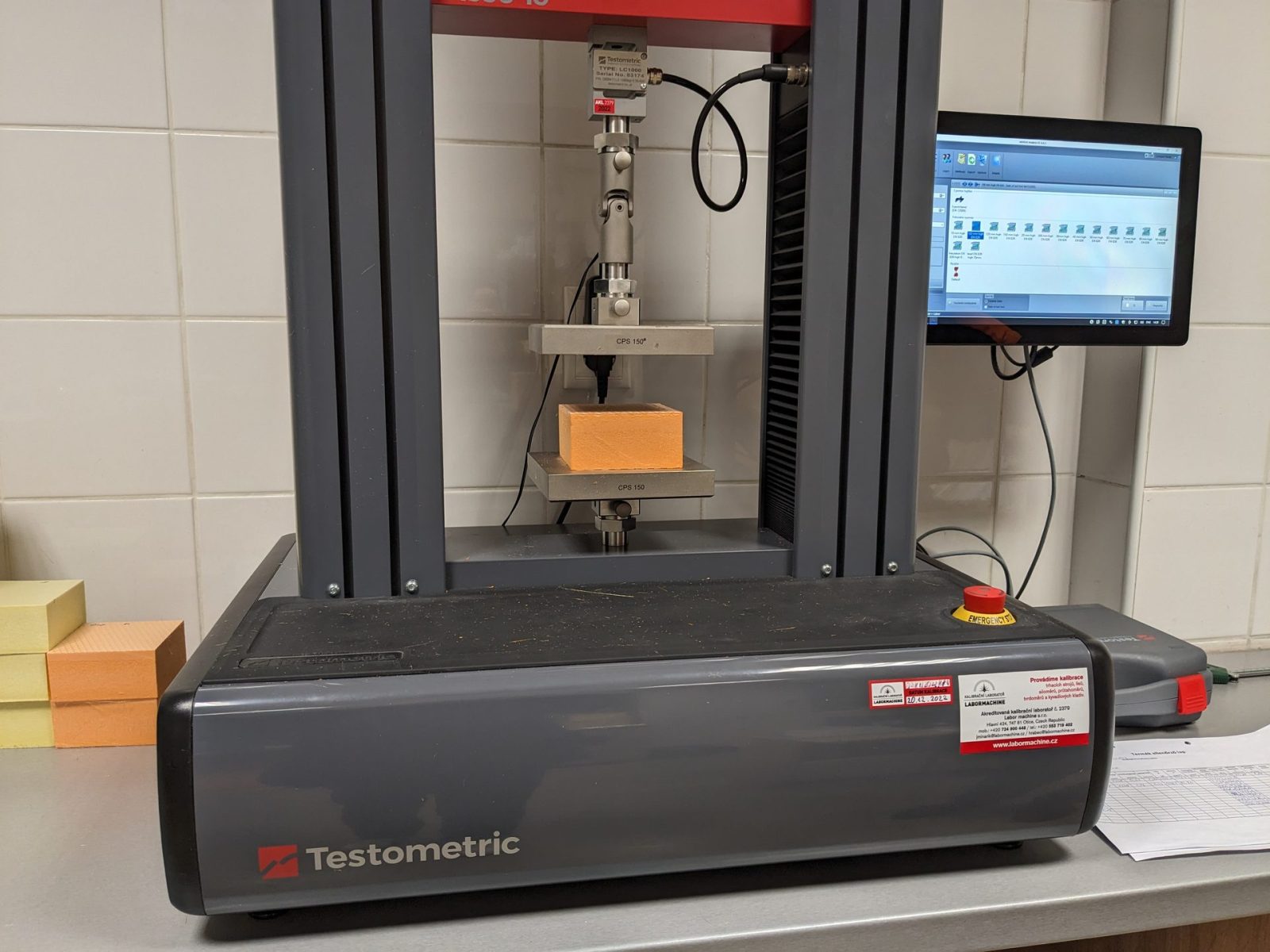
The test showed that XPS 300 and XPS 300 W achieve CC(2/1.5/50)130 compressive creep classification for thicknesses above 30 mm, and XPS 700 achieves CC(2/1.5/50)210 — values that support their suitability for long-term loaded applications. This alone does not prove suitability for any specific project; a qualified designer must verify load, thickness, dew point and local code requirements.
Surface Types and Their Function
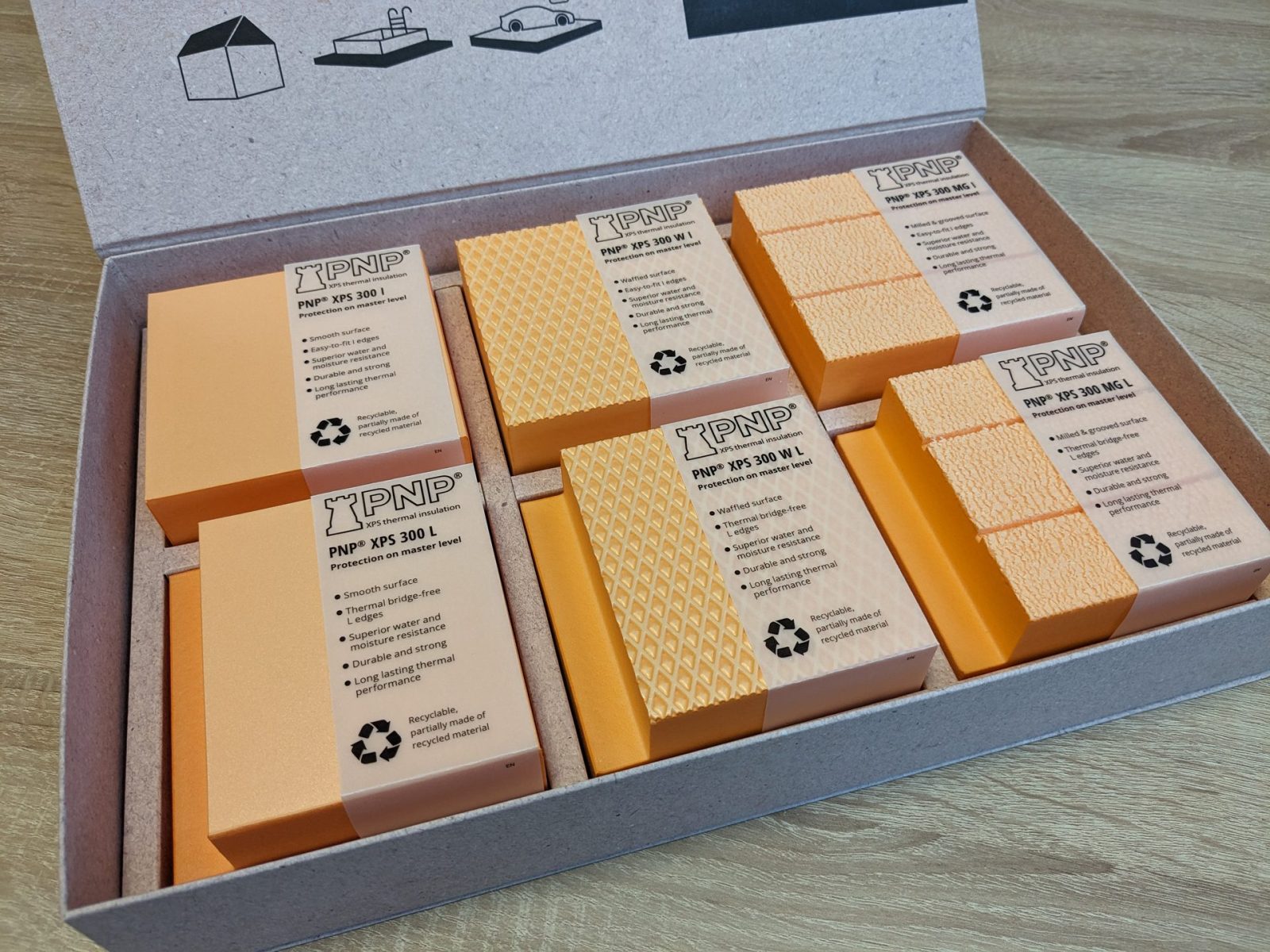
PNP XPS boards are produced in three surface configurations, each serving a distinct bonding function:
Smooth skin — factory extruded surface; used where no adhesive coat is applied directly to the board face (e.g. under slabs, in inverted roofs, in soil contact).
W (waffled) — embossed pattern providing mechanical key for adhesives, renders and plaster compounds in bonded systems (ETICS, tile-adhesive facades). The XPS 150 W X-Grip is the brand's dedicated waffled board optimised for adhesion at the 150 kPa strength class.
MG (milled and grooved) — milled rough surface with cut grooves; purpose-built for direct application of plaster or render where strong mechanical interlock is required.
Note that milled and grooved surfaces carry a higher WL(T) class (up to WL(T)3 or WL(T)4 depending on grade) compared to smooth and waffled surfaces (WL(T)0.7), because milling removes part of the extruded skin. This is a declared characteristic in each DoP and is not a defect; it reflects the trade-off between surface texture and water absorption resistance.
SLOPE Boards: Factory-Tapered Fall Formation
XPS 300 SLOPE and XPS 150 SLOPE are factory-tapered boards that create drainage falls on flat roofs, terraces and green roofs without a separate screed layer. The built-in gradient reduces roof dead load and installation time. Detailed technical data (taper angle, minimum/maximum board thickness, thermal resistance per zone) are not fully reproduced in the available data record; consult the current DoP files (DoP PNP 300 SLOPE A1-B1/A2-B2, updated 2025-03-17) and the TDS before specifying.
What the Evidence Does and Does Not Prove
The DoP files and TDS documents establish the following facts for each grade:
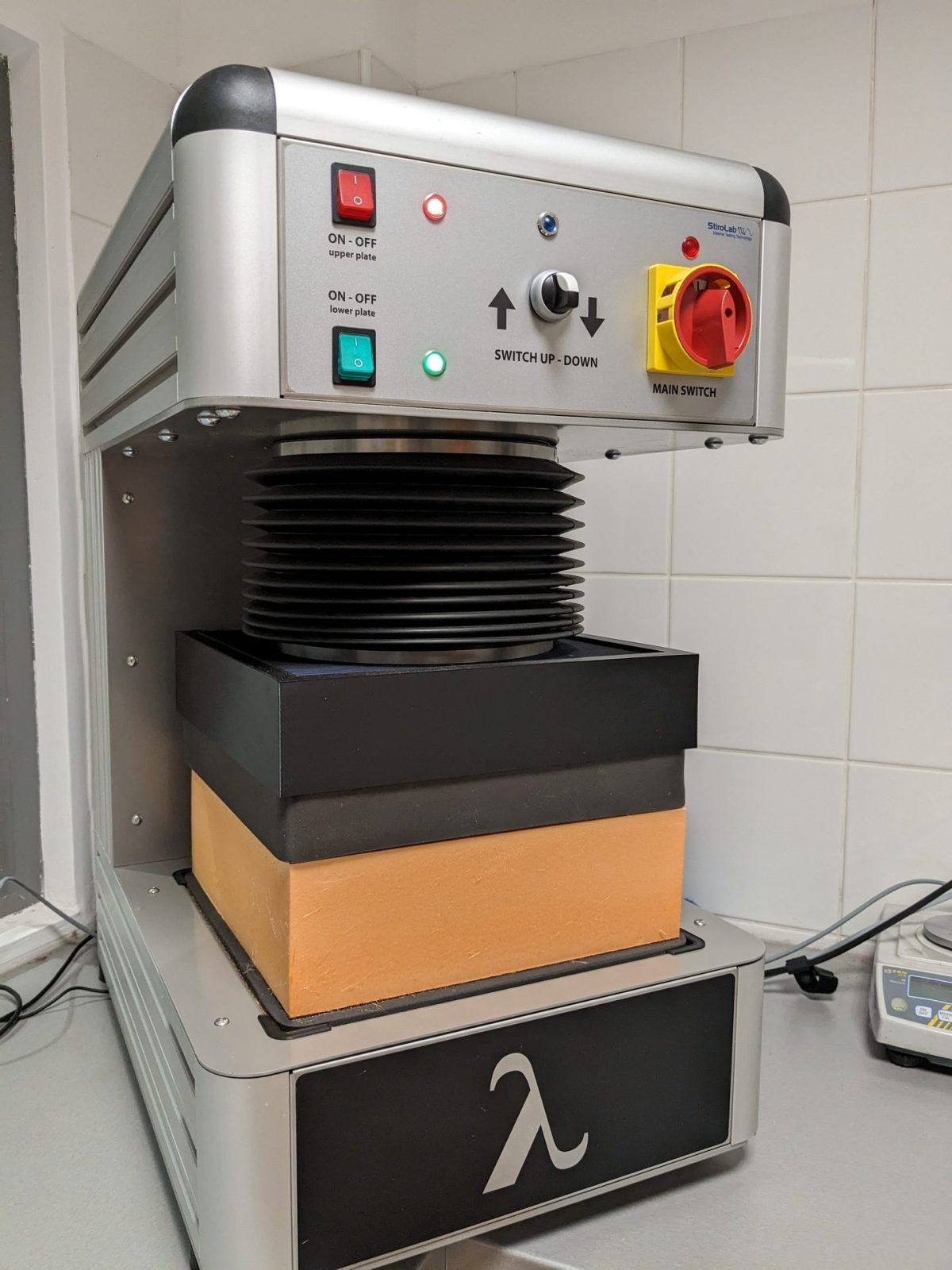
Declared thermal conductivity λD in W/(m·K) at the stated thickness ranges.
Compressive strength class CS(10\Y) in kPa at 10% deformation or yield (EN 826).
Long-term water absorption by immersion WL(T) and, where tested, by diffusion WD(V).
Freeze–thaw resistance FTCD, compressive creep CC(2/1.5/50), tensile strength TR and dimensional stability DS(70,90) where declared.
Euroclass reaction to fire (E or F depending on grade).
REACH compliance and absence of HBCDD.
The available data does not establish: production capacity, exact founding date, ISO or national quality-mark certifications, market-share figures, pricing, or project references. These points would require additional documentation not present in the current data set.
For any real engineering decision — including load verification, required insulation thickness, condensation/dew-point analysis, fire strategy or country-specific code compliance — consult the current TDS and DoP for the selected product and engage a qualified designer.
Documentation and Digital Resources
The following resources are available through pnpinsulation.com/documentation:
TDS (technical data sheets) — product-specific declared values, installation guidance and packaging data.
DoP (Declarations of Performance) — CPR-compliant performance declarations for CE marking.
EPD — Environmental Product Declaration to EN 15804, covering the Várpalota plant (updated 2025-03-19).
BIM — Building information model objects for integration into design software (updated 2025-02-24).
For application guidance, see the knowledge base articles including Which PNP XPS Should I Choose? and What Does '300 kPa' Compressive Strength Mean?
Sources
PNP XPS company data record (brand: PNP XPS, legal name: PNP Orange Kft.)
EN 13164:2012+A1:2015 — Thermal insulation products for buildings — Factory made products of extruded polystyrene foam (XPS) — Specification
Regulation (EU) No 305/2011 (Construction Products Regulation, CPR)
EPD — PNP XPS (Várpalota plant), EN 15804, updated 2025-03-19
PNP BIM Libraries, updated 2025-02-24
TDS pnp_xps300-300TB_600x1250_techcard_en (updated 2026-07-22)
DoP PNP XPS 300 EMI_en (U) (updated 2025-10-14)
TDS pnp_xps300W-300WTB_600x1250_techcard_en (updated 2026-07-22)
DoP PNP XPS 300 W EMI_en (U) (updated 2025-10-13)
TDS pnp_xpsX-Grip_X-GripTB_600x1250_techcard_en (updated 2026-07-22)
DoP PNP XPS X-Grip_en (U) (updated 2026-06-24)
TDS pnp_xps500-500TB_600x1250_techcard_en (updated 2026-07-22)
DoP PNP XPS 500_en (U) (updated 2025-07-22)
TDS pnp_xps700_600x1250_techcard_en (updated 2025-03-17)
DoP PNP XPS 700_eng (updated 2025-03-17)
DoP PNP 300 SLOPE A1-B1_en (updated 2025-03-17)
DoP PNP 300 SLOPE A2-B2_en (updated 2025-03-17)
TDS pnp_xps400-400TB_600x1250_techcard_en (updated 2026-07-22)
DoP PNP XPS 400_en (U) (updated 2026-04-10)