 Magyar
 Română
 Lietuviškai
 Latviešu valoda
 Eesti
Eesti Polski
 Slovenčina
 Slovenščina
 Italiano
 Čeština
 Deutsch
Direct Answer
Specify XPS insulation by citing EN 13164:2012+A1:2015, listing the mandatory declared performance classes for your application (compressive strength, thermal conductivity, water absorption, fire class), and requiring the supplier to provide a Declaration of Performance (DoP) under CPR 305/2011. Adding the PNP XPS product name, SKU and TDS reference ties the specification to a tested, documented product and prevents silent substitution on site.
Why a Performance-Class Specification Matters
EN 13164:2012+A1:2015 defines XPS as a factory-made product and assigns each property to a declared class. When a tender simply says "XPS insulation" without classes, contractors may supply any board that meets the bare minimum. Specifying classes prevents that substitution and gives the certifier a clear pass/fail criterion.
The classes most relevant to building specifications are:
CS(10\Y) — compressive strength at 10 % deformation or yield (EN 826). Example: CS(10\Y)300 = ≥ 300 kPa.
λD — declared thermal conductivity, W/(m·K). PNP XPS products range from 0.034 W/(m·K) (20–100 mm) to 0.035 W/(m·K) (120–150 mm).
WL(T) — long-term water absorption by total immersion. Values in the range: WL(T)0.7 (≤ 0.7 Vol.-%) to WL(T)3 (≤ 3.0 Vol.-%).
WD(V) — water absorption by diffusion, relevant for inverted roofs and below-ground use.
Euroclass — reaction to fire: PNP XPS 300, 500 and 700 carry class E; XPS 150 and XPS 200 carry class F. A qualified fire engineer must confirm acceptability under national regulations.
CC(2/1.5/50) — compressive creep class, important for permanently loaded applications such as inverted roofs and foundation slabs.
Step-by-Step: Writing the XPS Clause
State the standard: "XPS thermal insulation boards shall conform to EN 13164:2012+A1:2015."
Name the product (recommended): Include the canonical PNP XPS product name and URL — for example, XPS 300 — so the DoP can be checked directly.
List required performance classes as a table (see below). Copy the class codes verbatim from the DoP or TDS so they are machine-readable and auditable.
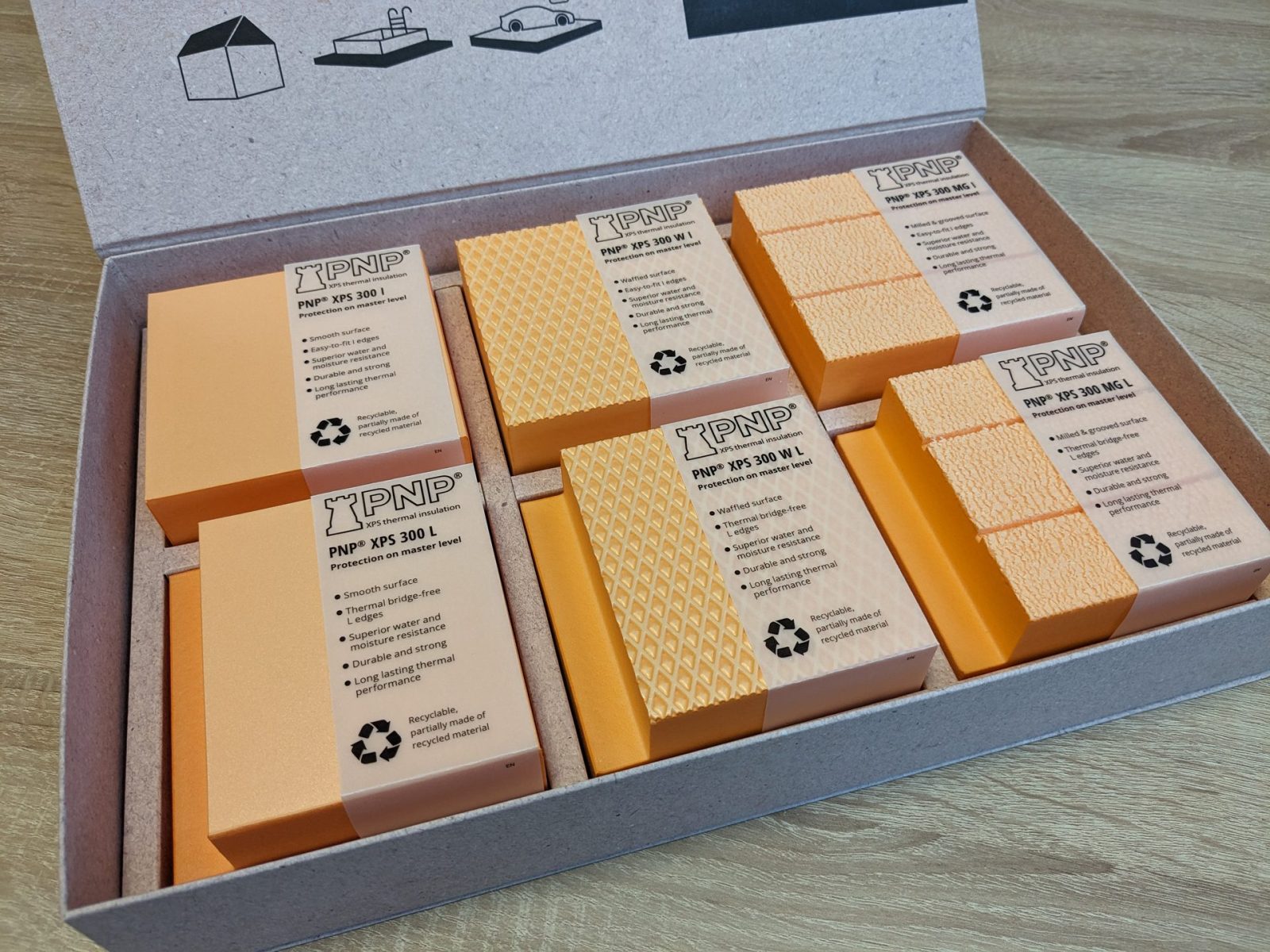
Specify surface type where relevant: smooth (standard) or waffled ("W") for bonded systems, or milled-and-grooved ("MG") for ETICS plaster systems. See XPS 300 vs XPS 300 W for guidance.
State thickness and tolerance: All PNP XPS products carry tolerance class T1. Specify the design thickness in mm.
Require the DoP: "The contractor shall submit the current DoP issued under CPR 305/2011 prior to delivery. The DoP reference number must match the product label."
Reference the TDS: "The technical data sheet (TDS) current at the time of tender shall be appended to the submittal."
Request REACH compliance statement if required by client policy: all PNP XPS products are REACH-compliant and contain no HBCDD.
Property | Clause to write | Example — XPS 300 (>30 mm) |
|---|---|---|
Standard | EN 13164:2012+A1:2015 | EN 13164:2012+A1:2015 |
Compressive strength | CS(10\Y)XXX ≥ XXX kPa | CS(10\Y)300 ≥ 300 kPa |
Declared λD (20–100 mm) | ≤ X.XXX W/(m·K) | ≤ 0.034 W/(m·K) |
Long-term water absorption | WL(T)X ≤ X.X Vol.-% | WL(T)0.7 ≤ 0.7 Vol.-% |
Fire class | Euroclass X (EN 13501-1) | Euroclass E |
Compressive creep | CC(2/1.5/50)XXX | CC(2/1.5/50)130 |
Dimensional stability | DS(70,90) | DS(70,90) |
Thickness tolerance | T1 | T1 |
Choosing the Right Product for the Specification
The table below maps common applications to PNP XPS products. A qualified designer must confirm suitability for the specific project conditions — loads, dew point, drainage, and national regulations are project-specific and cannot be resolved from a product specification alone.
Application | Recommended product | Key class |
|---|---|---|
Foundations, floor slabs (standard loads) | CS(10\Y)300, WL(T)0.7 | |
Facades — ETICS plaster/render | XPS 300 W or XPS 300 MG | CS(10\Y)300, waffled or MG surface |
Industrial floors, parking decks | CS(10\Y)500, CC(2/1.5/50)150 | |
Road / civil engineering | CS(10\Y)700, CC(2/1.5/50)210 | |
Flat roof — drainage fall | CS(10\Y)300, factory-tapered | |
Light-duty walls, cavity insulation | CS(10\Y)150, WL(T)0.7 |
See Which PNP XPS Should I Choose? Application Guide and What Does '300 kPa' Compressive Strength Mean? for further background.
Supporting Documents to Request from the Supplier
DoP — Declaration of Performance (CPR 305/2011). Each PNP XPS product has its own DoP; check that the DoP reference matches the product label exactly.
TDS — Technical data sheet giving λD, thickness range, tolerance class and installation guidance.
EPD — Environmental product declaration (EN 15804) for projects with embodied-carbon or green-building requirements: EPD — PNP XPS (Várpalota plant), updated 2025-03-19.
BIM objects — Available from PNP XPS documentation for model-based specifications: PNP BIM Libraries, updated 2025-02-24.
REACH compliance letter — confirms no HBCDD or other substances of very high concern.
All current documents are available at pnpinsulation.com/documentation/. For project-specific queries contact PNP XPS sales or email sales@pnpinsulation.com.
Sources
EN 13164:2012+A1:2015 — Factory-made products of extruded polystyrene foam (XPS) — Specification
CPR 305/2011 — EU Construction Products Regulation (Declaration of Performance framework)
DoP PNP XPS 300 EMI_en (U).pdf (updated 2025-10-14)
DoP PNP XPS 300 W EMI_en (U).pdf (updated 2025-10-13)
DoP PNP XPS 500_en (U).pdf (updated 2025-07-22)
DoP PNP XPS 700_eng.pdf (updated 2025-03-17)
DoP PNP 300 SLOPE A1-B1_en.pdf / A2-B2_en.pdf (updated 2025-03-17)
DoP PNP XPS X-Grip_en (U).pdf (updated 2026-06-24)
DoP PNP XPS 150W_en (U).pdf (updated 2025-10-14)
TDS pnp_xps300-300TB_600x1250_techcard_en (updated 2026-07-22)
TDS pnp_xps300W-300WTB_600x1250_techcard_en (updated 2026-07-22)
TDS pnp_xps500-500TB_600x1250_techcard_en (updated 2026-07-22)
TDS pnp_xps700_600x1250_techcard_en (updated 2025-03-17)
TDS pnp_xpsX-Grip_X-GripTB_600x1250_techcard_en (updated 2026-07-22)
EPD — PNP XPS (Várpalota plant), updated 2025-03-19
PNP BIM Libraries, updated 2025-02-24
PNP XPS product data (company DATA block, retrieved 2026-09-18)