The Direct Answer
Select the compressive strength class — expressed as CS(10\Y) per EN 826 — that equals or exceeds the design pressure the insulation layer will experience in service. PNP XPS boards are available in six declared classes:
CS class Min. strength Typical applications PNP XPS products CS(10\Y)150 150 kPa Cavity walls, non-load-bearing partitions, plinths (no render), non-trafficked roofs XPS 150, XPS 150 W X-Grip, XPS 150 MG, XPS 150 SLOPE CS(10\Y)200 200 kPa Lightly loaded floors, expansion joints, flat roofs under limited foot traffic XPS 200, XPS 200 W, XPS 200 MG CS(10\Y)300 300 kPa Foundations, slab-on-grade floors, accessible roofs, podium decks, landscaping XPS 300, XPS 300 W, XPS 300 MG, XPS 300 SLOPE CS(10\Y)400 400 kPa Industrial floors, cold stores, car parks, below-ground foundation slabs XPS 400 CS(10\Y)500 500 kPa Heavy industrial floors, parking decks, road construction, inverted roofs under traffic XPS 500 CS(10\Y)700 700 kPa Bridge decks, road infrastructure, extreme civil engineering loads XPS 700
Note: for XPS 300 and XPS 300 W, boards of 20–30 mm thickness are rated CS(10\Y)200; the 300 kPa class applies only to thicknesses above 30 mm. Verify the exact thickness-dependent values in the current TDS before specifying.
What Does Compressive Strength Class Mean?
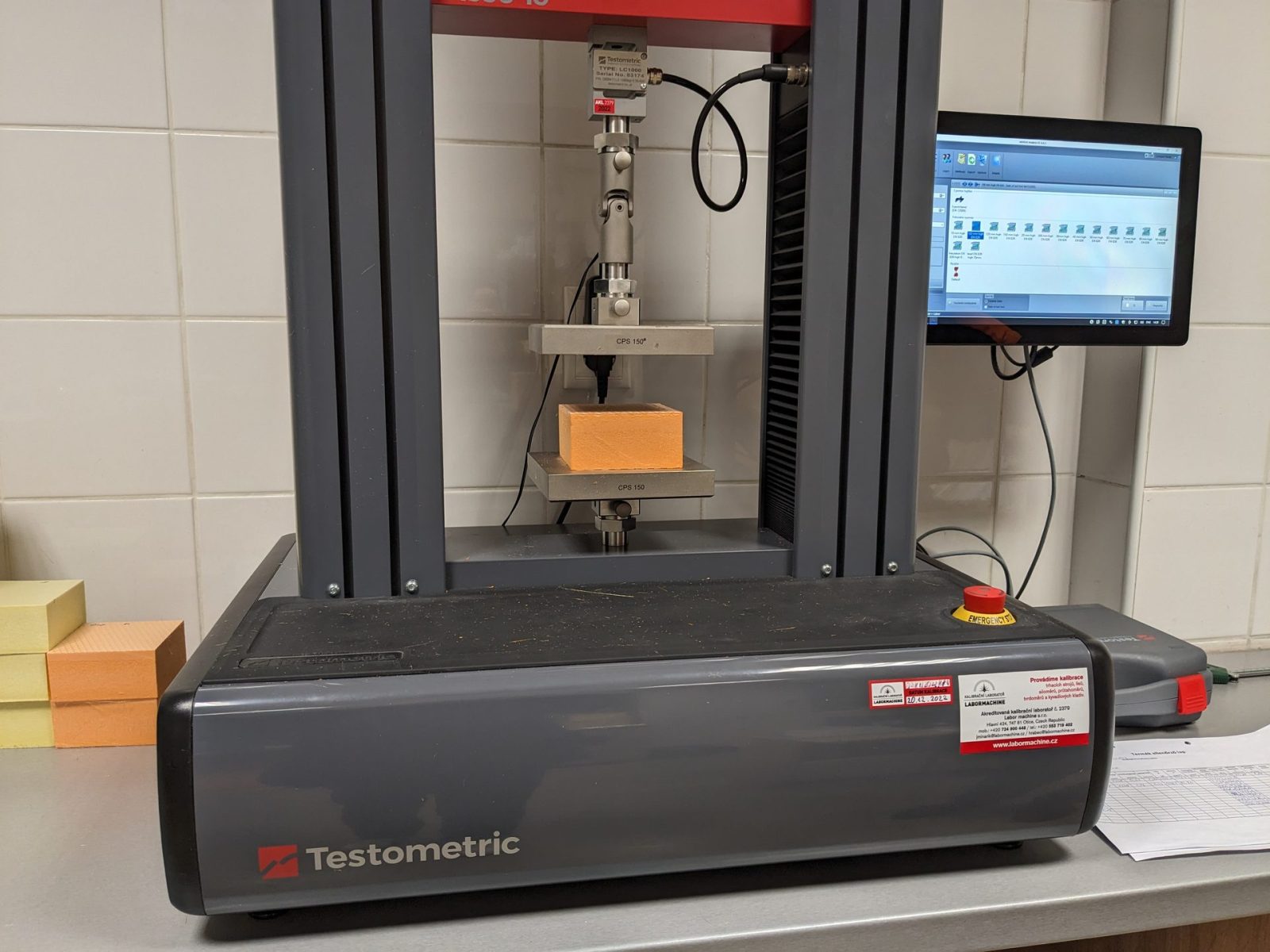
The designation CS(10\Y)300 means the board achieves at least 300 kPa at 10 % deformation or at yield, whichever comes first, when tested to EN 826. This is not the same as the working load: design loads must account for safety factors, load distribution through screeds or fill, long-term creep, and national standards. See the companion article What Does '300 kPa' Compressive Strength Mean? for a fuller explanation.
Compressive creep (CC) is also declared on the higher-strength grades and describes long-term deformation under sustained load — a critical parameter for foundations and floors that carry permanent loads. Selected declared creep values from the TDS:
XPS 300 / XPS 300 W (>30 mm): CC(2/1,5/50)130
XPS 500: CC(2/1,5/50)150
XPS 700: CC(2/1,5/50)210
A qualified structural engineer must determine whether the creep limit is acceptable for the specific assembly and load duration.
Application-by-Application Guidance
Walls and facades
Vertical elements carry minimal compressive load from the insulation's own weight. The governing criterion is usually surface type (smooth, waffled, or milled-and-grooved for render adhesion) rather than compressive class. CS(10\Y)150 or CS(10\Y)200 products cover most facade and plinth applications. Where a render or adhesive finish is applied directly, choose a W (waffled) or MG (milled and grooved) surface variant. See XPS 300 vs XPS 300 W — Smooth or Waffled Surface?.
Non-trafficked and lightly trafficked roofs
XPS 150 SLOPE or XPS 300 SLOPE boards (factory-tapered, SLOPE format) are used to create drainage fall in a single insulating layer. The 300 kPa class suits accessible roofs with foot traffic; the 150 kPa class is appropriate for non-accessible membraned roofs where the design load permits. For vehicle-accessed inverted roofs, XPS 500 is listed in the solutions catalogue.
Floors and slab-on-grade
Residential and lightly loaded commercial floors typically specify XPS 300. Industrial floors, cold stores, and car parks should start from XPS 400 or XPS 500. The slab-on-grade solution in the PNP catalogue places XPS insulation between the sub-base and the screed; the design pressure at the board face depends on the screed thickness, slab span and imposed load — always confirm with the project engineer.
Foundations and buried structures
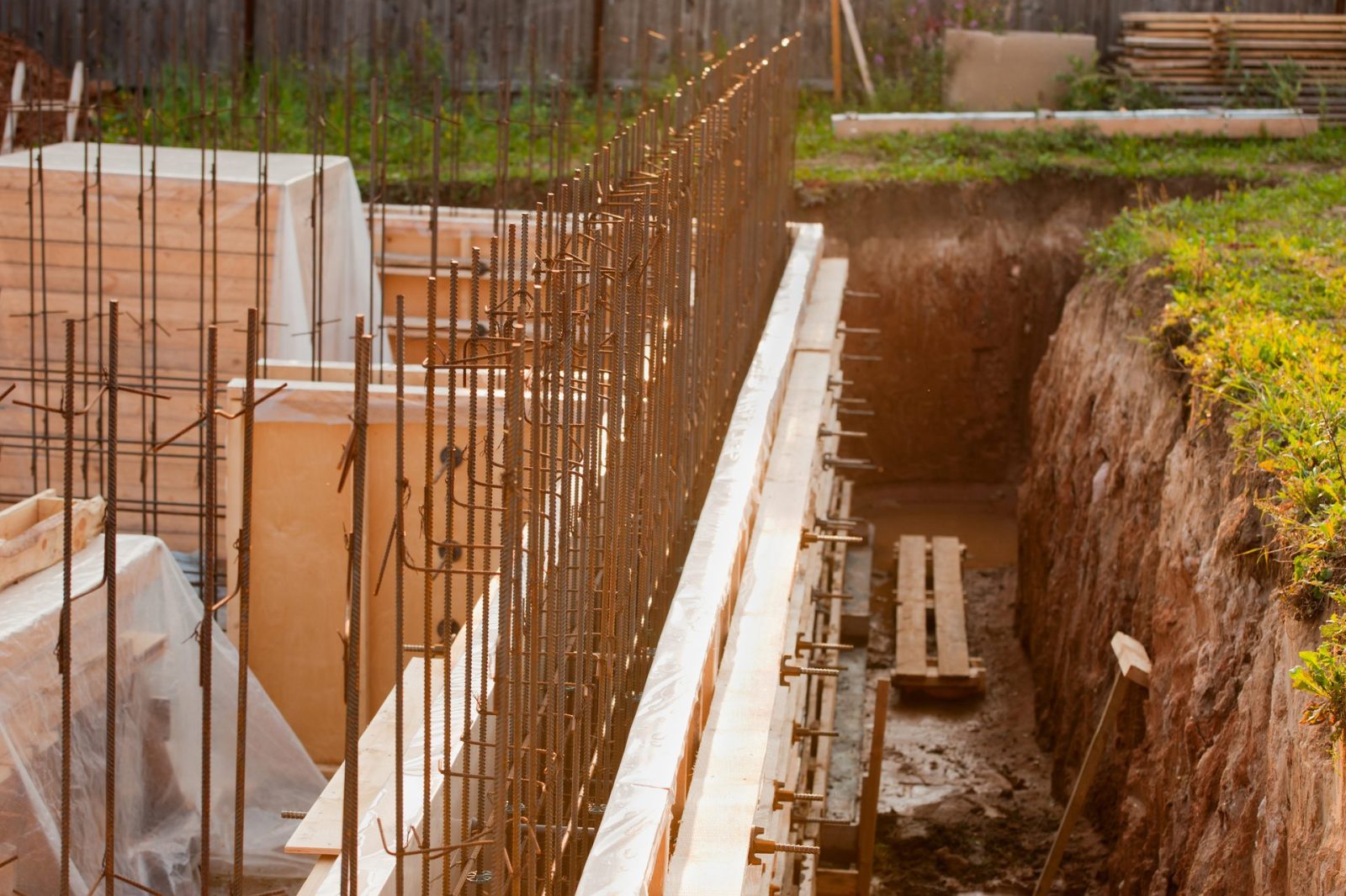
XPS 300 is the baseline grade for foundation slabs and perimeter insulation. Where soil pressures or structural loads are higher, XPS 500 or XPS 700 may be required. The freeze–thaw resistance rating (FTCD1) and low water absorption (WL(T)0,7) of the 300–700 kPa grades support long-term performance in wet ground conditions.
Road and civil engineering
XPS 700 (CS(10\Y)700, CC(2/1,5/50)210) is the grade listed for road structures on heaving soils, bridge decks, and infrastructure applications. XPS 500 is cited for road construction where lower loads are specified. Load design for these applications requires specialist geotechnical and structural input.
Surface Type and Compressive Strength Are Independent Choices
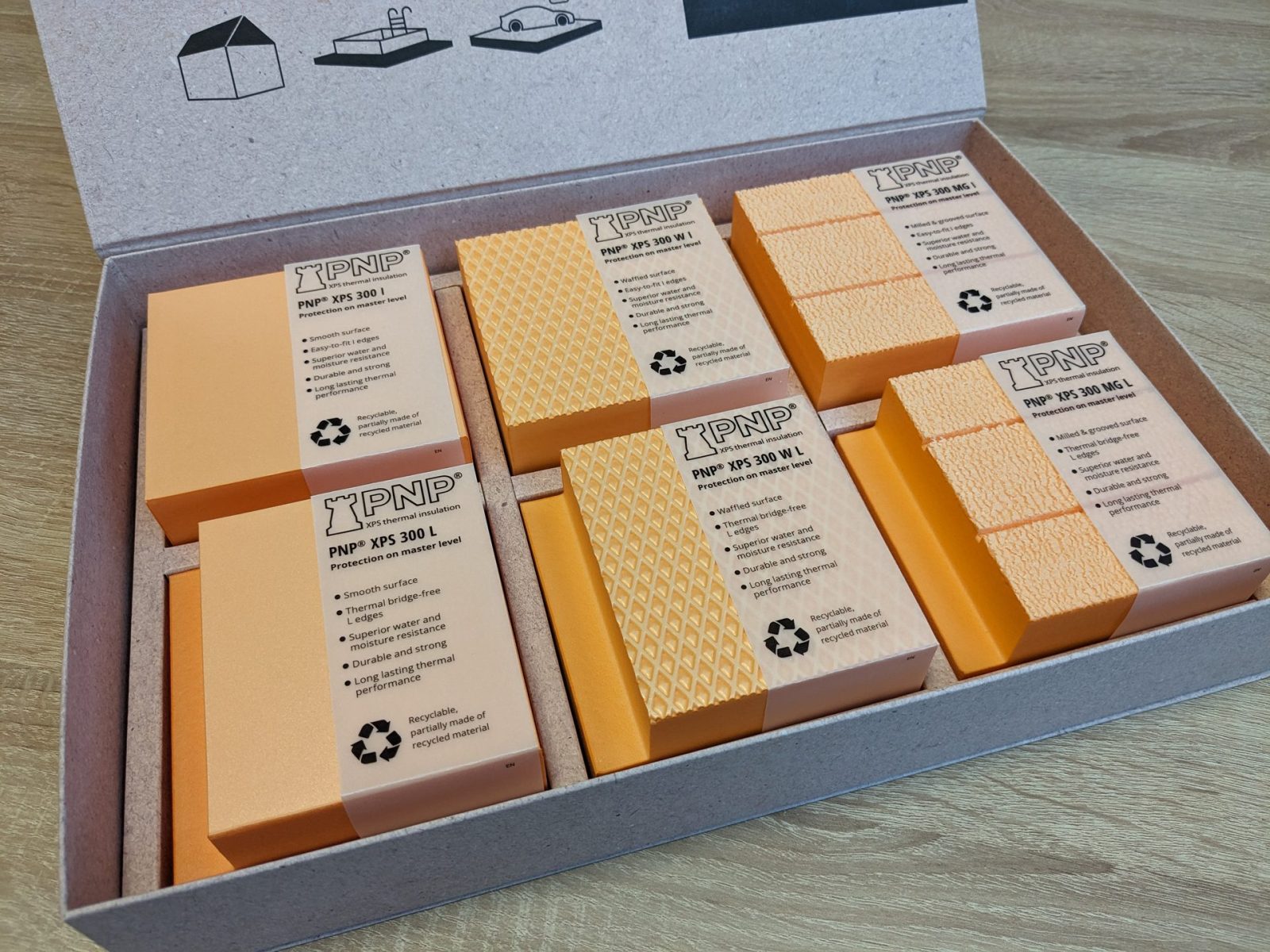
PNP XPS offers each compressive strength in multiple surface variants:
Smooth — standard boards for sub-slab, perimeter and inverted-roof use.
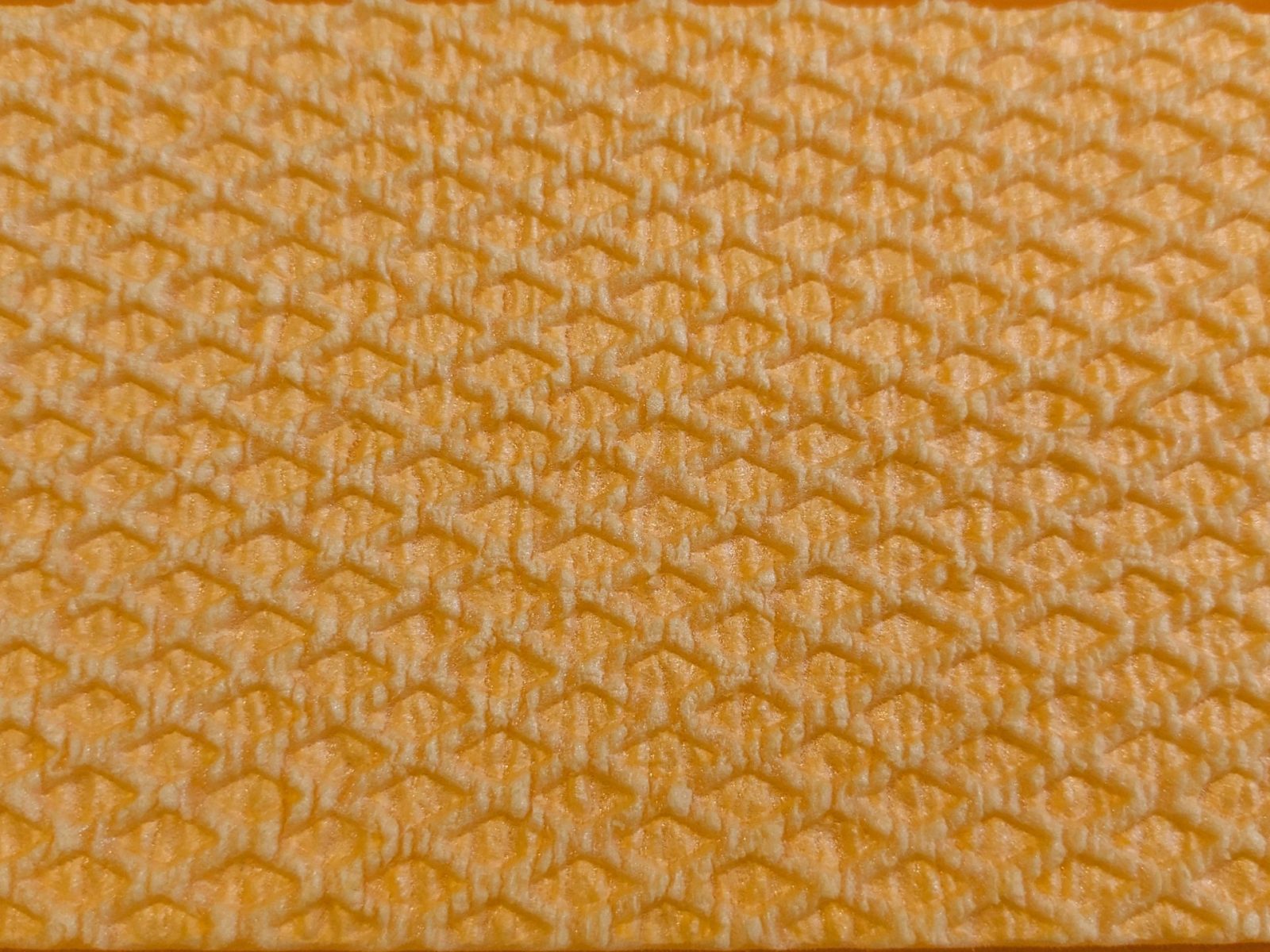
W (waffled) — embossed surface for bonded systems (renders, adhesives, ETICS); available at 150, 200 and 300 kPa.
MG (milled and grooved) — mechanically keyed surface for plaster and tile-adhesive systems; available at 150, 200 and 300 kPa.
SLOPE — factory-tapered for drainage fall; available at 150 and 300 kPa.
Select the surface type for the interface requirement, then confirm the compressive class for the structural requirement. The general product selection guide Which PNP XPS Should I Choose? covers both criteria together.
Fire Classification and Compressive Strength
All 150 kPa and 200 kPa PNP XPS products carry Euroclass F reaction-to-fire classification. Products rated 300 kPa and above (XPS 300, XPS 400, XPS 500, XPS 700) carry Euroclass E. National building regulations and the fire strategy for the specific assembly may impose additional requirements — consult the project fire engineer and the current DoP for each product.
Sources
EN 13164:2012+A1:2015 — Factory-made products of extruded polystyrene foam (XPS)
EN 826 — Thermal insulating products for building applications: determination of compression behaviour
XPS 150 TDS: pnp_xps150-150TB_600x1250_techcard_en (updated 2026-07-22)
XPS 150 DoP: DoP PNP XPS 150_en (U) (updated 2025-10-14)
XPS 150 W X-Grip TDS: pnp_xpsX-Grip_X-GripTB_600x1250_techcard_en (updated 2026-07-22); pnp_xps150W-150WTB_600x1250_techcard_en (updated 2026-07-22)
XPS 150 W X-Grip DoP: DoP PNP XPS X-Grip_en (U) (updated 2026-06-24); DoP PNP XPS 150W_en (U) (updated 2025-10-14)
XPS 150 MG TDS: pnp_xps150MG_600x1250_techcard_en (updated 2025-03-17)
XPS 150 MG DoP: DoP PNP XPS 150 MG 20 mm_eng.pdf; DoP PNP XPS 150 MG (30-150 mm)_eng.pdf (updated 2025-03-17)
XPS 200 TDS: pnp_xps200-200TB_600x1250_techcard_en (updated 2026-07-22)
XPS 200 DoP: DoP PNP XPS 200_en (U) (updated 2025-08-14)
XPS 200 W TDS: pnp_xps200W-200WTB_600x1250_techcard_en (updated 2026-07-22)
XPS 200 W DoP: DoP PNP XPS 200 W_en (U) (updated 2025-08-14)
XPS 200 MG TDS: pnp_xps200MG_600x1250_techcard_en (updated 2025-03-17)
XPS 200 MG DoP: DoP PNP XPS 200 MG_eng.pdf (updated 2025-03-17)
XPS 300 TDS: pnp_xps300-300TB_600x1250_techcard_en (updated 2026-07-22)
XPS 300 DoP: DoP PNP XPS 300 EMI_en (U) (updated 2025-10-14)
XPS 300 W TDS: pnp_xps300W-300WTB_600x1250_techcard_en (updated 2026-07-22)
XPS 300 W DoP: DoP PNP XPS 300 W EMI_en (U) (updated 2025-10-13)
XPS 300 MG TDS: pnp_xps300MG_600x1250_techcard_en (updated 2025-03-17)
XPS 300 MG DoP: DoP PNP XPS 300 MG_eng.pdf (updated 2025-03-17)
XPS 300 SLOPE DoP: DoP PNP 300 SLOPE A2-B2_en.pdf; DoP PNP 300 SLOPE A1-B1_en.pdf (updated 2025-03-17)
XPS 400 TDS: pnp_xps400-400TB_600x1250_techcard_en (updated 2026-07-22)
XPS 400 DoP: DoP PNP XPS 400_en (U) (updated 2026-04-10)
XPS 500 TDS: pnp_xps500-500TB_600x1250_techcard_en (updated 2026-07-22)
XPS 500 DoP: DoP PNP XPS 500_en (U) (updated 2025-07-22)
XPS 700 TDS: pnp_xps700_600x1250_techcard_en (updated 2025-03-17)
XPS 700 DoP: DoP PNP XPS 700_eng.pdf (updated 2025-03-17)
PNP XPS solutions catalogue (as provided in DATA)
Existing knowledge article: 'What Does 300 kPa Compressive Strength Mean?' /knowledge/300-kpa-meaning/