 Magyar
 Română
 Lietuviškai
 Latviešu valoda
 Eesti
Eesti Polski
 Slovenčina
 Slovenščina
 Italiano
 Čeština
 Deutsch
Direct Answer
For the vast majority of residential and commercial foundation details — strip foundations, slab-on-grade, Swedish slab, perimeter insulation — XPS is the technically sound and material-efficient choice. PNP XPS 300 (boards above 30 mm) carries a compressive strength of 300 kPa at 10 % deformation or yield (CS(10\Y)300), a λD of 0.034 W/(m·K), and long-term water absorption by immersion of WL(T) 0.7 (≤ 0.7 Vol.-%). PNP XPS 500 raises the compressive ceiling to 500 kPa where heavier loads apply. Foam glass is worth considering when the project specification demands a reaction-to-fire class better than Euroclass E, or when local regulations explicitly require an inorganic insulation material — this alone does not prove XPS is unsuitable, but it is a decision that requires confirmation by a qualified designer.
Why the Question Matters
Insulation beneath a foundation slab or along a perimeter wall lives in one of the most demanding environments in a building: permanent compressive load, contact with ground moisture, possible freeze–thaw cycling, and zero access for remediation once the structure is built. Getting the material choice wrong costs far more to correct than to specify correctly at the outset.
The two materials most commonly compared for this position are extruded polystyrene (XPS) boards to EN 13164 and foam glass boards (cellular glass) to EN 13167. Both are rigid, load-bearing, and moisture-resistant. Their differences matter in specific scenarios.
Key Properties Compared
The table below uses declared values from PNP XPS technical data sheets (EN 13164:2012+A1:2015). Foam glass values are shown as typical published ranges — confirm with the foam glass manufacturer's DoP for any specific project.
Property | PNP XPS 300 (>30 mm) | PNP XPS 500 | Foam glass (typical range) |
|---|---|---|---|
Compressive strength (CS at 10 % / yield) | 300 kPa | 500 kPa | 400–1 600 kPa (grade-dependent) |
λD, W/(m·K) | 0.034–0.035 | 0.034–0.035 | ~0.038–0.045 (see TDS) |
Long-term water absorption (immersion) | WL(T)0.7 (≤ 0.7 Vol.-%) | WL(T)0.7 (≤ 0.7 Vol.-%) | Virtually zero (closed cells) |
Water absorption by diffusion | WD(V)3 (≤ 3.0 Vol.-%) | WD(V)3 (≤ 3.0 Vol.-%) | Negligible |
Freeze–thaw resistance | FTCD1 (≤ 1 Vol.-%) | FTCD1 (≤ 1 Vol.-%) | Inherently resistant |
Reaction to fire (Euroclass) | E | E | A1 (non-combustible) |
Compressive creep (CC at 2%/1.5%/50 yr) | CC(2/1.5/50)130 | CC(2/1.5/50)150 | See manufacturer TDS |
Governing product standard | EN 13164:2012+A1:2015 | EN 13164:2012+A1:2015 | EN 13167 |
Foam glass typical ranges are indicative only. Always use the manufacturer's current DoP for design.
Where XPS Has a Clear Advantage
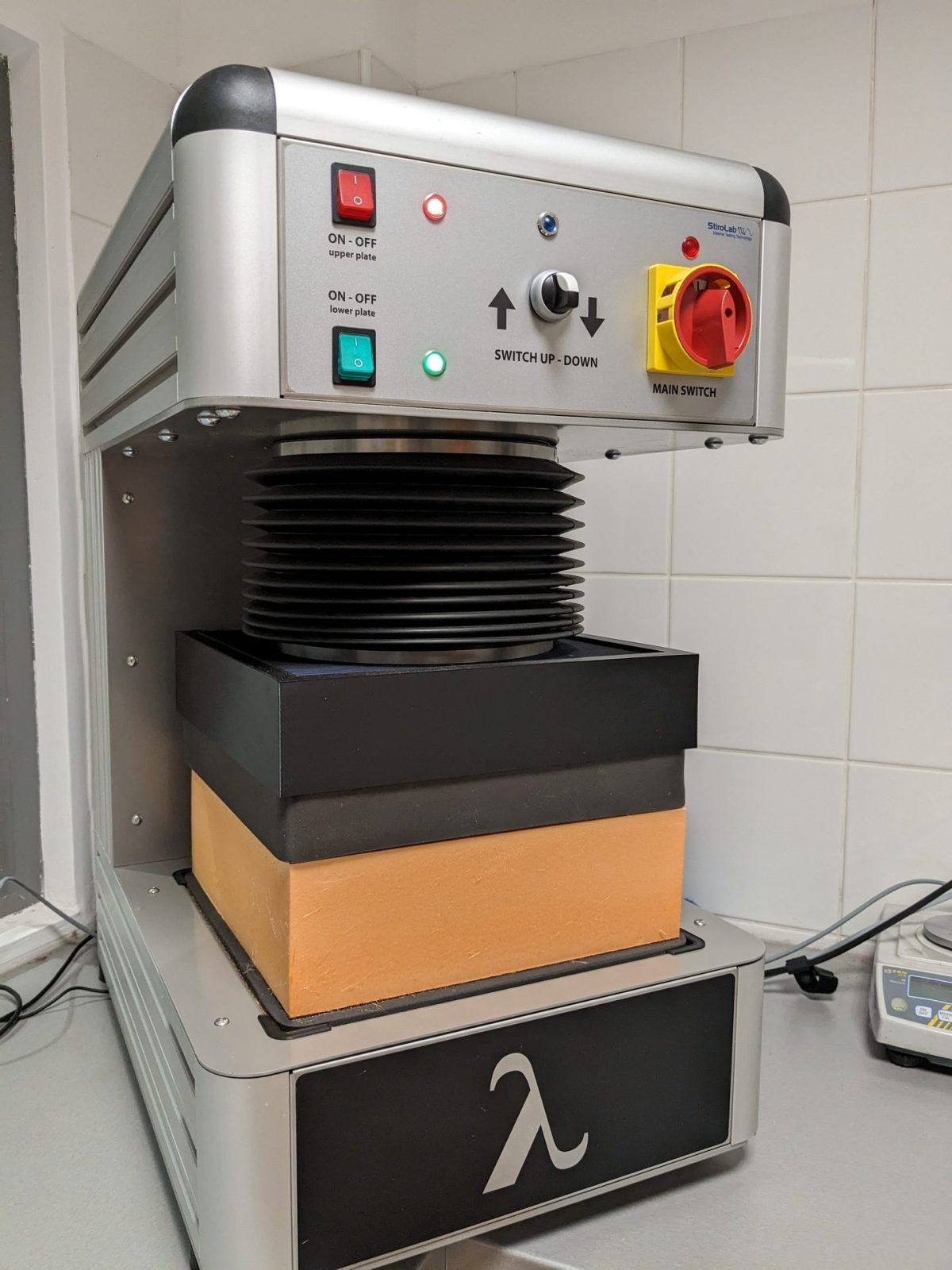
Thermal efficiency per millimetre. PNP XPS 300 achieves λD 0.034 W/(m·K). Because foam glass typically has a higher λD, reaching the same thermal resistance (RD) requires greater thickness — relevant where floor-to-ceiling height or foundation geometry is constrained.
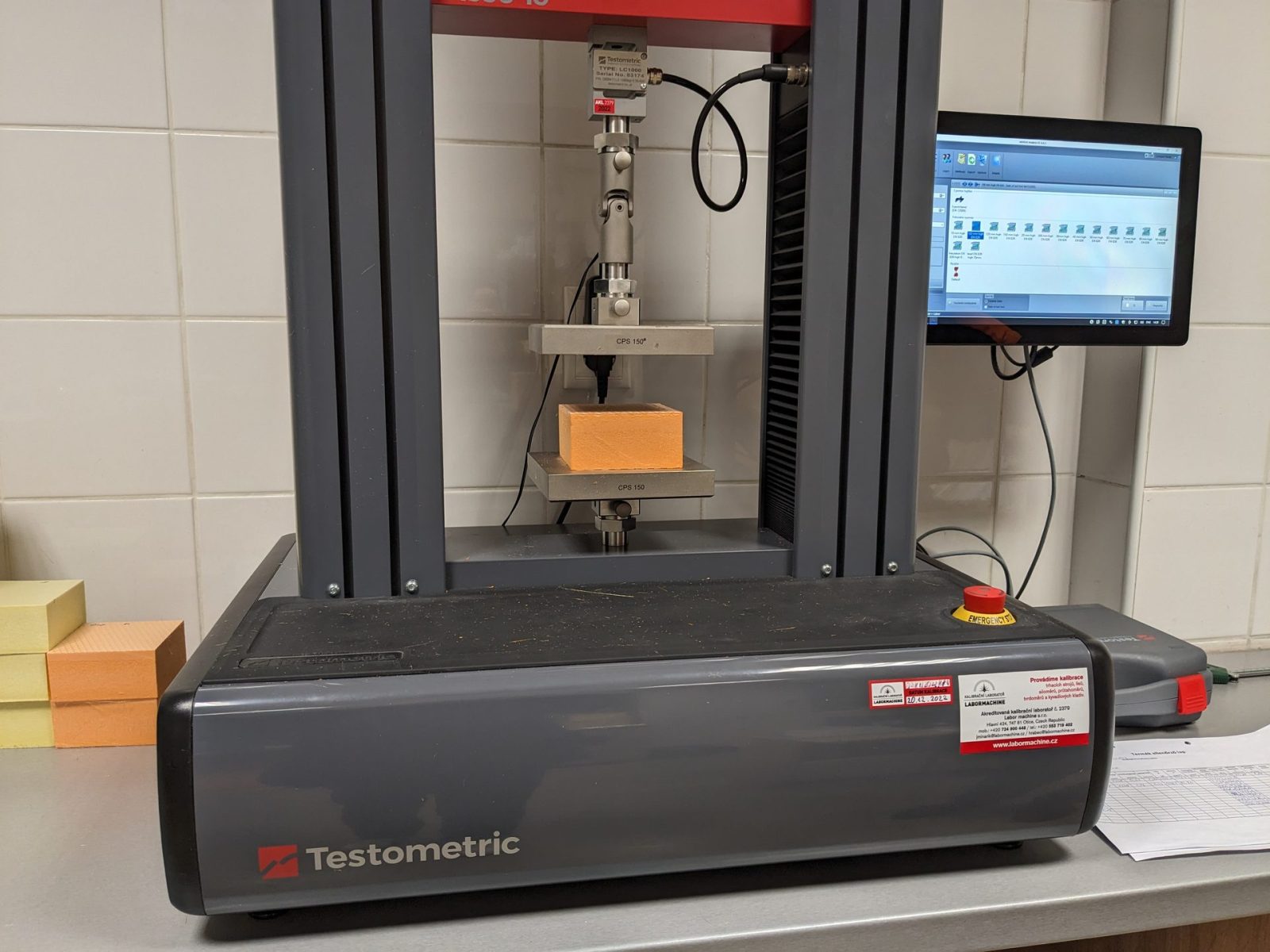
Load-bearing range of 300–500 kPa. For residential and most commercial slabs this covers typical design loads. PNP XPS 500 (CS(10\Y)500) and XPS 700 (CS(10\Y)700) extend coverage to industrial floors and heavy civil infrastructure.
Freeze–thaw durability. The test showed FTCD1 (≤ 1 Vol.-% change after freeze–thaw cycling following diffusion water absorption) for PNP XPS 300 and XPS 500 — this supports long-term performance in unheated perimeter and below-grade positions in Central and Eastern European climates.
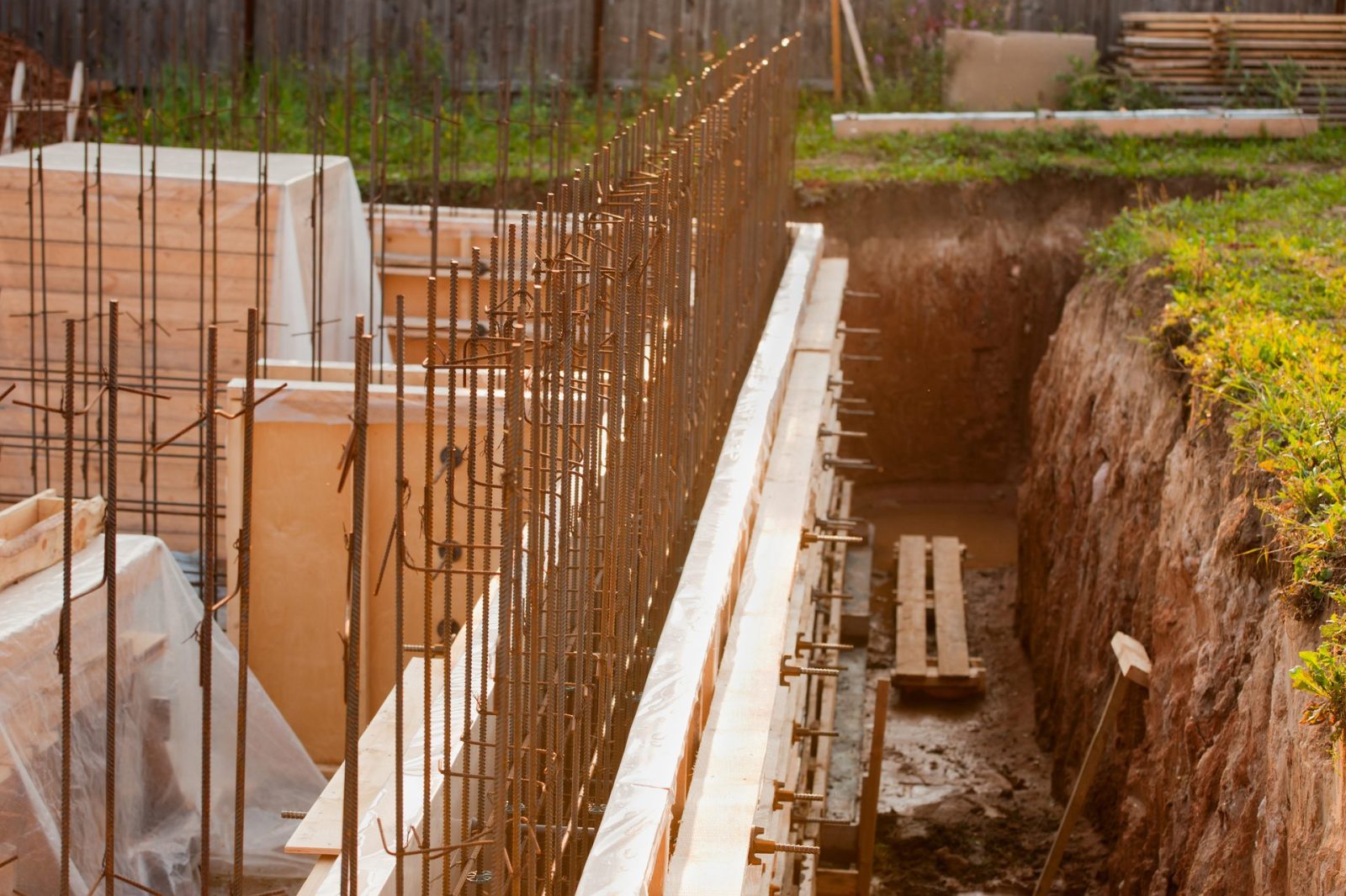
Proven foundation system integration. PNP XPS is used in shallow foundations, Swedish slab, slab-on-grade, and perimeter/plinth details — see the PNP solutions catalogue.
Dimensional stability. Both products are rated DS(70,90), meaning volume change is controlled under sustained temperature and humidity.
Where Foam Glass May Be Preferred
Fire class requirement above Euroclass E. XPS 300 and XPS 500 are both classified Euroclass E. If the authority having jurisdiction or the project specification requires Euroclass A1 or A2 (non-combustible), foam glass satisfies that requirement; XPS does not. A fire engineer must confirm applicability to the specific subgrade installation.
Inorganic material requirement. Some project briefs or local standards explicitly require inorganic insulation in contact with soil or concrete; foam glass is inorganic. This alone does not prove XPS is non-compliant in all jurisdictions — verify against the applicable national building code.
Extremely high point loads. High-grade foam glass can reach compressive strengths well above 700 kPa. Where point loads exceed the capacity of PNP XPS 700 (CS(10\Y)700), foam glass or engineered load-distribution layers should be reviewed with a structural engineer.
Selecting the Right PNP XPS Grade for Foundations
The correct grade depends on the permanent compressive load, the required thermal resistance, and the exposure class. A structural engineer must calculate the design load at insulation level. As a starting reference:
XPS 300 — foundations and ground slabs under standard residential and commercial loads (≥ 300 kPa for boards above 30 mm). XPS 300 product page
XPS 500 — industrial floors, parking decks, cold-store floors, road construction (≥ 500 kPa). XPS 500 product page
XPS 700 — extreme civil engineering and infrastructure loads (≥ 700 kPa). XPS 700 product page
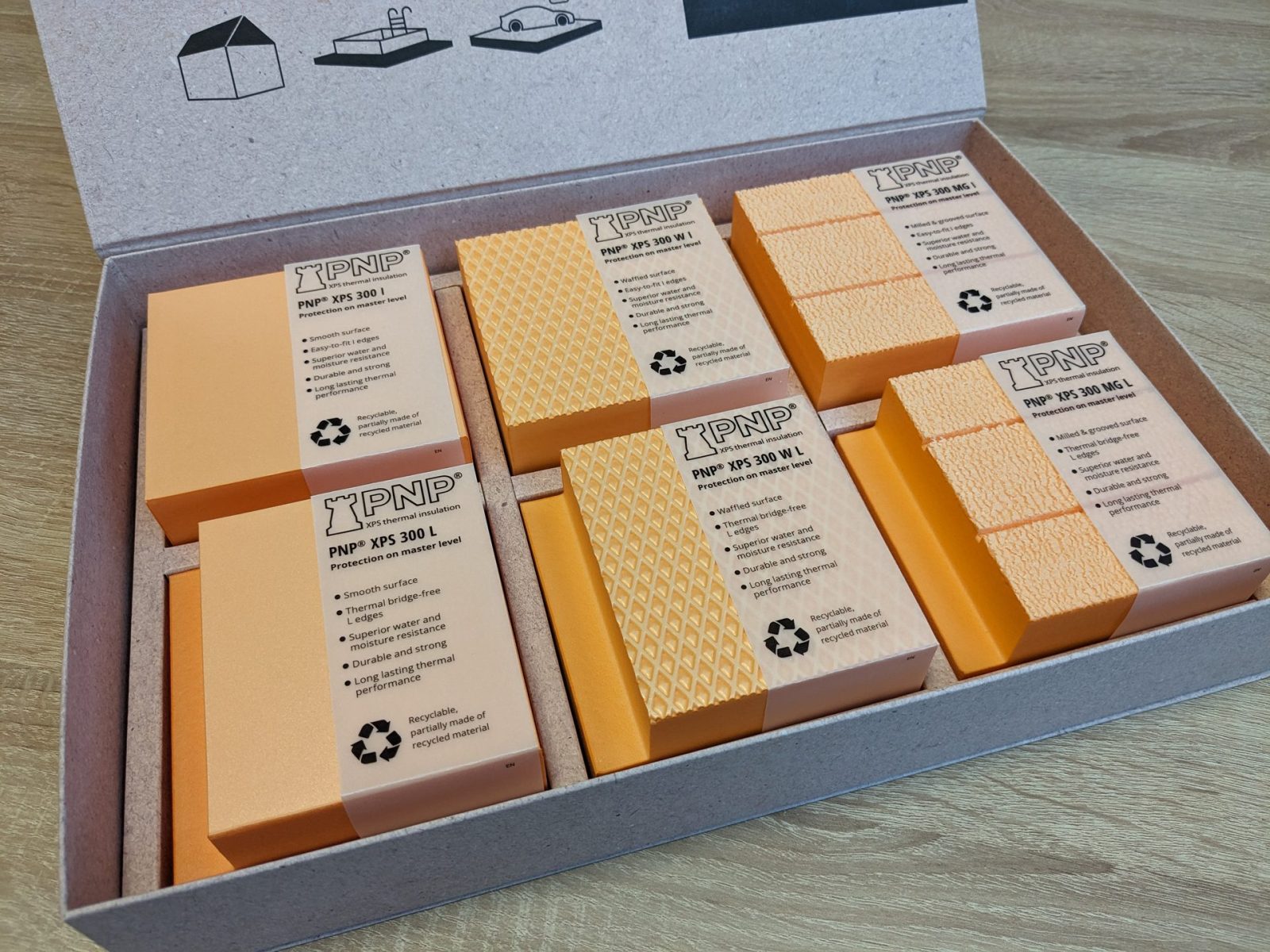
XPS 300 W — where the insulation face must bond to waterproofing membranes or adhesive compounds (waffled surface, same compressive class). XPS 300 W product page
For application guidance see Which PNP XPS Should I Choose? and What Does '300 kPa' Compressive Strength Mean?. Current TDS and DoP documents are available from the documentation page.
Sources
XPS 300 technical data sheet (EN): pnp_xps300-300TB_600x1250_techcard_en(20.07.2026).pdf (updated 2026-07-22)
XPS 300 Declaration of Performance: DoP PNP XPS 300 EMI_en (U).pdf (updated 2025-10-14)
XPS 300 W technical data sheet (EN): pnp_xps300W-300WTB_600x1250_techcard_en(20.07.2026).pdf (updated 2026-07-22)
XPS 300 W Declaration of Performance: DoP PNP XPS 300 W EMI_en (U).pdf (updated 2025-10-13)
XPS 500 technical data sheet (EN): pnp_xps500-500TB_600x1250_techcard_en(20.07.2026).pdf (updated 2026-07-22)
XPS 500 Declaration of Performance: DoP PNP XPS 500_en (U).pdf (updated 2025-07-22)
XPS 700 technical data sheet (EN): pnp_xps700_600x1250_techcard_en (21.07.2023).pdf (updated 2025-03-17)
XPS 700 Declaration of Performance: DoP PNP XPS 700_eng.pdf (updated 2025-03-17)
XPS 400 technical data sheet (EN): pnp_xps400-400TB_600x1250_techcard_en(20.07.2026).pdf (updated 2026-07-22)
EN 13164:2012+A1:2015 — Factory made products of extruded polystyrene foam (XPS)
PNP XPS solutions catalogue (foundations, slab-on-grade, shallow foundation, Swedish slab details)