What the compressive strength class means
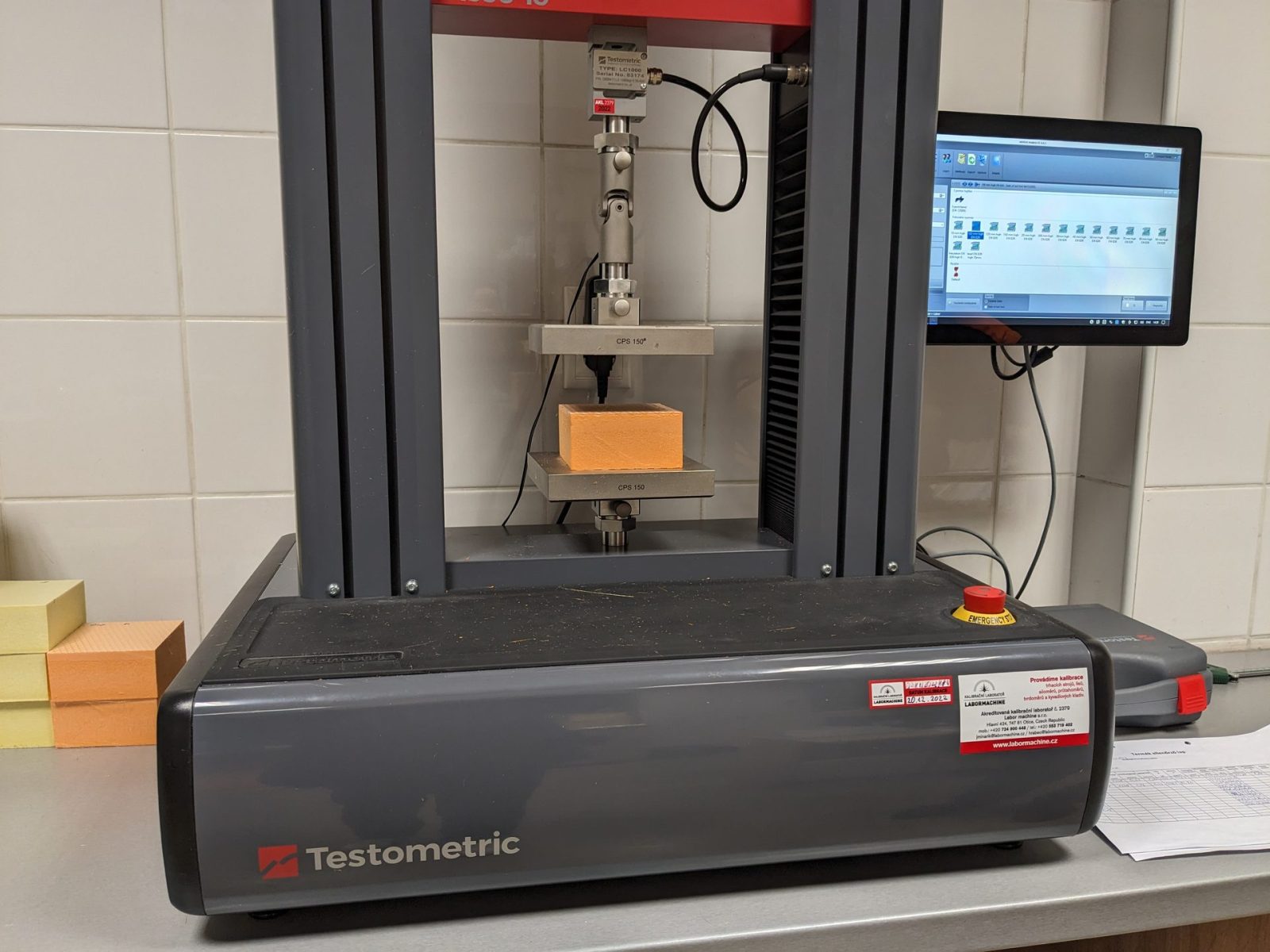
Both boards are classified under EN 13164:2012+A1:2015. The designation CS(10\Y)300 means the board resists a stress of at least 300 kPa at 10 % deformation or at yield, whichever comes first (EN 826). CS(10\Y)500 raises that threshold to 500 kPa — 67 % higher.
Compressive strength class is a declared minimum, not an average. Every board leaving the Várpalota plant must meet or exceed it. For detailed guidance on what the 300 kPa class means in practice, see the knowledge article What Does '300 kPa' Compressive Strength Mean?
Declared values compared
The table below lists only the properties that differ between the two products. Properties that are identical — λD, WL(T), DS(70,90), DLT(2)5, thickness tolerance T1, operating temperature −70 … +75 °C — are noted beneath the table.
Property XPS 300 (> 30 mm) XPS 500 Compressive strength (EN 826) CS(10\Y)300 — ≥ 300 kPa CS(10\Y)500 — ≥ 500 kPa Compressive creep (EN 1606) CC(2/1,5/50)130 — ≤ 130 kPa at 50 years CC(2/1,5/50)150 — ≤ 150 kPa at 50 years Tensile strength perpendicular to faces (EN 1607) TR 400 — ≥ 400 kPa TR 400 — ≥ 400 kPa Euroclass reaction to fire E E Available thicknesses (standard format) 20 – 150 mm 40 – 120 mm WD(V) — water absorption by diffusion WD(V)3 — ≤ 3,0 Vol.-% WD(V)3 — ≤ 3,0 Vol.-% Freeze–thaw resistance FTCD 1 — ≤ 1 Vol.-% FTCD 1 — ≤ 1 Vol.-%
Identical declared values (both products): λD 0,034 W/(m·K) for 40–100 mm / 0,035 W/(m·K) for 120 mm; WL(T)0,7 ≤ 0,7 Vol.-%; DS(70,90); DLT(2)5; T1 thickness tolerance.
Where XPS 300 is the appropriate choice
XPS 300 is designed for applications where design loads do not exceed 300 kPa. Typical uses confirmed in the PNP product data include:
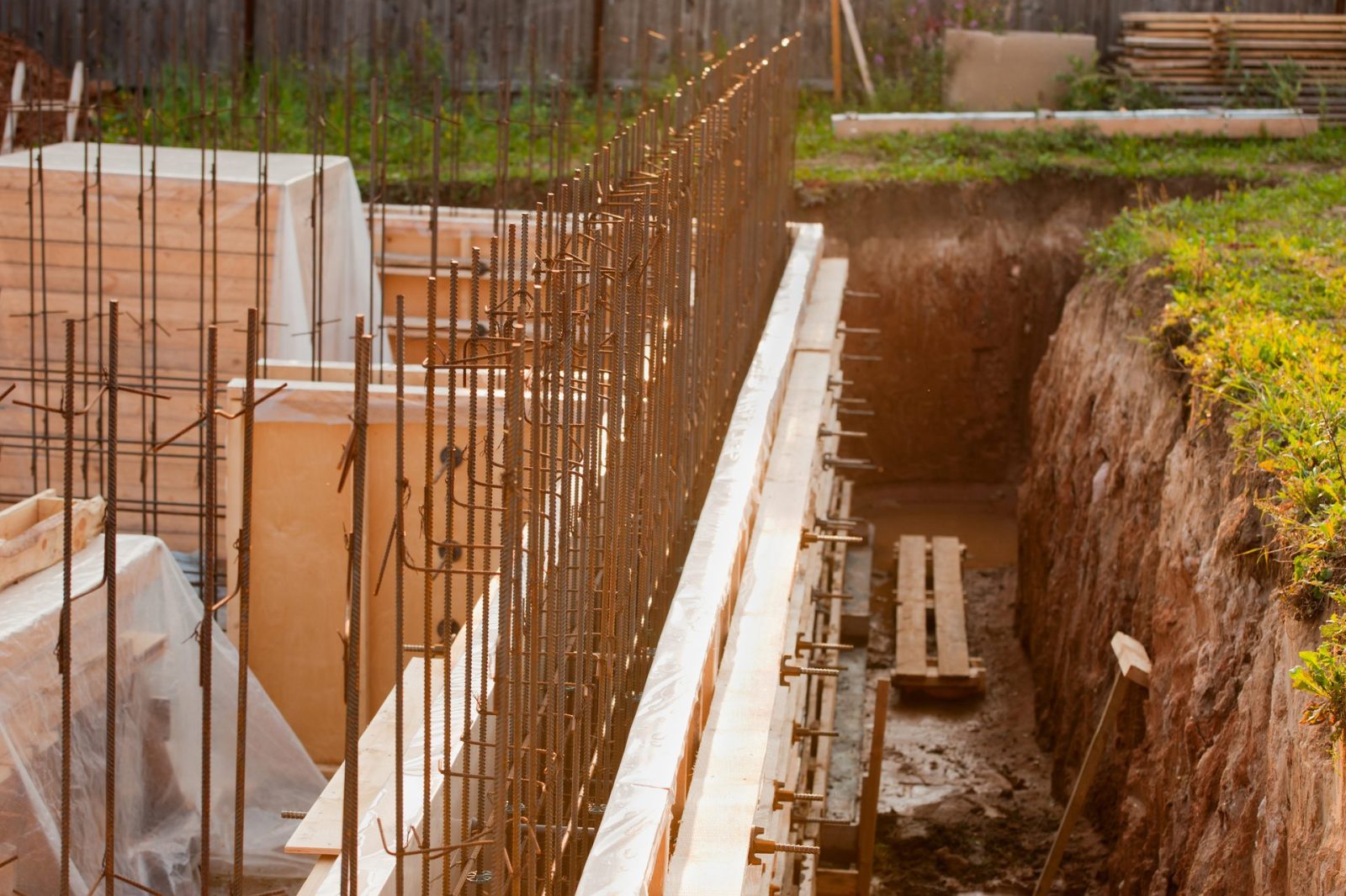
Thermal insulation of foundations and foundation slabs (residential and light commercial)
Floor and underfloor insulation in load-bearing assemblies under standard screeds
Accessible roofs, stylobates and paving systems under pedestrian or light vehicular traffic
Landscaping improvement and insulation beneath heavy-duty surface finishes
Applications requiring thicknesses from 20 mm to 150 mm (and beyond on request), including the thinner 20–30 mm range where a CS(10\Y)200 class applies
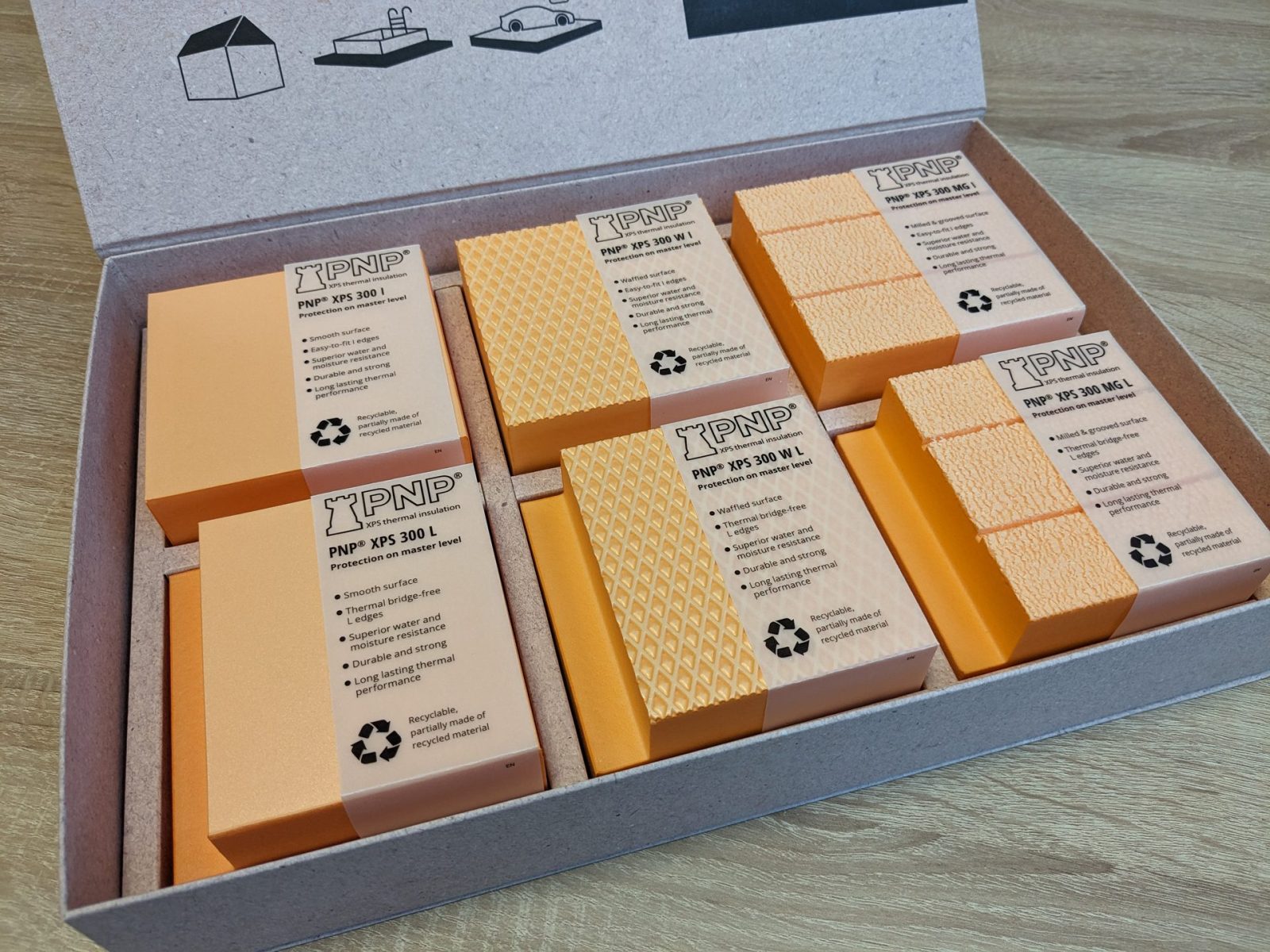
The broader thickness range (20–150 mm standard) also makes XPS 300 more flexible for designs requiring thinner boards at openings, plinths or tapered details. For bonded systems, the waffled-surface variant XPS 300 W is available with identical mechanical ratings.
Where XPS 500 is required
XPS 500 is specified when the insulation layer must resist compressive stresses above 300 kPa, or when the long-term creep limit at 50 years must reach 150 kPa rather than 130 kPa. Typical applications include:
Industrial floors and heavily loaded floor slabs subject to point loads, forklift traffic, or racking systems
Parking decks under vehicular loads
Road and infrastructure construction where elevated load-bearing performance is specified
Cold-store and refrigeration facility floors carrying racking and fork-lift loads
Flat-roof and inverted-roof insulation under traffic or heavy plant loads
Foundation and basement insulation under exceptional permanent loads
The standard thickness range for XPS 500 is 40–120 mm; thicker boards are available in the TB format — confirm availability with PNP sales or see the current TDS.
Compressive creep: the long-term load criterion
Short-term compressive strength is only part of the picture for permanently loaded assemblies. Compressive creep (EN 1606) defines the maximum long-term stress the board can carry without exceeding 2 % deformation over 50 years under the test conditions.
XPS 300 (> 30 mm): CC(2/1,5/50)130 — the declared long-term compressive stress is 130 kPa
XPS 500: CC(2/1,5/50)150 — the declared long-term compressive stress is 150 kPa
Where permanent loads are high and deformation tolerance is tight — for example, under a screed with underfloor heating or a cold-store floor with racking — the higher creep class of XPS 500 this supports specifying it even if the short-term stress might fall below 300 kPa. A qualified structural engineer should verify the actual design load against both the short-term and creep class for the specific assembly; see the relevant TDS and DoP for the declared values to use in calculations.
Thermal performance: no difference between grades
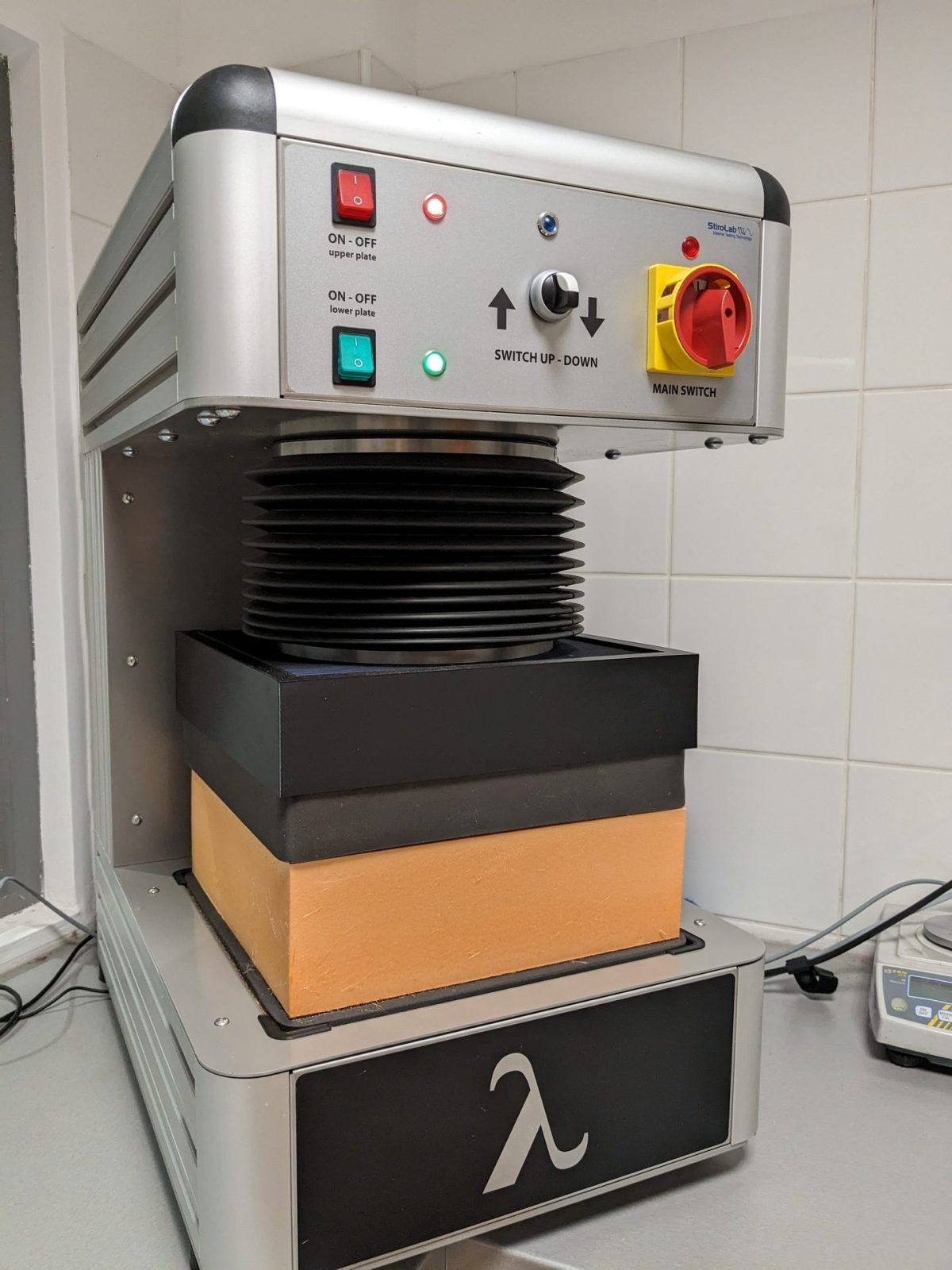
Upgrading from XPS 300 to XPS 500 does not change thermal performance. Both products declare:
λD = 0,034 W/(m·K) for thicknesses 40–100 mm
λD = 0,035 W/(m·K) for 120 mm (XPS 500 standard range) / up to 150 mm (XPS 300)
The required insulation thickness for a given RD target is therefore identical for both products. Thickness selection for thermal compliance remains a separate calculation governed by local energy codes and the project's U-value targets — consult a qualified designer and the current TDS for RD values by thickness.
Fire classification
Both XPS 300 and XPS 500 carry Euroclass E reaction to fire under EN 13501-1. This alone does not determine suitability for a specific application; national fire regulations and the position of the insulation within the construction element govern whether Euroclass E is acceptable. Always confirm with the project fire engineer and the applicable national code.
Decision guide
Use the following as a first-pass filter, not a design instruction. A qualified structural engineer must verify the actual design loads against the declared product values in the DoP and TDS before specifying either product.
Identify the design compressive stress on the insulation layer (short-term and long-term).
If the short-term stress is ≤ 300 kPa and the long-term permanent stress is ≤ 130 kPa: XPS 300 (> 30 mm) meets the declared values.
If the short-term stress is 301–500 kPa or the long-term permanent stress is 131–150 kPa: specify XPS 500.
If loads exceed 500 kPa, consider XPS 700 (CS(10\Y)700).
If a bonded or rendered finish is required on XPS 300, check whether the XPS 300 W waffled surface is needed for adhesion.
If the design requires thicknesses below 40 mm, only XPS 300 (available from 20 mm) covers that range in the standard format.
For product selection across the full PNP range, see Which PNP XPS Should I Choose? Application Guide. Full declared values are in the DoPs and TDS documents listed in the sources below; download them from the documentation page.
Sources
XPS 300 technical data sheet: pnp_xps300-300TB_600x1250_techcard_en(20.07.2026).pdf (updated 2026-07-22)
XPS 300 Declaration of Performance: DoP PNP XPS 300 EMI_en (U).pdf (updated 2025-10-14)
XPS 500 technical data sheet: pnp_xps500-500TB_600x1250_techcard_en(20.07.2026).pdf (updated 2026-07-22)
XPS 500 Declaration of Performance: DoP PNP XPS 500_en (U).pdf (updated 2025-07-22)
EN 13164:2012+A1:2015 — Factory-made products of extruded polystyrene foam (XPS)
EN 826 — Thermal insulating products for building applications: determination of compression behaviour
EN 1606 — Thermal insulating products for building applications: determination of compressive creep
EN 1607 — Thermal insulating products for building applications: determination of tensile strength perpendicular to faces
EN 13501-1 — Fire classification of construction products and building elements