 Magyar
 Română
 Lietuviškai
 Latviešu valoda
 Eesti
Eesti Polski
 Slovenčina
 Slovenščina
 Italiano
 Čeština
 Deutsch
What EN 13164 Is and Why It Exists
EN 13164:2012+A1:2015 is the harmonised European product standard for factory-made extruded polystyrene (XPS) thermal insulation boards intended for use in buildings and civil engineering structures. It is published by the European Committee for Standardisation (CEN) and adopted without change by national standards bodies in all EU and EEA member states.
Under Regulation (EU) No 305/2011 (the Construction Products Regulation, CPR), a harmonised standard creates the legal framework for CE marking. A manufacturer who demonstrates conformity with EN 13164 can draw up a Declaration of Performance (DoP), apply the CE mark, and place the product on the European single market. All PNP XPS boards produced at the Várpalota plant (Hungary) are manufactured and tested in conformity with EN 13164:2012+A1:2015.
What the Standard Covers
EN 13164 defines:
Material scope — rigid boards made by the extrusion of polystyrene (XPS), with or without facings or coatings.
Dimensional characteristics — length, width, thickness, squareness and edge profile requirements, and the tolerance classes (e.g. T1) used to classify them.
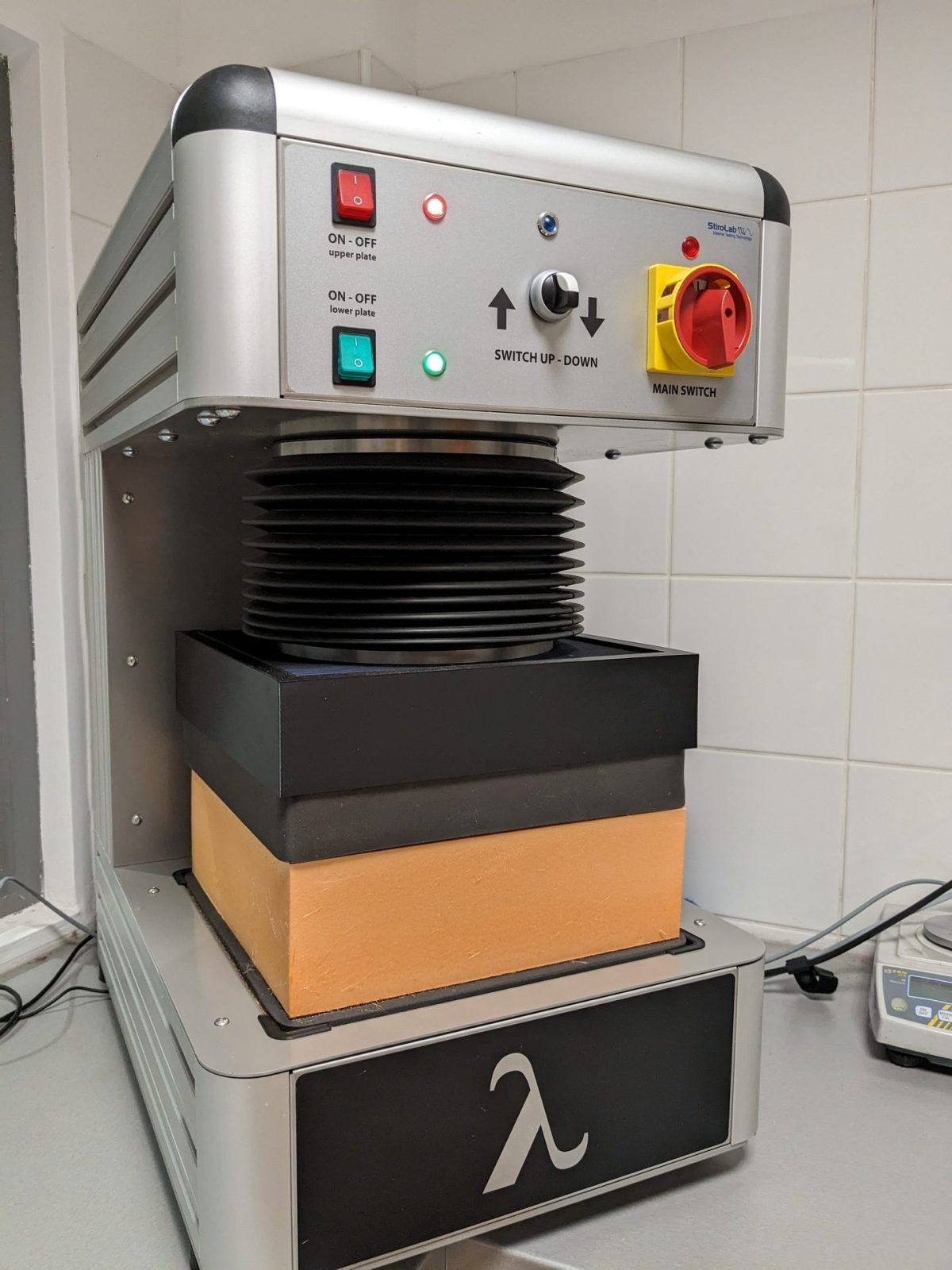
Thermal performance — the method for declaring the thermal conductivity (λD, W/(m·K)) and the derived thermal resistance (RD, m²·K/W).
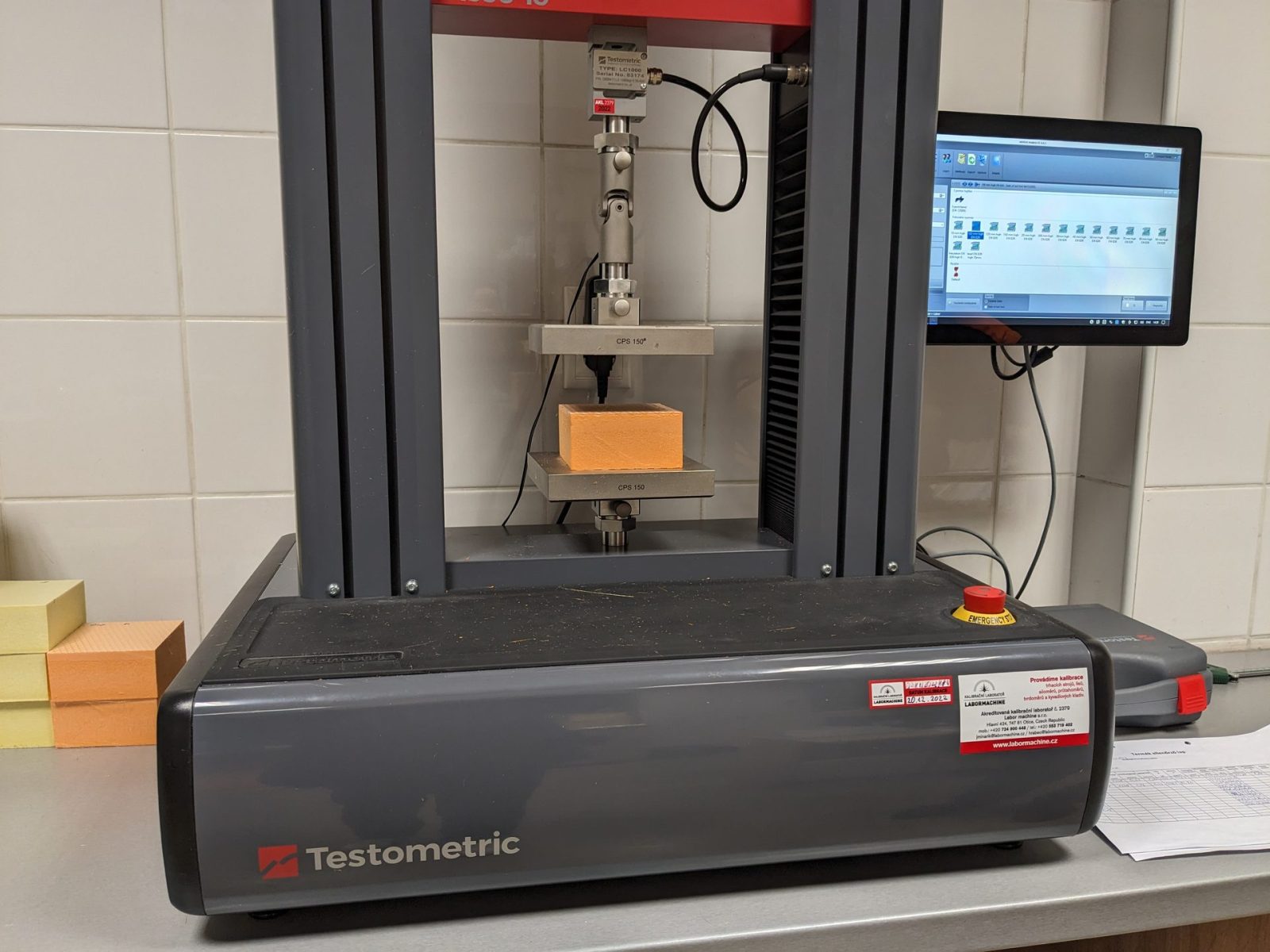
Mechanical properties — compressive strength at 10 % deformation or yield (CS(10\Y), in kPa per EN 826), tensile strength perpendicular to faces (TR), compressive creep (CC(2/1,5/50)), and deformation under load at temperature (DLT(2)5).
Hygric properties — long-term water absorption by total immersion (WL(T)) and by diffusion (WD(V)).
Durability indicators — dimensional stability at elevated temperature and humidity (DS(70,90)) and freeze–thaw resistance after diffusion (FTCD).
Reaction to fire — Euroclass classification (e.g. E or F) per EN 13501-1.
Marking and labelling — the mandatory information that must appear on every product or its packaging to enable traceability and compliance verification.
The Classification System: How to Read an XPS Product Code
EN 13164 uses a structured designation system that encodes the key declared values. The table below maps the notation used on PNP XPS data sheets and DoPs to the underlying standard concept.
Notation | Property | Example value (XPS 300) |
|---|---|---|
CS(10\Y)300 | Compressive strength at 10 % deformation or yield (EN 826) | ≥ 300 kPa |
λD | Declared thermal conductivity | 0.034 W/(m·K) (20–100 mm) |
WL(T)0,7 | Long-term water absorption by total immersion | ≤ 0.7 Vol.-% |
WD(V)3 | Long-term water absorption by diffusion | ≤ 3.0 Vol.-% |
DS(70,90) | Dimensional stability at 70 °C / 90 % RH | Declared |
FTCD1 | Freeze–thaw resistance (after diffusion) | ≤ 1 Vol.-% |
CC(2/1,5/50)130 | Compressive creep: 2 % creep strain, 1.5 % initial deformation, 50 years, 130 kPa | 130 kPa |
TR 400 | Tensile strength perpendicular to faces | ≥ 400 kPa |
T1 | Thickness tolerance class | T1 |
E / F | Euroclass reaction to fire | E (XPS 300); F (XPS 150) |
Each PNP XPS DoP lists the declared value for every property that is relevant to the intended use. Specifiers should always check the current DoP and TDS for the specific product and thickness being considered.
How EN 13164 Affects Product Selection
Because EN 13164 requires that every declared value is substantiated by testing and factory production control, specifiers can compare products from different manufacturers on an equal footing — provided they read the declared class, not just the grade name.
Key points for practical specification:
Compressive strength class is the primary selection criterion for load-bearing applications (foundations, floors, roofs under traffic). CS(10\Y)150, 200, 300, 400, 500 and 700 are the classes offered by PNP XPS.
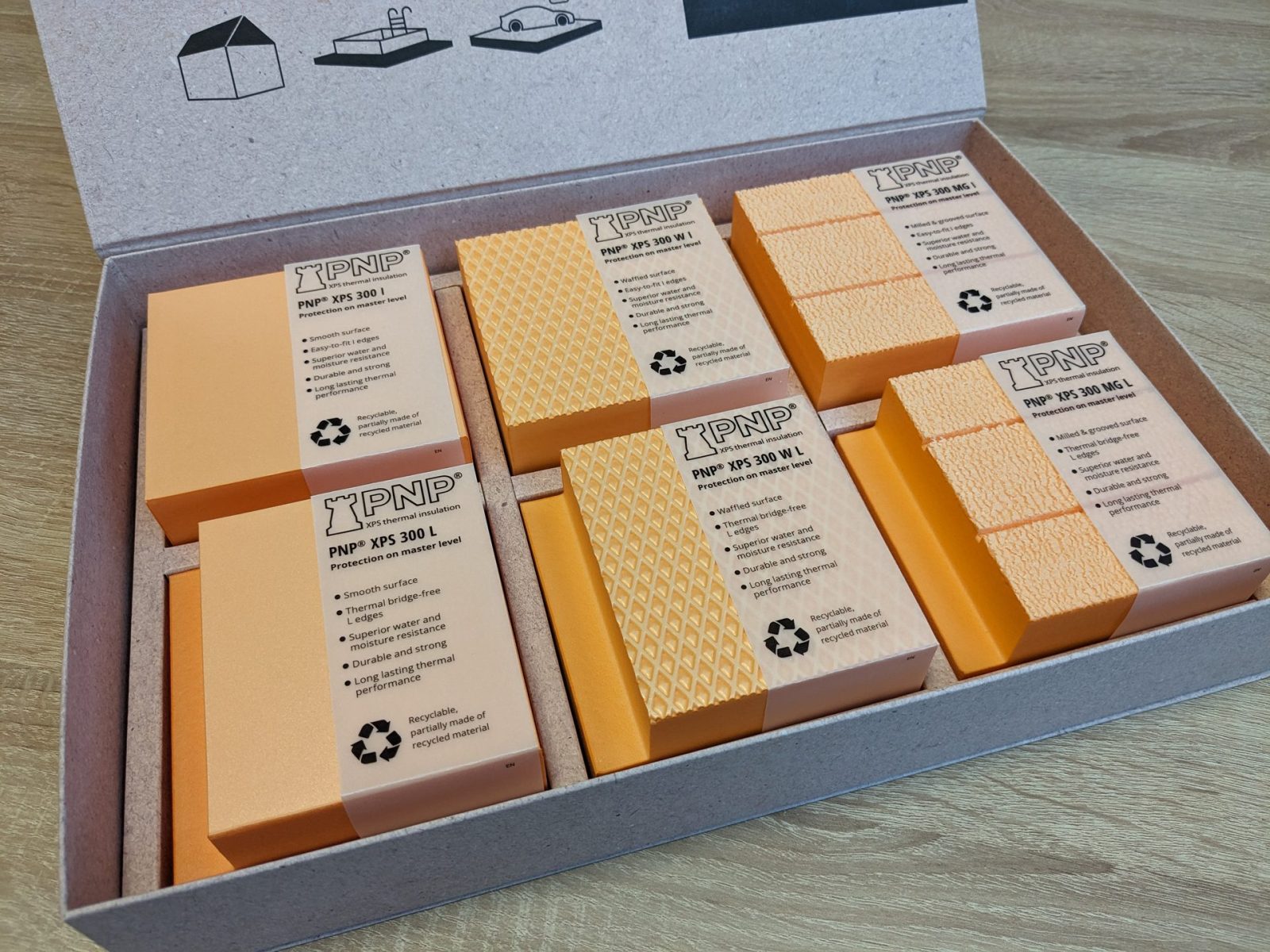
Surface type (smooth, waffled W, or milled-and-grooved MG) is not a property classified by EN 13164 itself, but it affects suitability for bonded systems (ETICS, renders, tile adhesives) and is declared in the DoP under intended use.
Water absorption class matters for below-ground, inverted-roof and road applications. A board declared WL(T)0,7 (≤ 0.7 Vol.-%) provides substantially better moisture resistance than one declared WL(T)3.
Fire class is a national building-regulation input. PNP XPS 300, 400, 500 and 700 are classified E; PNP XPS 150 and 200 variants are classified F. Whether class E or F is acceptable in a given application depends on the applicable national fire regulation — consult a qualified fire engineer and the relevant national code.
For a structured guide to choosing between PNP XPS grades, see Which PNP XPS Should I Choose? Application Guide.
EN 13164 and the Declaration of Performance (DoP)
Every PNP XPS product is accompanied by a DoP drawn up under Regulation (EU) No 305/2011. The DoP references EN 13164:2012+A1:2015 as the harmonised technical specification, identifies the product type, lists the declared performance values for each essential characteristic, and bears a unique identification number for traceability.
DoPs for all current PNP XPS products are available from the Documentation section of this website. BIM objects that embed the declared performance data are available via PNP BIM Libraries. An Environmental Product Declaration (EPD) covering the Várpalota plant, prepared in accordance with EN 15804, is also available in the same section.
Where a specific declared value is not shown on this page, refer to the current TDS and DoP for the product in question, or contact PNP XPS directly.
Sources
EN 13164:2012+A1:2015 — Factory-made thermal insulation products for buildings — Specification for extruded polystyrene foam (XPS) products
Regulation (EU) No 305/2011 (Construction Products Regulation, CPR)
DoP PNP XPS 300 EMI_en (U).pdf (updated 2025-10-14)
DoP PNP XPS 300 W EMI_en (U).pdf (updated 2025-10-13)
DoP PNP XPS 500_en (U).pdf (updated 2025-07-22)
DoP PNP XPS 700_eng.pdf (updated 2025-03-17)
DoP PNP XPS X-Grip_en (U).pdf (updated 2026-06-24)
DoP PNP 300 SLOPE A1-B1_en.pdf / A2-B2_en.pdf (updated 2025-03-17)
TDS pnp_xps300-300TB_600x1250_techcard_en (updated 2026-07-22)
EPD — PNP XPS (Várpalota plant), updated 2025-03-19
PNP BIM Libraries, updated 2025-02-24