 Magyar
 Română
 Lietuviškai
 Latviešu valoda
 Eesti
Eesti Polski
 Slovenčina
 Slovenščina
 Italiano
 Čeština
 Deutsch
Why the Plinth Zone Is a Demanding Environment
The plinth zone sits at the base of the building envelope, typically spanning from below finished ground level up to 300–500 mm above it. This zone is simultaneously exposed to:
Driving rain splash and surface run-off from above
Ground moisture and capillary water from below
Repeated freeze–thaw cycles in Central and Eastern European climates
Mechanical loads from backfill compaction and foot traffic
Direct adhesion requirements when a render or decorative finish is applied
No other zone on the building envelope combines all five of these stresses simultaneously, which is why insulation material selection here matters more than almost anywhere else.
Key Property Differences: XPS Versus Mineral Wool
The table below compares the relevant declared properties of PNP XPS grades suited to the plinth against the general characteristics of mineral wool. Mineral wool values are not in the PNP data; consult the mineral wool manufacturer's DoP for specific figures.
Property | PNP XPS (plinth grades) | Mineral wool (general) |
|---|---|---|
Long-term water absorption by immersion (WL(T)) | ≤ 0.7 Vol.-% (smooth/W grades); ≤ 3.0 Vol.-% (MG grades) | Significantly higher — see manufacturer DoP |
Freeze–thaw resistance (FTCD) | FTCD 1 (≤ 1 Vol.-%) — declared on CS 300 and higher grades | Not typically declared for wet-environment use |
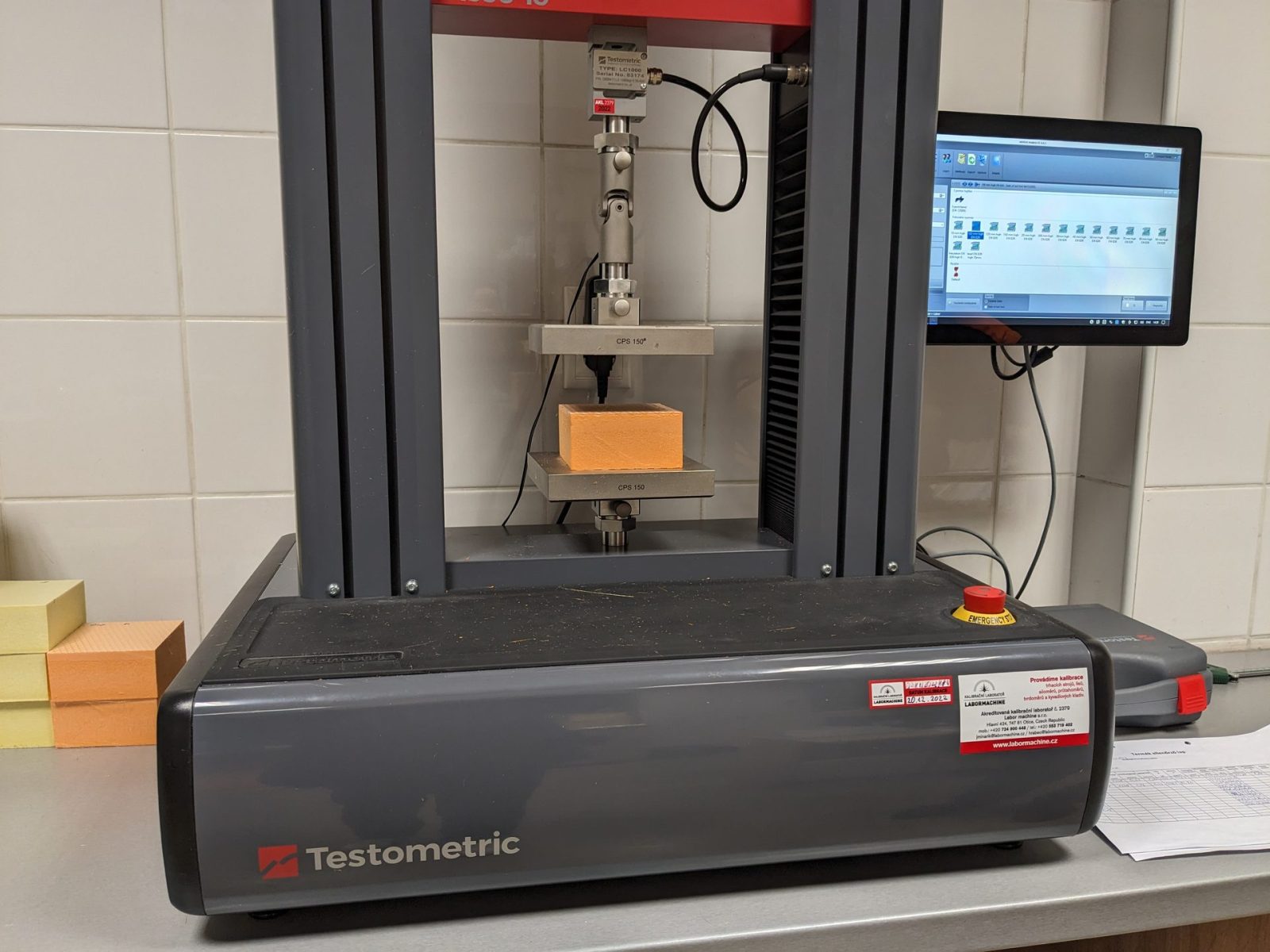
Compressive strength | 150–300 kPa (CS(10\Y) class) depending on grade | Generally lower; façade mineral wool boards rated for ETICS use — see DoP |
Dimensional stability | DS(70,90) — declared | Varies by product type |
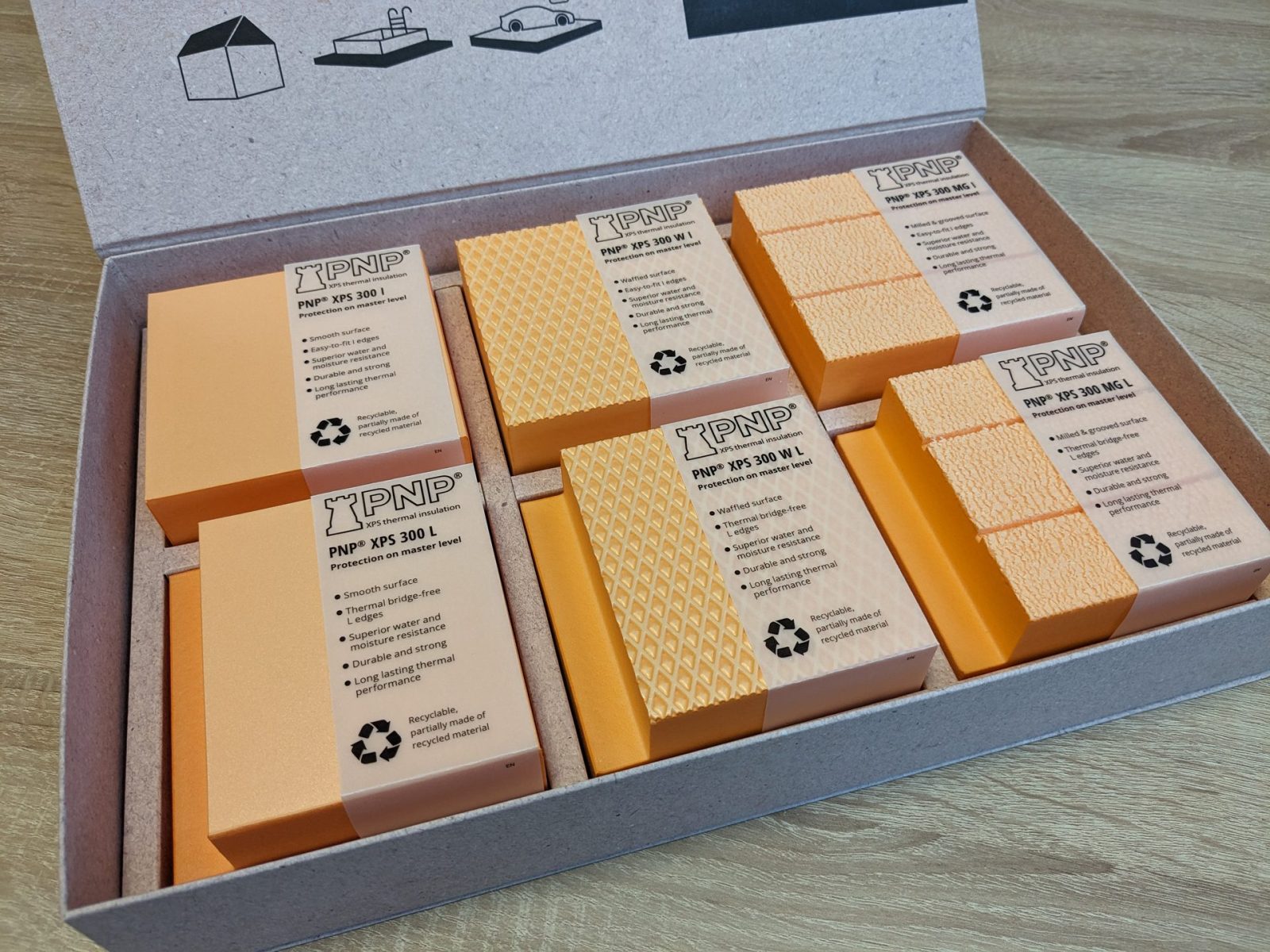
Surface for render adhesion | Waffled (W) or milled-and-grooved (MG) surface grades available | Fibrous surface provides mechanical key natively |
Reaction to fire (Euroclass) | E (CS 300 and above); F (CS 150/200 grades) | Typically A1 or A2 — non-combustible |
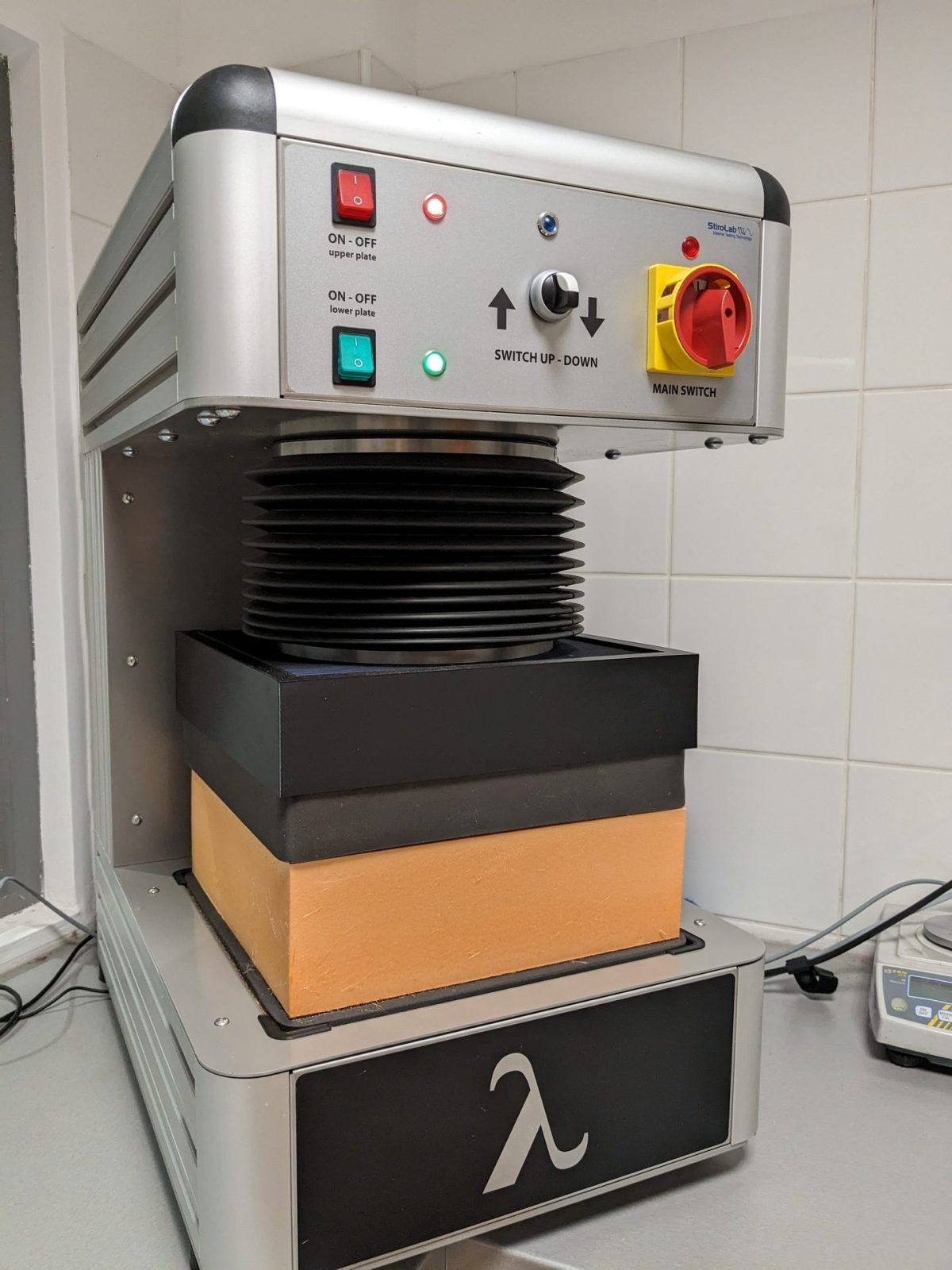
λD (declared thermal conductivity) | 0.034–0.035 W/(m·K) | See manufacturer TDS |
Fire class note: Mineral wool has a clear advantage in reaction-to-fire classification. Whether that advantage is decisive at the plinth depends on national building regulations and the fire performance requirements of the full wall assembly. A qualified designer must verify the applicable rules for the specific project and country.
Why XPS Is the Standard Choice at the Plinth
The closed-cell structure of XPS means water cannot migrate between cells. PNP XPS 300 W, for example, declares WL(T) 0.7 (≤ 0.7 Vol.-%) by long-term immersion and FTCD 1 (≤ 1 Vol.-%) freeze–thaw resistance. This supports reliable long-term thermal and structural performance in the damp, frost-exposed plinth zone.
Mineral wool is an open-fibre material. When persistently wet — as the plinth zone often is — mineral wool can absorb water, which raises its effective thermal conductivity and, depending on product type, may compromise its dimensional stability over time. This alone does not prove mineral wool always fails at the plinth, but it explains why XPS is the industry-standard specification for this detail across Central and Eastern Europe.
Additionally, compressive strength matters at the plinth: backfill pressure, ground settlement and the weight of cladding details all act on the insulation. PNP XPS 300 and XPS 300 W deliver CS(10\Y) 300 (≥ 300 kPa) for boards above 30 mm — sufficient for most residential and commercial plinth details. See the article on what 300 kPa compressive strength means for further explanation.
Choosing the Right PNP XPS Grade for the Plinth
Two variables drive grade selection: (a) whether a render or adhesive finish coat is applied directly to the insulation face, and (b) the required compressive strength.
Plinth detail | Recommended PNP XPS grade | Surface type | CS class |
|---|---|---|---|
Below-ground / no finish coat (waterproofing membrane applied over board) | Smooth | 300 kPa (>30 mm) | |
Above-ground plinth with render or adhesive finish coat — standard loads | Waffled | 150 kPa (30–150 mm) | |
Above-ground plinth with render or adhesive finish coat — higher loads | Waffled | 300 kPa (>30 mm) | |
Plinth ETICS with plaster / tile adhesive, milled-surface preference | Milled and grooved | 300 kPa |
All grades listed conform to EN 13164:2012+A1:2015 and are REACH-compliant. The correct grade and thickness for a specific project depend on the wall build-up, thermal requirements, load conditions and applicable national standards — always verify with a qualified designer and refer to the current TDS and DoP for each product.
The PNP solutions catalogue also shows a dedicated Plinths and basements detail: XPS board against the basement wall, waterproofing PVC membrane, drainage system and blind area.
Sources
XPS 150 W X-Grip technical data sheet — TDS pnp_xpsX-Grip_X-GripTB_600x1250_techcard_en (updated 2026-07-22)
XPS 150 W DoP — DoP PNP XPS 150W_en (U) (updated 2025-10-14)
XPS 300 technical data sheet — TDS pnp_xps300-300TB_600x1250_techcard_en (updated 2026-07-22)
XPS 300 DoP — DoP PNP XPS 300 EMI_en (U) (updated 2025-10-14)
XPS 300 W technical data sheet — TDS pnp_xps300W-300WTB_600x1250_techcard_en (updated 2026-07-22)
XPS 300 W DoP — DoP PNP XPS 300 W EMI_en (U) (updated 2025-10-13)
XPS 150 MG technical data sheet — TDS pnp_xps150MG_600x1250_techcard_en (updated 2025-03-17)
XPS 300 MG technical data sheet — TDS pnp_xps300MG_600x1250_techcard_en (updated 2025-03-17)
XPS 300 MG DoP — DoP PNP XPS 300 MG_eng (updated 2025-03-17)
PNP XPS Solutions Catalogue — Plinths and basements detail
EN 13164:2012+A1:2015 — Thermal insulation products for buildings: factory-made extruded polystyrene foam (XPS) products