Direct Answer: XPS Thermal Performance Is Designed to Last
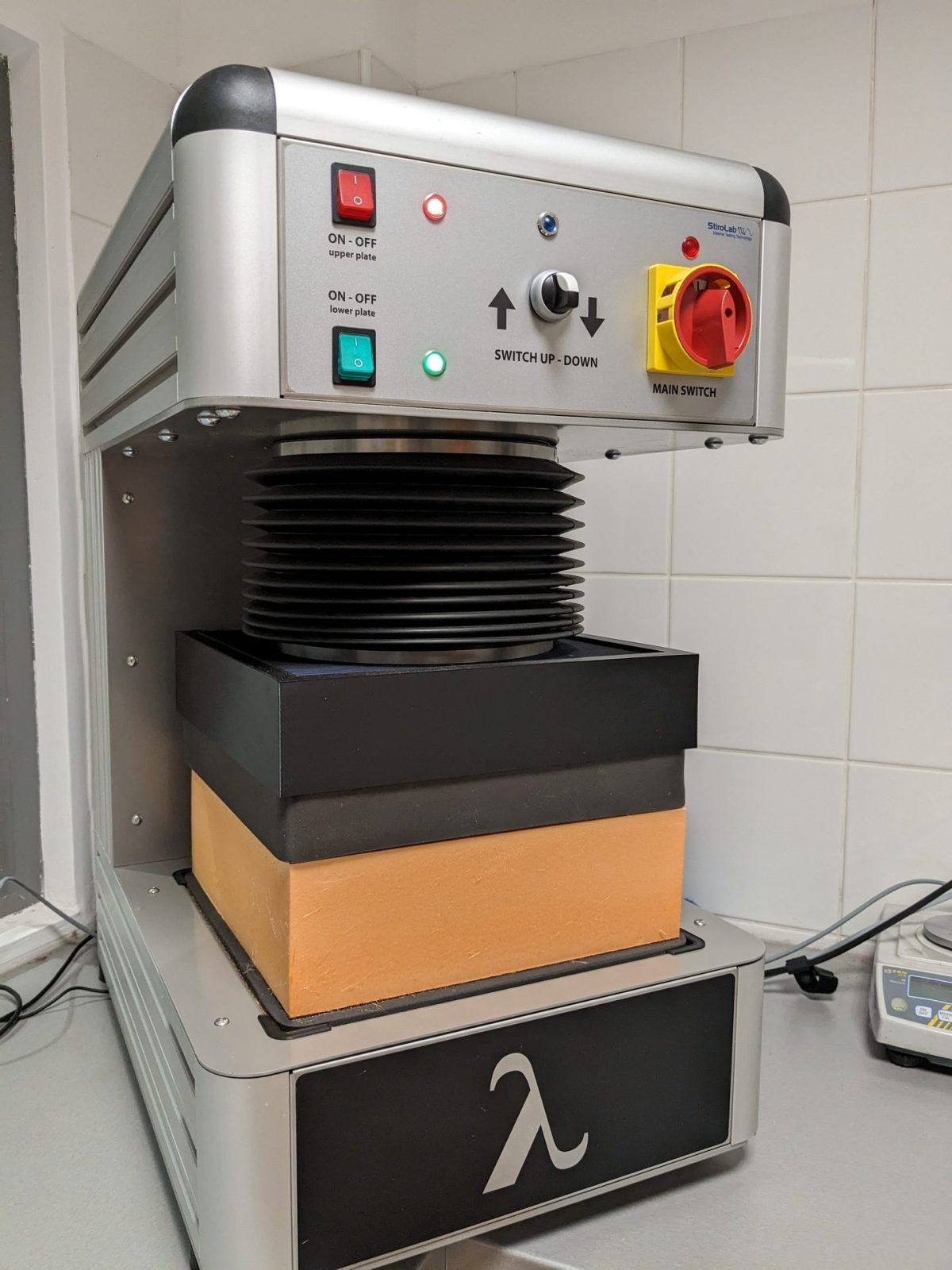
PNP XPS boards are engineered so that the declared thermal conductivity (λD) stated on the Declaration of Performance (DoP) is a long-term declared value, not a new-product figure. The closed-cell extruded polystyrene structure — tested and certified to EN 13164:2012+A1:2015 — resists the three main causes of insulation degradation: moisture uptake, dimensional change, and sustained compressive deformation. Provided the board is installed within its rated operating temperature range (−70 to +75 °C) and the assembly is designed correctly, the thermal resistance will not measurably decrease over a building's service life.
Why Moisture Resistance Is the Key Factor
Water is the principal enemy of insulation performance. Liquid water filling cell walls conducts heat roughly 25 times better than still air, so any material that absorbs moisture will lose R-value over time. XPS avoids this through its homogeneous closed-cell structure: each cell is sealed and independent.
PNP XPS boards are tested for two distinct moisture scenarios under EN 13164:
Long-term water absorption by immersion — WL(T): XPS 300 and XPS 300 W, for example, are rated WL(T)0,7 (≤ 0.7 Vol.-%). After prolonged total immersion — the most severe laboratory condition — moisture uptake remains below 0.7 % by volume.
Water absorption by diffusion — WD(V): XPS 300 and XPS 300 W are rated WD(V)3 (≤ 3.0 Vol.-%), covering vapour-driven uptake over time.
These are ceiling values declared on the DoP; actual in-service uptake in a well-designed assembly will typically be lower. The test showed that even under immersion, the boards absorb negligible moisture relative to their volume — this supports the inference that λD will remain stable in service.
Dimensional Stability: No Shrinkage, No Gaps
A board that shrinks after installation creates thermal bridges at joints and reduces effective thickness. All PNP XPS products carry the dimensional stability class DS(70,90), meaning that after 90 days at 70 °C — conditions far more severe than any normal service environment — linear dimensions remain within the declared tolerance. This class is defined in EN 13164 and confirmed in the respective DoPs.
In practice, boards installed in foundations, inverted roofs, or under floor slabs will never approach 70 °C; the dimensional stability rating therefore provides a large safety margin against real-world temperature cycling.
Creep Resistance: Maintaining Thickness Under Load
Insulation that compresses permanently under load loses both thickness and thermal resistance. PNP XPS boards used in load-bearing applications carry a compressive creep class CC(2/1.5/50), which defines the maximum additional strain after 50 years under a sustained load. Specific values from the product data:
ProductCreep class CC(2/1.5/50)Compressive strengthXPS 300 / XPS 300 W (>30 mm)CC(2/1.5/50)130300 kPaXPS 500CC(2/1.5/50)150500 kPaXPS 700CC(2/1.5/50)210700 kPa
The CC value is the maximum allowable long-term compressive stress in kPa such that creep strain after 50 years will not exceed 2 % at a reference condition of 1.5 % initial strain. A qualified structural designer must verify that the applied load stays below this limit — this article alone does not constitute a design instruction.
Freeze–Thaw Resistance in Exposed and Ground-Contact Positions
For boards installed in inverted roofs, foundations, pavements, and road construction — positions subject to repeated wetting and freezing — PNP XPS 300, XPS 300 W, XPS 500, and XPS 700 are all rated FTCD1 (≤ 1 Vol.-%). This freeze–thaw resistance class (tested after long-term water absorption by diffusion) confirms that the closed-cell structure does not fracture or delaminate under repeated freeze–thaw cycling, so thermal performance is maintained in the most demanding exposure conditions.
Operating Temperature Range and Biostability
All PNP XPS boards are declared for continuous use between −70 °C and +75 °C. This covers cold-store floors, subgrade foundations in continental climates, and roof surfaces in summer. Extruded polystyrene is also fully biostable: it does not rot, is not a nutrient source for mould or bacteria, and does not corrode. These characteristics contribute to unchanged thermal performance regardless of how long the board remains in place.
All PNP XPS boards are REACH-compliant and contain no HBCDD or other substances of very high concern.
What Could Reduce Performance in Practice
The properties above are measured under standardised laboratory conditions. Real-world performance depends on correct specification and installation. Factors that a qualified designer must assess include:
Sustained load exceeding the creep class limit — can cause progressive thickness loss in floor or foundation applications.
Temperatures above +75 °C — for example, directly beneath dark flat-roof membranes in extreme climates; check the TDS and consult a designer.
Mechanical damage during installation — cuts, point loads, or missing protection layers can compromise the closed-cell skin, locally increasing moisture uptake.
Assembly design errors — missing vapour barriers or incorrect drainage details can raise in-service moisture levels beyond what the board alone can resist.
For any specific project, refer to the current TDS and DoP for the selected grade, and engage a qualified designer to verify compliance with national regulations and EN 13164.
Sources
EN 13164:2012+A1:2015 — Thermal insulation products for buildings — Factory made products of extruded polystyrene foam (XPS)
DoP PNP XPS 300 EMI_en (U) (updated 2025-10-14)
DoP PNP XPS 300 W EMI_en (U) (updated 2025-10-13)
DoP PNP XPS 500_en (U) (updated 2025-07-22)
DoP PNP XPS 700_eng (updated 2025-03-17)
TDS pnp_xps300-300TB_600x1250_techcard_en (updated 2026-07-22)
TDS pnp_xps300W-300WTB_600x1250_techcard_en (updated 2026-07-22)
TDS pnp_xps500-500TB_600x1250_techcard_en (updated 2026-07-22)
TDS pnp_xps700_600x1250_techcard_en (updated 2025-03-17)
EPD — PNP XPS (Várpalota plant) (updated 2025-03-19)