Direct Answer: Key Storage Rules for XPS on Site
XPS boards delivered to site should be stored in a way that protects their geometry, surface condition and fire safety until installation. The following rules apply to all PNP XPS grades (XPS 150 through XPS 700, including SLOPE and waffled variants):
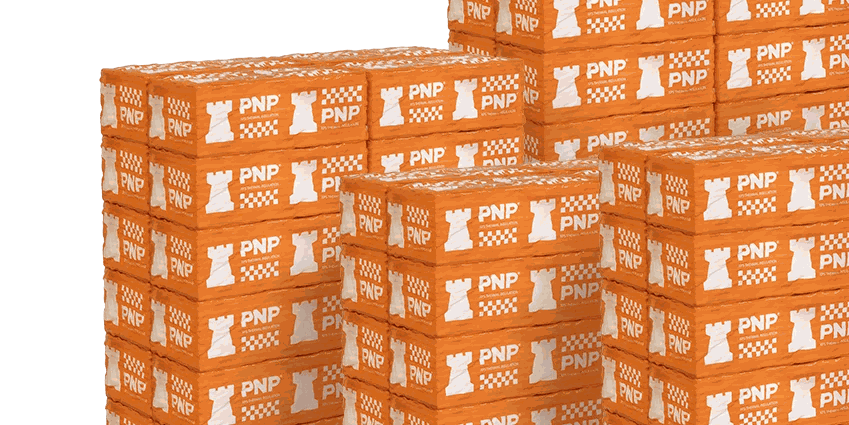
Store flat and level. Stack boards horizontally on a firm, level surface — timber bearers or pallets are suitable. Avoid storing boards on end or leaning them against a wall; this can cause permanent bowing that makes installation harder.
Protect from direct sunlight (UV). Extended UV exposure degrades the surface layer of XPS. Keep boards under an opaque cover (tarpaulin, sheeting or a temporary shelter). This is especially important for waffled-surface grades (XPS 150 W X-Grip, XPS 300 W) and milled-and-grooved grades (MG range), where surface condition directly affects adhesion performance.
Keep dry but do not rely on storage as a drying step. XPS has extremely low water absorption — WL(T) ≤ 0.7 Vol.-% for smooth and waffled grades, WL(T) ≤ 3.0 Vol.-% for MG grades — so brief rain exposure is unlikely to cause measurable moisture uptake. However, standing water on pallets can contaminate surfaces, so cover boards and raise them off the ground.
Segregate from heat sources, solvents and open flame. XPS is classified Euroclass E or F (depending on grade — see the table below). Keep boards away from hot works, bitumen torches, welding, solvent-based products and any ignition source. Do not store adjacent to fuel, paints or adhesives with hydrocarbon solvents, which can attack the XPS foam.
Limit stack height to what is structurally safe. Excessively tall stacks risk toppling and edge damage. Observe any height limit posted on the pallet or stated in the TDS.
Protect edges and corners. L-edge profiles, used on most PNP XPS boards, can chip if boards are dropped or dragged. Chipped edges affect the thermal continuity of tongue-and-groove joints at installation.
Fire Classification by Grade
Reaction-to-fire class determines the level of fire precaution required on site. All PNP XPS grades are combustible; treat stored boards as a fire risk.
ProductEuroclassXPS 150 / XPS 150 W X-Grip / XPS 150 MG / XPS 200 / XPS 200 W / XPS 200 MGFXPS 300 / XPS 300 W / XPS 300 MG / XPS 400 / XPS 500 / XPS 700 / XPS 300 SLOPEE
Euroclass E means the product is combustible but passes a small-flame test; Euroclass F means no performance determined. In practice, both classes require the same site fire precautions: no hot works in the immediate vicinity, no storage near ignition sources, and compliance with the site fire plan. A qualified fire-safety officer should confirm site-specific requirements.
Surface-Specific Considerations
Different PNP XPS surface finishes have different sensitivities during storage:
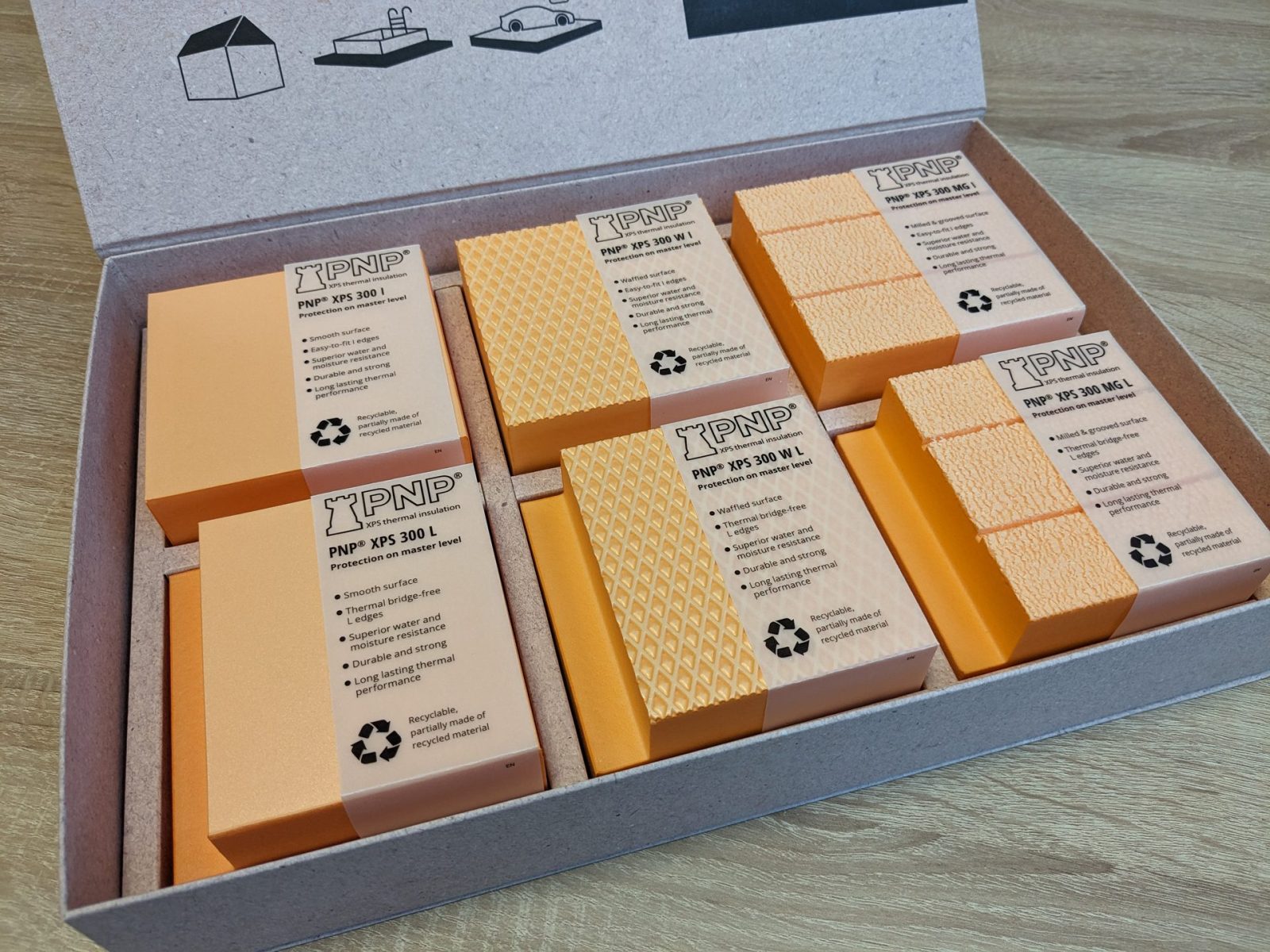
Smooth-surface grades (XPS 150, 200, 300, 400, 500, 700): The factory skin is robust. Avoid abrasion from dragging boards across rough ground, which can damage the skin and increase local water absorption.
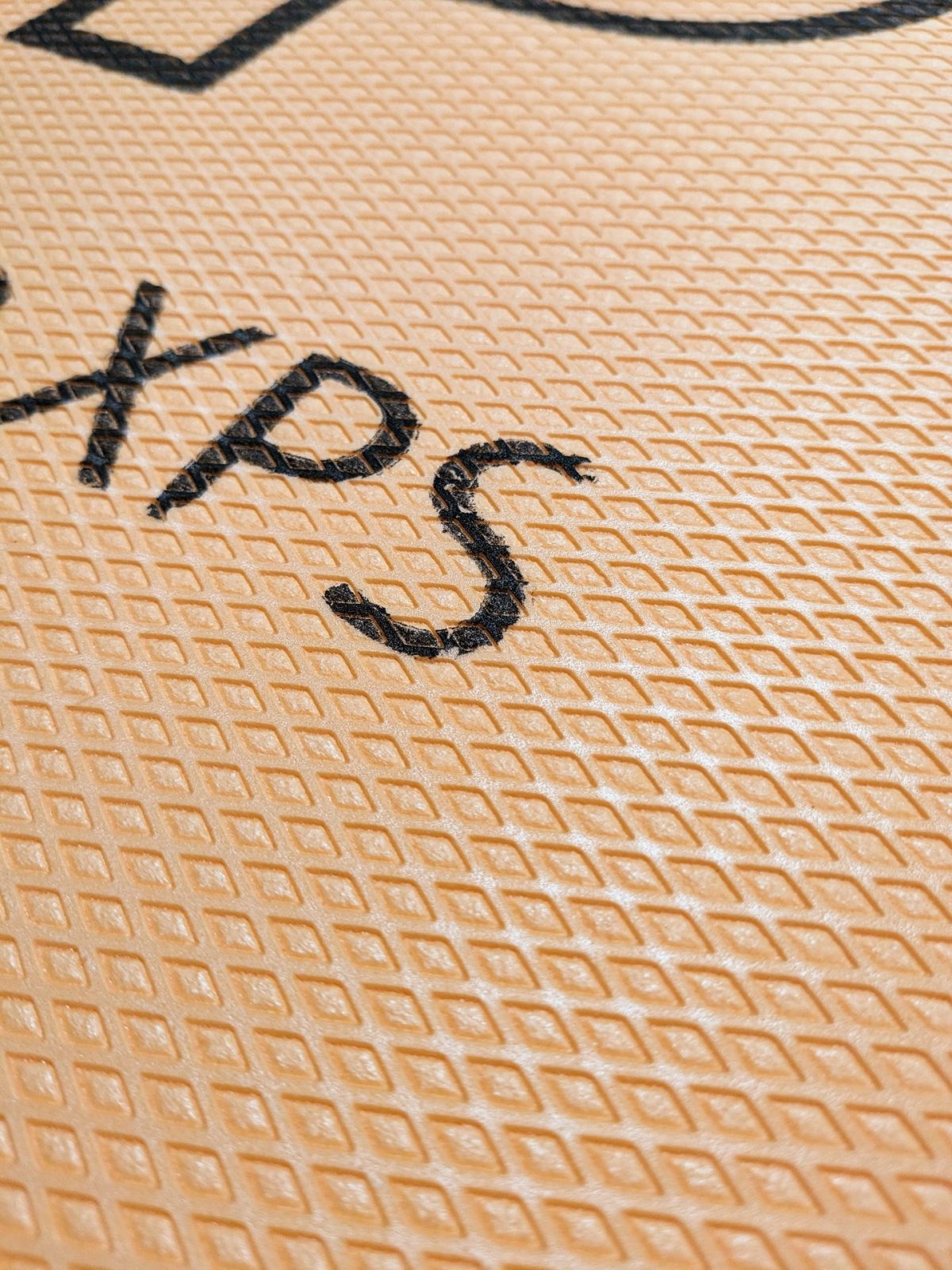
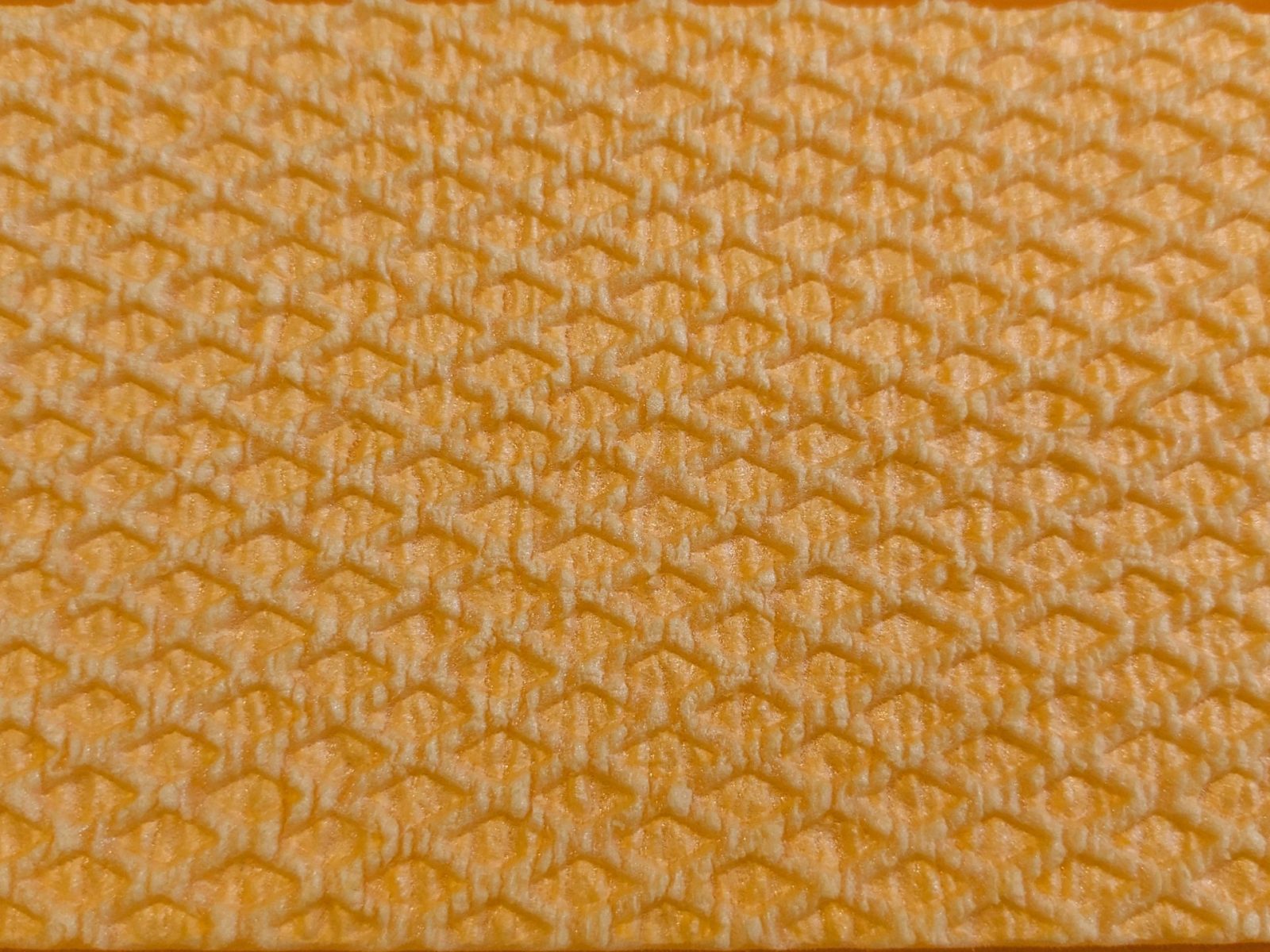
Waffled grades (XPS 150 W X-Grip, XPS 200 W, XPS 300 W): The waffled surface provides mechanical key for adhesives and renders. Contamination with dust, oil, solvent or UV-degraded material can reduce bond strength. Keep the waffled face clean and covered.
Milled-and-grooved grades (XPS 150 MG, XPS 200 MG, XPS 300 MG): These grades have higher declared water absorption (WL(T) ≤ 3.0 Vol.-%) due to the open surface. Although this remains within the declared performance envelope, avoid prolonged saturation; store off the ground and keep covered.
Tapered boards (XPS 150 SLOPE, XPS 300 SLOPE): The varying thickness makes stacks uneven. Alternate board orientations (thin end to thick end) to keep the stack level and prevent edge loading on the thinner end.
Operating Temperature Context
All PNP XPS grades have a declared operating temperature range of −70 to +75 °C. Storage within this range — covering all Central and Eastern European site conditions — does not affect the declared properties. However, boards stored in direct summer sunlight on a dark surface can reach surface temperatures above +75 °C locally; shading eliminates this risk.
Cold-weather storage (below 0 °C) does not damage XPS, but condensation can form on cold boards brought into a warm environment. Allow boards to equilibrate to ambient temperature before applying adhesive or render systems.
Handling and Lifting
XPS boards are lightweight and rigid. Standard manual handling applies:
Carry boards on edge between two people for long lengths to avoid flexural cracking at mid-span.
Do not drop pallets or individual boards; corner and edge damage is the most common site defect.
Use strapping and pallet wrapping supplied by PNP Orange Kft. until boards are needed; do not remove wrapping until immediately before installation.
For questions about specific delivery or pallet configurations, contact PNP XPS at sales@pnpinsulation.com or visit the contact page.
Sources
XPS 150 technical data sheet: TDS pnp_xps150-150TB_600x1250_techcard_en (updated 2026-07-22)
XPS 150 W X-Grip technical data sheet: TDS pnp_xpsX-Grip_X-GripTB_600x1250_techcard_en (updated 2026-07-22)
XPS 200 technical data sheet: TDS pnp_xps200-200TB_600x1250_techcard_en (updated 2026-07-22)
XPS 200 W technical data sheet: TDS pnp_xps200W-200WTB_600x1250_techcard_en (updated 2026-07-22)
XPS 300 technical data sheet: TDS pnp_xps300-300TB_600x1250_techcard_en (updated 2026-07-22)
XPS 300 W technical data sheet: TDS pnp_xps300W-300WTB_600x1250_techcard_en (updated 2026-07-22)
XPS 400 technical data sheet: TDS pnp_xps400-400TB_600x1250_techcard_en (updated 2026-07-22)
XPS 500 technical data sheet: TDS pnp_xps500-500TB_600x1250_techcard_en (updated 2026-07-22)
XPS 700 technical data sheet: TDS pnp_xps700_600x1250_techcard_en (updated 2025-03-17)
XPS 150 MG technical data sheet: TDS pnp_xps150MG_600x1250_techcard_en (updated 2025-03-17)
XPS 200 MG technical data sheet: TDS pnp_xps200MG_600x1250_techcard_en (updated 2025-03-17)
XPS 300 MG technical data sheet: TDS pnp_xps300MG_600x1250_techcard_en (updated 2025-03-17)
EN 13164:2012+A1:2015 — Thermal insulation products for buildings, factory-made extruded polystyrene foam (XPS) products
PNP XPS product DATA block (supplied 2026-09-18)