What λD Means and Why It Matters
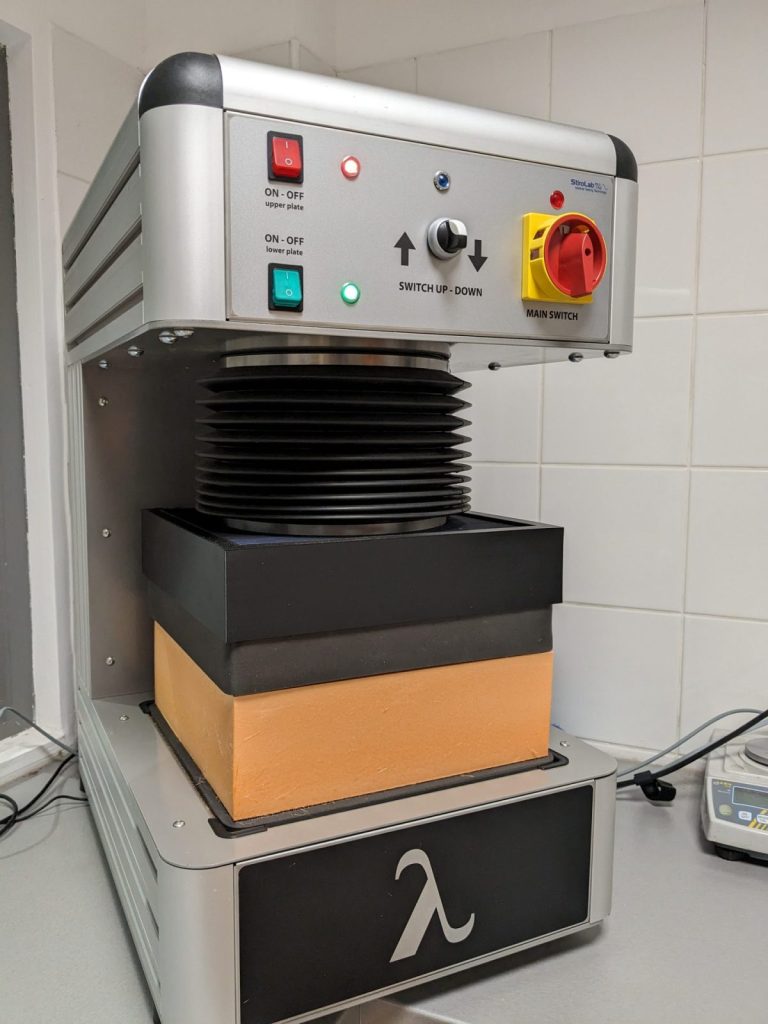
λD — declared thermal conductivity — is the standardised measure of how readily heat passes through one metre of insulation material under steady-state conditions. Its unit is W/(m·K): watts of heat flow per metre of thickness per kelvin of temperature difference. The lower the value, the less heat passes through the board and the better the insulating effect.
λD is the input value every designer needs to calculate the declared thermal resistance RD of an insulation layer:
RD = d / λD, where d is the board thickness in metres
Example: a 100 mm (0.10 m) PNP XPS 300 board → RD = 0.10 / 0.034 = 2.94 m²·K/W
Because λD is a declared value — not a nominal or catalogue estimate — it is published in the Declaration of Performance (DoP) and technical data sheet (TDS) for each product, and it is backed by third-party testing under EN 13164:2012+A1:2015. Specifiers and building-regulation authorities can rely on it directly in energy and hygrothermal calculations.
How λD Is Established Under EN 13164
EN 13164:2012+A1:2015 is the harmonised European product standard for factory-made XPS thermal insulation boards. It defines the test methods, statistical treatment and declaration rules that manufacturers must follow. The declared value is derived from measurements of thermal conductivity and is set at a confidence level that accounts for production variability — it is not simply the average of test results.
Because the closed-cell structure of XPS traps gas within the foam, thermal conductivity is slightly dependent on board thickness: thicker boards retain more gas and can show marginally different conductivity. EN 13164 accounts for this by permitting thickness-banded declarations, which is why PNP XPS products carry two λD values:
0.034 W/(m·K) — for board thicknesses 20–100 mm (and 40–100 mm where 20 mm is not offered)
0.035 W/(m·K) — for board thicknesses 120–150 mm
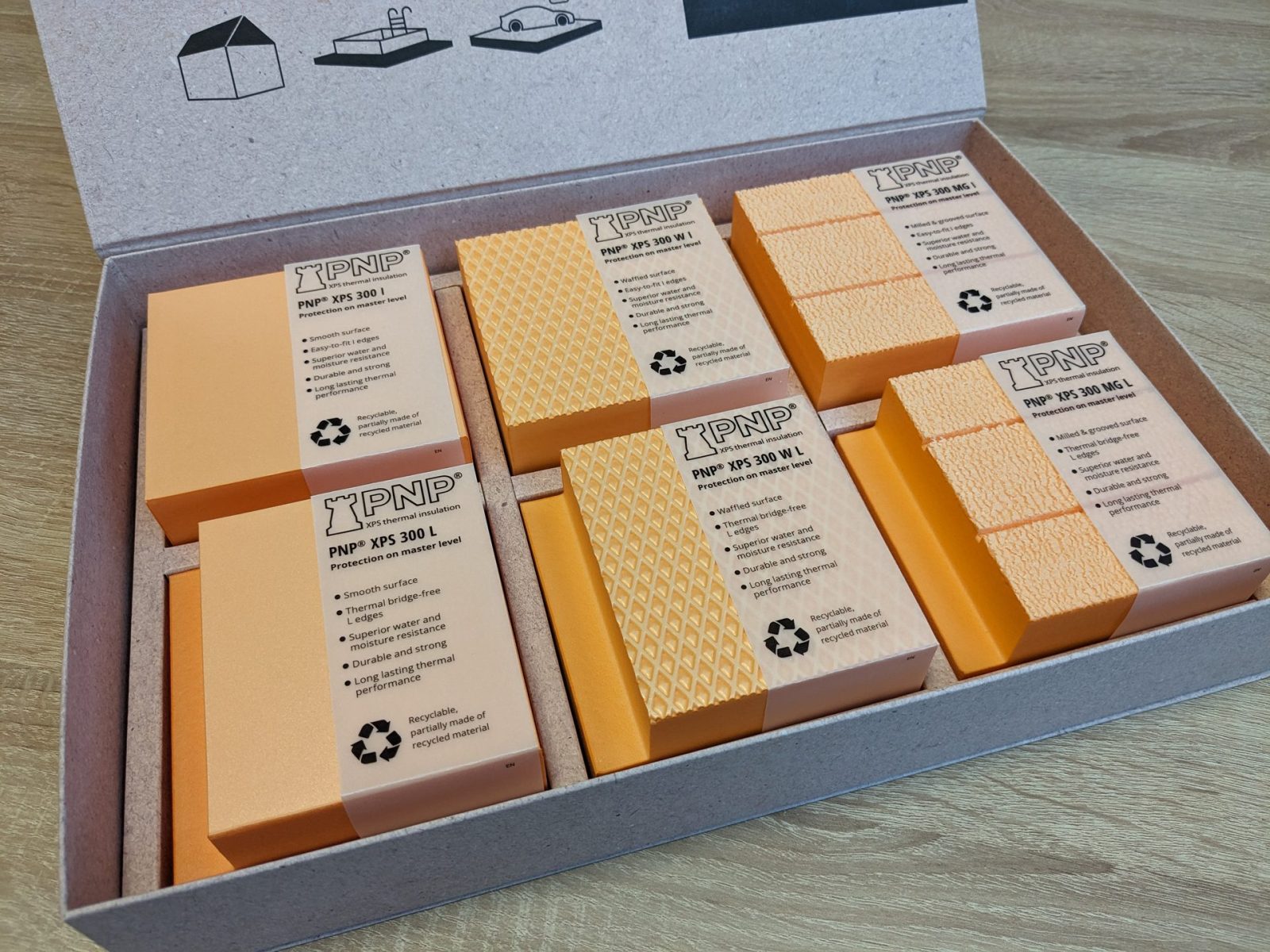
These values apply consistently across the entire PNP XPS range, regardless of compressive strength class (150 kPa through 700 kPa) or surface type (smooth, waffled, milled and grooved, or SLOPE).
λD Values Across the PNP XPS Range
The table below summarises the declared thermal conductivity for every published PNP XPS product. Compressive strength and surface type vary widely; λD does not.
ProductCompressive strengthSurfaceλD (20–100 mm)λD (120–150 mm)XPS 150150 kPaSmooth0.034 W/(m·K)0.035 W/(m·K)XPS 150 MG150 kPaMilled & grooved0.034 W/(m·K)0.035 W/(m·K)XPS 150 W X-Grip150 kPaWaffled0.034 W/(m·K)0.035 W/(m·K)XPS 200200 kPaSmooth0.034 W/(m·K)0.035 W/(m·K)XPS 200 MG200 kPaMilled & grooved0.034 W/(m·K)0.035 W/(m·K)XPS 200 W200 kPaWaffled0.034 W/(m·K)0.035 W/(m·K)XPS 300300 kPa (>30 mm)Smooth0.034 W/(m·K)0.035 W/(m·K)XPS 300 MG300 kPaMilled & grooved0.034 W/(m·K)0.035 W/(m·K)XPS 300 W300 kPa (>30 mm)Waffled0.034 W/(m·K)0.035 W/(m·K)XPS 400400 kPaSmooth0.034 W/(m·K)see current TDSXPS 500500 kPaSmooth0.034 W/(m·K)0.035 W/(m·K)XPS 700700 kPaSmooth0.034 W/(m·K)0.035 W/(m·K)XPS 300 SLOPE300 kPaTaperedsee current TDSXPS 150 SLOPE150 kPaTaperedsee current TDS
Note: XPS 400 is declared only for 40–100 mm in the available data; the 120–150 mm band is not listed in the current data — verify in the TDS before specifying.
λD, RD and the Design Process
λD is an input to thermal design, not an output. A qualified designer uses it together with the required thermal resistance (set by national energy regulations) to determine the board thickness needed. Selecting a thicker board within the 120–150 mm range will increase RD slightly less efficiently per millimetre because λD rises from 0.034 to 0.035 W/(m·K); this supports the use of two-layer assemblies in some roof or floor configurations.
For any real project, confirm the required RD or U-value from the applicable national regulation and consult a qualified thermal engineer or architect. The DoP and TDS for each PNP XPS product are available at pnpinsulation.com/documentation/.
Related Knowledge Articles
Sources
EN 13164:2012+A1:2015 — Thermal insulation products for buildings: factory-made extruded polystyrene foam (XPS) products
TDS pnp_xps300-300TB_600x1250_techcard_en(20.07.2026).pdf (updated 2026-07-22)
TDS pnp_xps300W-300WTB_600x1250_techcard_en(20.07.2026).pdf (updated 2026-07-22)
TDS pnp_xpsX-Grip_X-GripTB_600x1250_techcard_en(19.06.2026).pdf (updated 2026-07-22)
TDS pnp_xps500-500TB_600x1250_techcard_en(20.07.2026).pdf (updated 2026-07-22)
TDS pnp_xps700_600x1250_techcard_en (21.07.2023).pdf (updated 2025-03-17)
TDS pnp_xps150-150TB_600x1250_techcard_en(20.07.2026).pdf (updated 2026-07-22)
TDS pnp_xps200-200TB_600x1250_techcard_en(20.07.2026).pdf (updated 2026-07-22)
TDS pnp_xps400-400TB_600x1250_techcard_en(20.07.2026).pdf (updated 2026-07-22)
DoP PNP XPS 300 EMI_en (U).pdf (updated 2025-10-14)
DoP PNP XPS 300 W EMI_en (U).pdf (updated 2025-10-13)
DoP PNP XPS X-Grip_en (U).pdf (updated 2026-06-24)
DoP PNP XPS 500_en (U).pdf (updated 2025-07-22)
DoP PNP XPS 700_eng.pdf (updated 2025-03-17)