Preskoči na glavno vsebino

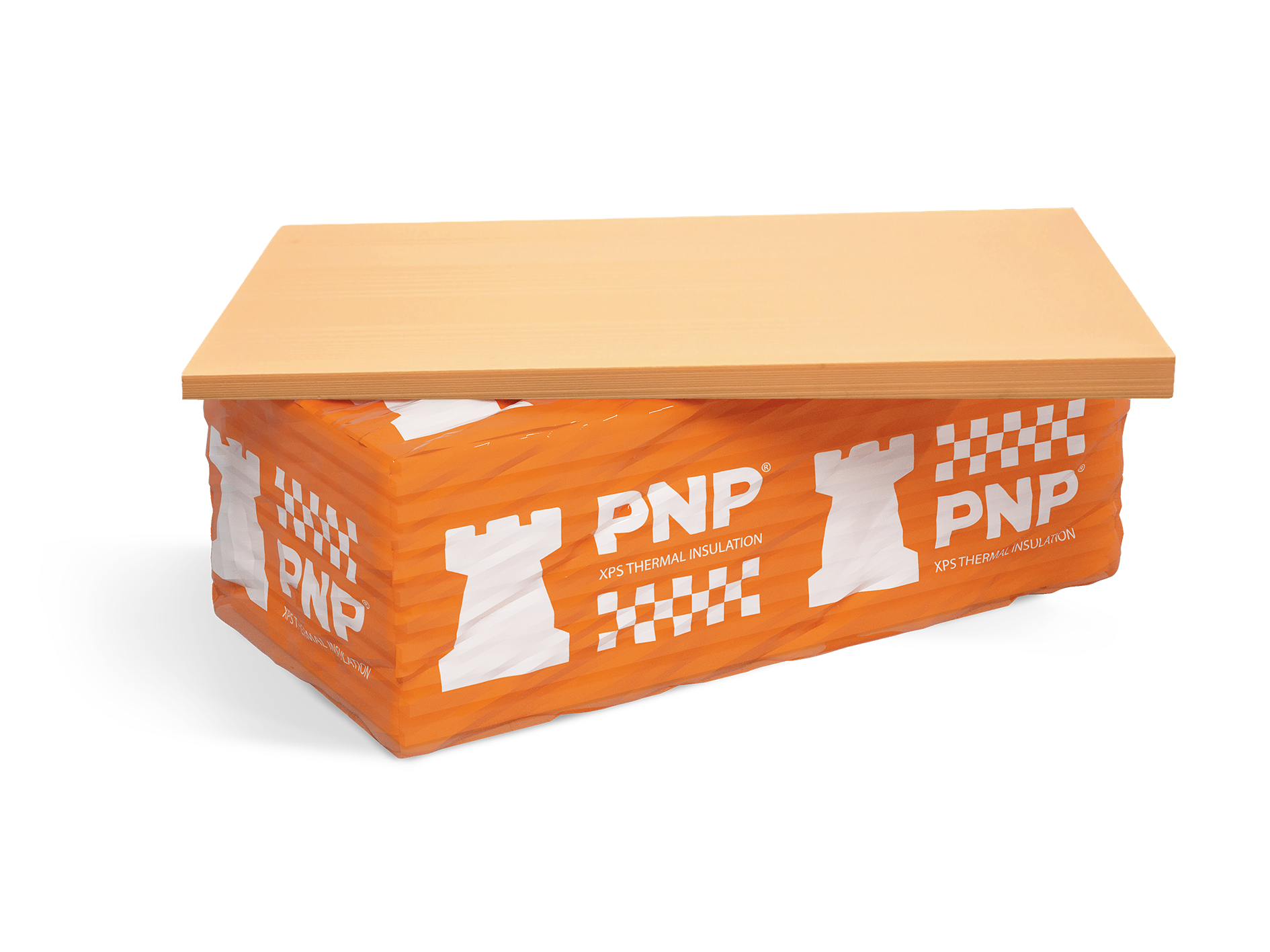
XPS 300 — Toplotna izolacija temeljev in tal

Uporabite XPS 300 tam, kjer težke obremenitve zahtevajo zanesljivo toplotno izolacijo – vključno s temelji, talnimi ploščami in dostopnimi strehami.

Tlačna trdnost, kPa:
200–300
Deklarirana toplotna prevodnost λD, W/(m·K):
0,034–0,035
Razred reakcije na ogenj:
E
Dimenzije plošče (dolžina × širina), mm:
1250 × 600
Nazivna debelina, mm:
20–150
Vrsta površine:
Gladko
Vrsta roba:
Ravni rob (I) / L-oblikovni rob (L)
Standard proizvoda:
EN 13164:2012+A1:2015

Robustna toga plošča iz ekstrudiranega polistirena, zasnovana za toplotno izolacijo v visoko obremenjenih konstrukcijskih aplikacijah – XPS 300 zagotavlja izjemne tlačne lastnosti pri temeljih, tleh in dostopnih strehah. Na voljo v debelinah od 20 mm do 200 mm (in več na zahtevo), PNP XPS 300 združuje dosledno nizko toplotno prevodnost z izjemno mehansko trdnostjo.

Opis

PNP XPS 300 je visokozmogljiv toplotnoizolacijski material (najnovejša generacija XPS), izdelan iz splošno namenskega polistirena z gladko površino in homogeno strukturo zaprtih celic. Deklarirana toplotna prevodnost (λD) znaša 0,034 W/m·K za debeline od 20 do 100 mm in 0,035 W/m·K za debeline od 120 do 150 mm. Tlačna trdnost je ocenjena kot CS(10\Y) 300 (≥ 300 kPa) za plošče debelejše od 30 mm in CS(10\Y) 200 (≥ 200 kPa) za debeline od 20 do 30 mm. Dolgotrajna absorpcija vode pri popolni potopitvi je ocenjena kot WL(T) 0,7 (≤ 0,7 Vol.-%). Plošče so skladne s standardom EN 13164:2012+A1:2015 in v celoti izpolnjujejo zahteve uredbe REACH ter ne vsebujejo HBCDD ali drugih snovi, ki vzbujajo veliko skrb.

Področja uporabe

  • Toplotna izolacija temeljev in temeljnih plošč
  • Izolacija tal in podtalja v nosilnih sklopih
  • Stilobati in dostopne strehe
  • Tlakovalni sistemi in urejanje krajine
  • Izolacija pod težkimi površinskimi oblogami in prometnimi površinami

Prednosti

  • Dosledno nizka toplotna prevodnost (λD 0,034–0,035 W/m·K)
  • Izjemna tlačna trdnost — CS(10\Y) ≥ 300 kPa za plošče nad 30 mm
  • Praktično ničelna absorpcija vode — homogena struktura zaprtih celic (WL(T) ≤ 0,7 Vol.-%)
  • Popolna biostabilnost in dokazana dolgotrajna obstojnost
  • Skladnost z uredbo REACH in okoljska odgovornost — pri proizvodnji niso uporabljena sredstva za penenje, ki tanjšajo ozonski plašč
  • Široko delovno temperaturno območje: −70 °C do +75 °C
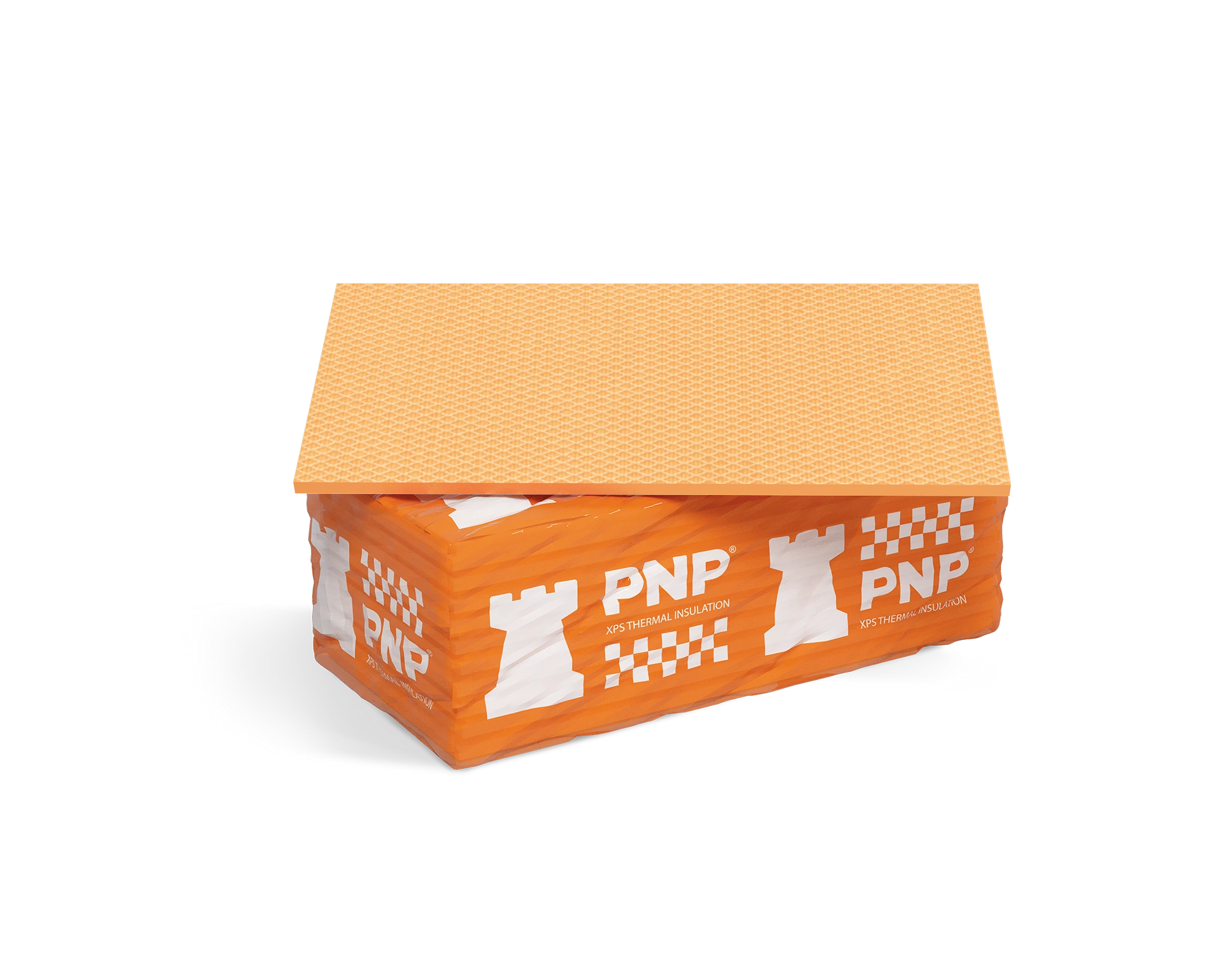
XPS 300 — Toplotna izolacija temeljev in tal — Tehnično
NepremičninaDebelina / stanjeDeklarirana vrednost
Tlačna trdnost / tlačna napetost pri 10 % deformaciji, CS(10\Y)20–30 mmCS(10\Y) 200 (≥200 kPa)
Tlačna trdnost / tlačna napetost pri 10 % deformaciji, CS(10\Y)>30 mmCS(10\Y) 300 (≥300 kPa)
Razred reakcije na ogenjE
Deklarirana toplotna prevodnost λD, W/(m·K)20–100 mm0,034
Deklarirana toplotna prevodnost λD, W/(m·K)120–150 mm0,035
Dolgotrajna absorpcija vode s popolnim potapljanjem, WL(T)WL(T)0,7 (≤ 0,7 [Vol.-%])
Dolgotrajna absorpcija vode z difuzijo, WD(V)WD(V) 3 (≤ 3,0 [Vol-%])
Dimenzijska stabilnost pri določenih pogojih, DSDS(70,90)
Tlačna leznost, CC>30 mmCC(2/1,5/50)130
Natezna trdnost pravokotno na površino, TRTR 400
Odpornost proti zmrzovanju in tajanju, FTCDFTCD 1 (≤1 [Vol-%])
Debelinska toleranca, razredT1
Delovna temperatura, °C−70 … +75 °C
Deformation under specified compressive load and temperature conditionsDL T(2)5
Vrsta površineGladko
Standard proizvodaEN 13164:2012+A1:2015

Vrednosti so v skladu z aktualnim tehničnim listom.

XPS 300 — Toplotna izolacija temeljev in tal — Embalaža
Nazivna debelina, mmDeklarirana toplotna upornost RD, m²·K/WPlošč v paketu, kosPovršina paketa, m²Prostornina paketa, m³
200,552015,000,3000
300,85139,750,2925
401,15107,500,3000
501,4586,000,3000
601,7564,500,2700
802,3553,750,3000
1002,9043,000,3000
1203,4032,250,2700
1504,2521,500,2250

Transport dimensions for boards with L-edge: 615×1265 mm

XPS 300 — Toplotna izolacija temeljev in tal

Tehnični list

pnp_xps300-300TB_600x1250_techcard_sl(20.07.2026).pdf

PDF · SL

XPS 300 — Toplotna izolacija temeljev in tal

Izjava o lastnostih

DoP PNP XPS 300 EMI_sl (U).pdf

PDF · SL

XPS 300 — Toplotna izolacija temeljev in tal: is it the right board?

When to use it

  • Insulating foundation slabs and strip footings where boards thicker than 30 mm must carry ≥ 300 kPa compressive load (CS(10\Y)300).
  • Floor insulation beneath cement-sand screeds in residential or commercial buildings with standard occupancy loads.
  • Slab-on-grade construction where the board lies directly on compacted granular fill and must resist permanent ground pressure.
  • Accessible flat roofs, terraces, and stylobates with pedestrian traffic and a smooth surface finish is acceptable.
  • Paving systems and landscaped podiums where a smooth, dimensionally stable board is placed under paving slabs or crushed-stone bedding.
  • Thermal-insulating inserts in reinforced concrete lintels and slab edges where a compact, high-strength board is required to bridge cold-bridge details.
  • Expansion-joint filler applications where a rigid, dimensionally stable XPS board is needed between connected structure sections.

When not to use it

  • Do not use XPS 300 in ETICS plaster or render systems, because its smooth skin does not provide the mechanical key required for adhesive compounds to bond reliably.
  • Do not use XPS 300 where the design compressive load exceeds 300 kPa (for boards >30 mm) or 200 kPa (for 20–30 mm boards), because the declared strength class will be exceeded.
  • Do not use XPS 300 on flat roofs, terraces, or green roofs where drainage fall must be created within the insulation layer, because the boards are parallel-faced and provide no slope.
  • Do not use XPS 300 on facades, clinker-tile systems, or any application where plaster, render, or tile adhesive is applied directly to the board face, because the smooth surface lacks the texture needed for adhesion.
  • Do not use XPS 300 where the project fire specification requires Euroclass E or better and only XPS 300 qualifies, but do verify: for applications where Euroclass F is the lower limit, note that XPS 300 is already rated Euroclass E — a higher classification — so it meets that requirement; however, always confirm local fire regulations with a qualified designer.
  • Do not use XPS 300 under industrial floors, vehicle-access roofs, or road pavements where the design load demands ≥ 400 kPa, because a higher-grade board is required.

Choose instead

  • For ETICS plaster/render facades (smooth surface unsuitable): choose XPS 300 W (waffled surface, same 300 kPa strength) or XPS 300 MG (milled and grooved surface, 300 kPa).
  • For loads exceeding 300 kPa (industrial floors, heavily trafficked areas): choose XPS 400 (400 kPa) or XPS 500 (500 kPa) or XPS 700 (700 kPa) depending on the design requirement.
  • For flat roofs or terraces requiring a built-in drainage fall: choose XPS 300 SLOPE (factory-tapered boards, 300 kPa).
  • For facades or bonded systems where plaster or tile adhesive is applied directly to the board: choose XPS 300 W (waffled) or XPS 300 MG (milled and grooved).
  • For vehicle-access roofs or road pavements exceeding 300 kPa: choose XPS 500 or XPS 700.

When does XPS 300 deliver the right balance of strength and simplicity?

XPS 300 is the standard structural-grade board in the PNP XPS range, carrying a declared compressive strength of 300 kPa at 10 % deformation or yield (CS(10\Y)300) for thicknesses above 30 mm, and 200 kPa for the 20–30 mm thickness range. This makes it the appropriate choice for the majority of load-bearing insulation positions in conventional construction: foundation slabs, slab-on-grade floors, accessible roof terraces with pedestrian use, and paving beds — applications where the insulation must carry real structural load without deforming over time.

The board also carries a compressive creep classification of CC(2/1.5/50)130 for thicknesses above 30 mm, meaning it is tested for long-term deformation under sustained load — a critical property beneath screeds and ground slabs where the insulation remains permanently compressed. Its tensile strength perpendicular to faces is TR 400, freeze–thaw resistance is FTCD1, and long-term water absorption by total immersion is WL(T)0.7 (≤ 0.7 Vol.-%), confirming suitability for below-ground and inverted-roof positions subject to moisture.

What XPS 300 does not provide is a prepared adhesion surface. Its smooth skin is optimised for load distribution and direct contact with concrete or granular fill, not for bonding renders or adhesive compounds. Where a finish layer must be applied directly to the board face, the waffled XPS 300 W or milled-and-grooved XPS 300 MG variants are the correct substitutes — they share the same strength class while offering the surface texture that adhesive systems require.

Finally, XPS 300 is parallel-faced. On flat roofs where drainage fall must be created within the insulation layer itself, XPS 300 SLOPE (factory-tapered boards with the same 300 kPa strength) eliminates the need for a separate slope screed. A qualified designer should confirm the appropriate product, thickness, and compressive-load class for any specific project — refer to the current TDS and DoP for all declared values.

XPS 300 — Toplotna izolacija temeljev in tal — frequently asked questions

What is the compressive strength of XPS 300, and does it apply across all thicknesses?

For boards thicker than 30 mm, XPS 300 is rated CS(10\Y)300, meaning ≥ 300 kPa at 10 % deformation or yield (EN 826). For 20–30 mm boards the declared class is CS(10\Y)200 (≥ 200 kPa). Always verify the applicable thickness range with the current TDS before specifying.

Can XPS 300 be used under a cement-sand screed in a residential floor?

Yes — floor insulation beneath cement-sand screeds in load-bearing assemblies is one of the primary applications of XPS 300. The board's 300 kPa compressive strength and CC(2/1.5/50)130 creep classification (for thicknesses above 30 mm) support this use, but the designer should confirm the required thickness and load class for the specific project.

Is XPS 300 suitable for ETICS or plastered facade systems?

No. XPS 300 has a smooth skin that does not provide the mechanical key needed for plaster, render, or tile adhesive. For bonded facade systems, choose XPS 300 W (waffled surface) or XPS 300 MG (milled and grooved surface) instead.

What fire classification does XPS 300 carry?

XPS 300 is classified Euroclass E for reaction to fire under EN 13164:2012+A1:2015. This is a higher classification than Euroclass F but does not satisfy requirements for Euroclass D or above. Always confirm the fire performance requirement for your application with a qualified designer and the local building regulations.

How does XPS 300 perform in permanently wet or below-ground conditions?

Long-term water absorption by total immersion is WL(T)0.7 (≤ 0.7 Vol.-%), and freeze–thaw resistance is FTCD1 (≤ 1 Vol.-%), confirming that the board's thermal and mechanical properties remain stable in below-ground and moisture-exposed positions. See the current TDS and DoP for full declared values.

Can XPS 300 create a drainage fall on a flat roof?

No — XPS 300 boards are parallel-faced and cannot form a slope. For flat roofs, terraces, or green roofs where drainage fall must be built into the insulation layer, use XPS 300 SLOPE (factory-tapered boards, 300 kPa compressive strength) as a top layer, but you can reach the effective thickness of thermal insulation by combining XPS 300 and XPS 300 Slope boards.

What should I choose if my design loads exceed 300 kPa?

XPS 300 should not be used where the design compressive load exceeds its declared class. PNP XPS offers XPS 400 (400 kPa), XPS 500 (500 kPa), and XPS 700 (700 kPa) for higher-load applications such as industrial floors, vehicle-access decks, and road construction. A structural engineer should determine the required class.

What thicknesses are available for XPS 300?

Standard packaged thicknesses are 20, 30, 40, 50, 60, 80, 100, 120, and 150 mm; thicker boards (TB format) are available — see the current TDS for details. Boards are 1250 × 600 mm nominally, available with straight (I) or L-edge profiles.

Oglejte si tudi

XPS 150 W X-Grip — Vrhunska toplotna izolacija z močnim oprijemom

X-Grip · 150 kPa

XPS 150 W X-Grip — Vrhunska toplotna izolacija z močnim oprijemom

Izberite XPS 150 W X-Grip za nanašanje težkih ometov, lepil za ploščice ali sistemov ETICS na stene, kletne prostore, tla ali strehe, kjer je zahtevana visoka trdnost sprijemnosti izolacije.

Več podrobnosti

XPS 300 W — Visoko-adhezivna strukturna toplotna izolacija

W (Waffle) · 300 kPa

XPS 300 W — Visoko-adhezivna strukturna toplotna izolacija

Uporabite XPS 300 W na dostopnih strehah ali podestnih ploščah, kjer sta ključnega pomena nosilnost in maksimalna oprijemljivost za membrane ali premaze.

Več podrobnosti

XPS 500 — Industrijska in visokotlačna toplotna izolacija

Smooth · 500 kPa

XPS 500 — Industrijska in visokotlačna toplotna izolacija

Uporabite XPS 500 tam, kjer visoke statične in dinamične obremenitve zahtevajo maksimalno odpornost na tlak – vključno s industrijskimi tlemi, parkirnimi ploščadmi in gradnjo cest.

Več podrobnosti

XPS 700 — Toplotna izolacija za ekstremne obremenitve in gradbeništvo

Smooth · 700 kPa

XPS 700 — Toplotna izolacija za ekstremne obremenitve in gradbeništvo

Uporabite XPS 700 tam, kjer je ključna maksimalna tlačna trdnost – vključno s težko civilno infrastrukturo, industrijskimi temelji in visokoobremenjeno cestno gradnjo.

Več podrobnosti

XPS 300 SLOPE — Konična toplotna izolacija za odvodnjavanje ravnih streh

Slope · 300 kPa

XPS 300 SLOPE — Konična toplotna izolacija za odvodnjavanje ravnih streh

Uporabite XPS 300 SLOPE na ravnih strehah, terasah in zelenih strehah, kjer mora enoslojna rešitev zagotoviti odtočni naklon in trajno toplotno izolacijo.

Več podrobnosti
Pojdi v katalog
Kontaktirajte nas

Kontaktirajte nas

Pustite svoje kontaktne podatke in odgovorili vam bomo v najkrajšem možnem času.

Kontaktirajte nas

Pustite svoje kontaktne podatke in odgovorili vam bomo v najkrajšem možnem času.

Vaša zahteva je bila poslana

Kmalu vas bomo kontaktirali