Přeskočit na hlavní obsah

XPS 300 — Tepelná izolace základů a podlah

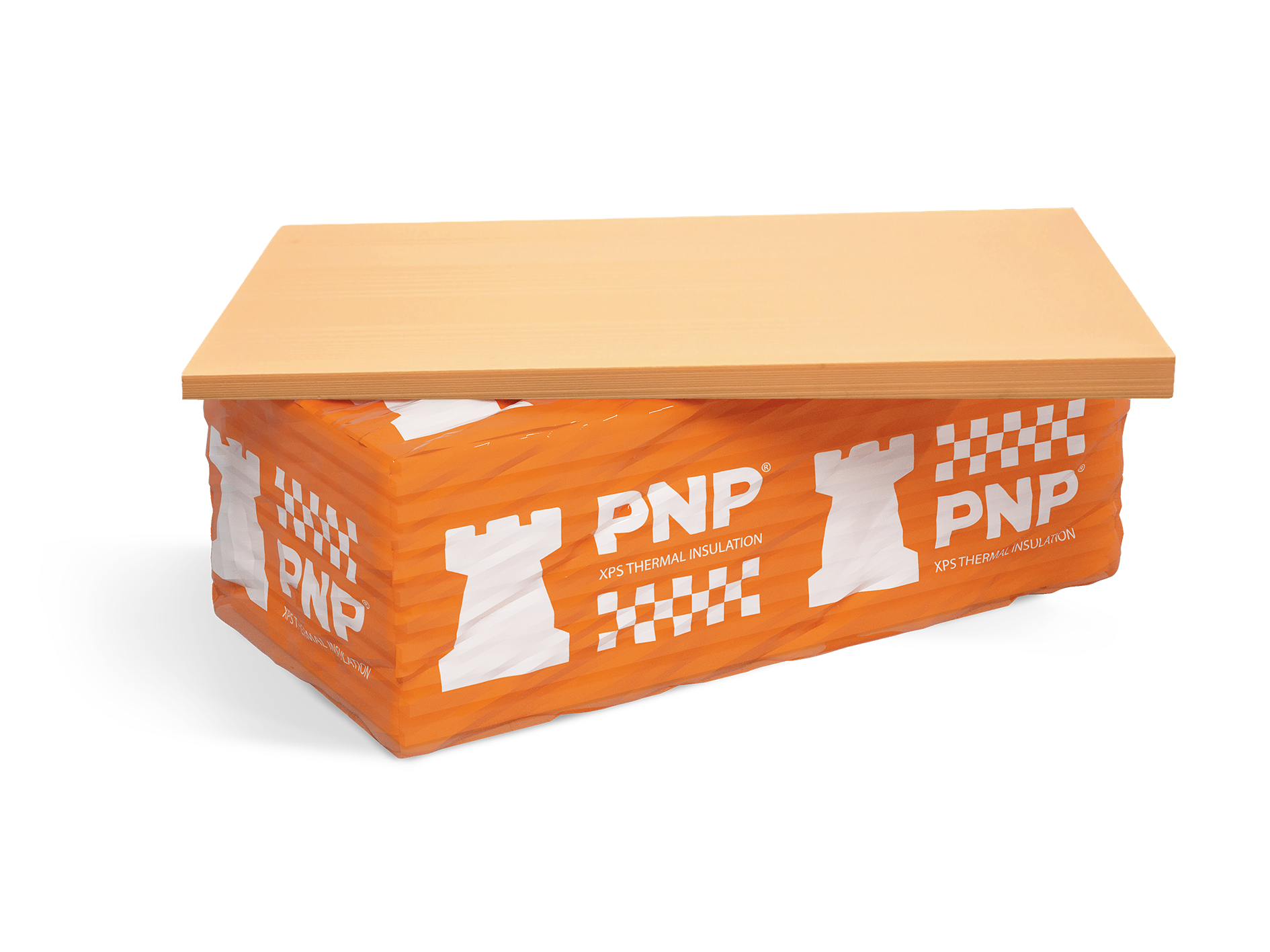
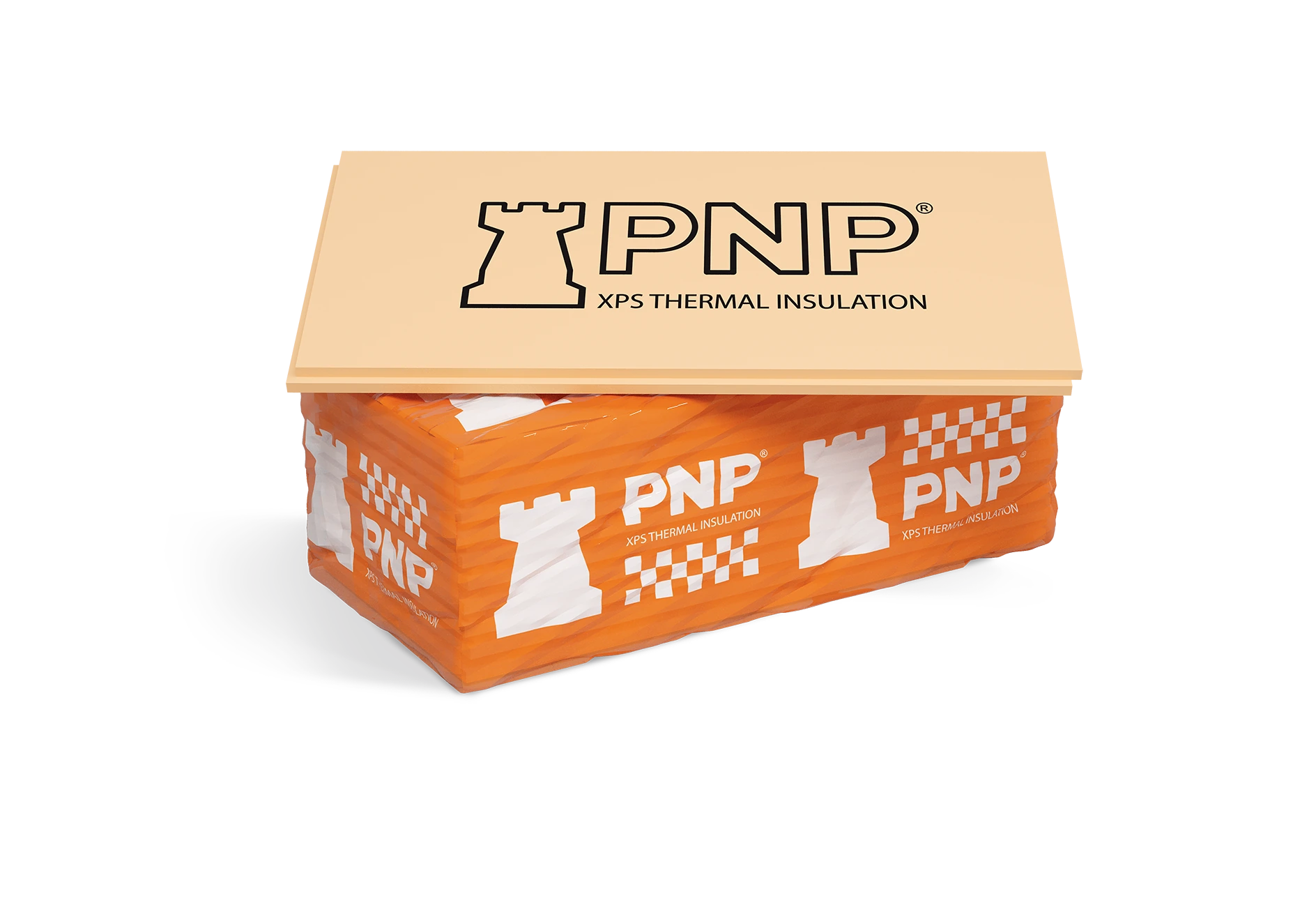
Používejte XPS 300 tam, kde vysoké zatížení vyžaduje spolehlivou tepelnou izolaci – základy, podlahové desky a pochozí střechy.

Pevnost v tlaku, kPa:
200–300
Deklarovaná tepelná vodivost λD, W/(m·K):
0,034–0,035
Reakce na oheň, třída:
E
Rozměr desky (délka × šířka), mm:
1250 × 600
Jmenovitá tloušťka, mm:
20–150
Typ povrchu:
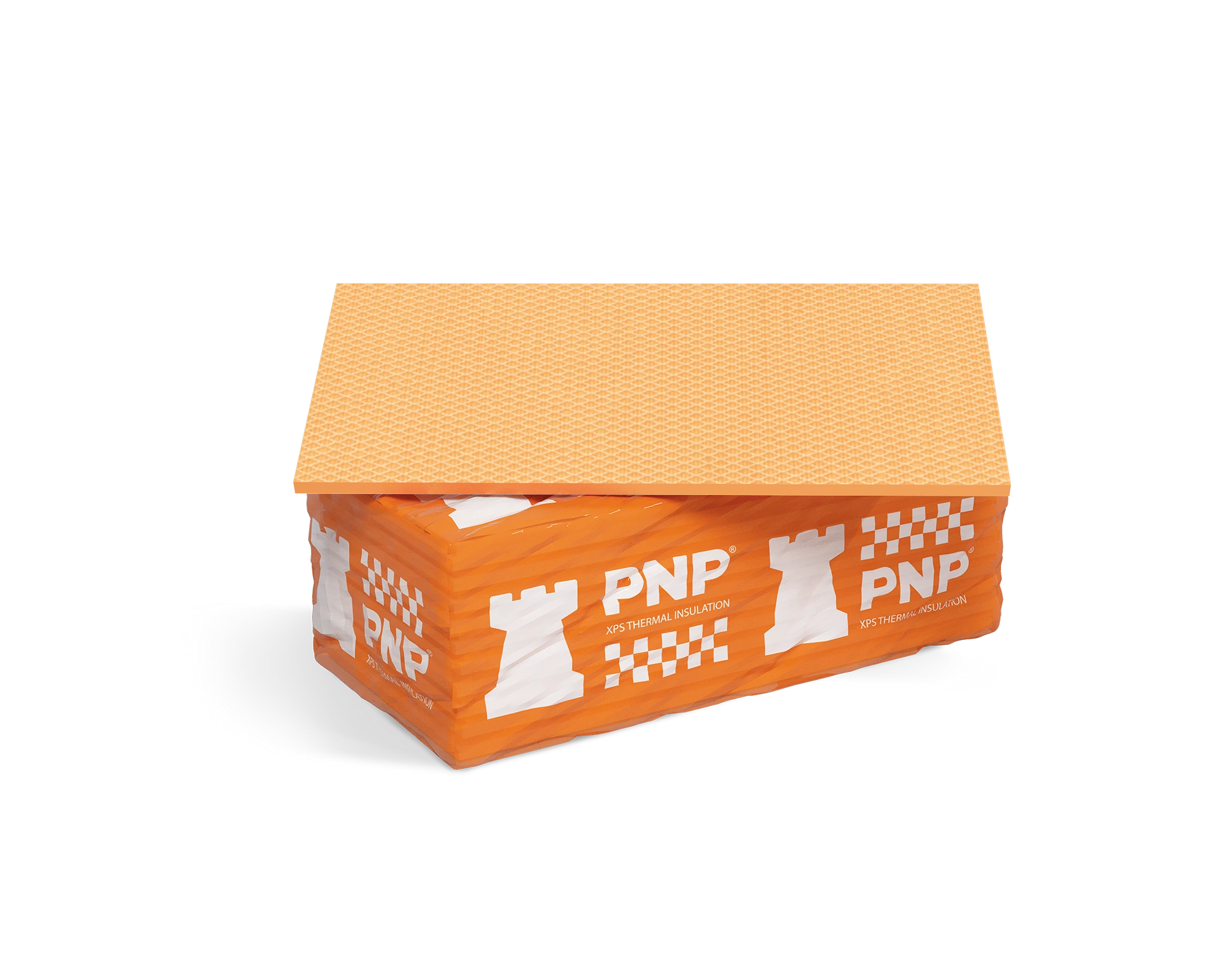
Hladký
Typ hrany:
Rovná hrana (I) / L-tvarová hrana (L)
Norma výrobku:
EN 13164:2012+A1:2015

Robustní tuhá deska z extrudovaného polystyrenu určená pro tepelnou izolaci vysoce zatížených konstrukčních aplikací – XPS 300 zajišťuje výjimečný tlakový výkon v základech, podlahách a pochozích střechách. Dostupná v tloušťkách od 20 mm do 200 mm (a více na vyžádání), PNP XPS 300 kombinuje trvale nízkou tepelnou vodivost s vynikající mechanickou pevností.

Popis

PNP XPS 300 je vysoce výkonný tepelněizolační materiál (XPS nejnovější generace) vyráběný z polystyrenu pro všeobecné použití, s hladkým povrchem a homogenní uzavřenou buněčnou strukturou. Deklarovaná tepelná vodivost (λD) je 0,034 W/m·K pro tloušťky 20–100 mm a 0,035 W/m·K pro tloušťky 120–150 mm. Pevnost v tlaku je hodnocena CS(10\Y) 300 (≥ 300 kPa) pro desky tloušťky nad 30 mm a CS(10\Y) 200 (≥ 200 kPa) pro tloušťky 20–30 mm. Dlouhodobá absorpce vody při úplném ponoření je hodnocena WL(T) 0,7 (≤ 0,7 obj.-%). Desky splňují normu EN 13164:2012+A1:2015 a jsou plně v souladu s nařízením REACH – neobsahují HBCDD ani jiné látky vzbuzující mimořádné obavy.

Aplikace

  • Tepelná izolace základů a základových desek
  • Izolace podlah a podkladních vrstev v nosných skladbách
  • Stylobaty a pochozí střechy
  • Dlažební systémy a úpravy krajiny
  • Izolace pod těžkými povrchovými úpravami a pojezdovými plochami

Výhody

  • Trvale nízká tepelná vodivost (λD 0,034–0,035 W/m·K)
  • Výjimečná pevnost v tlaku — CS(10\Y) ≥ 300 kPa pro desky nad 30 mm
  • Prakticky nulová absorpce vody — homogenní uzavřená buněčná struktura (WL(T) ≤ 0,7 obj.-%)
  • Absolutní biostabilita a ověřená dlouhodobá trvanlivost
  • V souladu s REACH a ekologicky odpovědný — při výrobě se nepoužívají nadouvadla poškozující ozonovou vrstvu
  • Široký rozsah provozních teplot: −70 °C až +75 °C
XPS 300 — Tepelná izolace základů a podlah — Technické
NemovitostRozsah tloušťky / stavDeklarovaná hodnota
Pevnost v tlaku / napětí v tlaku při 10% deformaci, CS(10\Y)20–30 mmCS(10\Y) 200 (≥200 kPa)
Pevnost v tlaku / napětí v tlaku při 10% deformaci, CS(10\Y)>30 mmCS(10\Y) 300 (≥300 kPa)
Reakce na oheň, třídaE
Deklarovaná tepelná vodivost λD, W/(m·K)20–100 mm0,034
Deklarovaná tepelná vodivost λD, W/(m·K)120–150 mm0,035
Dlouhodobá absorpce vody při úplném ponoření, WL(T)WL(T)0,7 (≤ 0,7 [Vol.-%])
Dlouhodobá absorpce vody difuzí, WD(V)WD(V) 3 (≤ 3,0 [Vol-%])
Rozměrová stabilita za stanovených podmínek, DSDS(70,90)
Tlaková tečivost, CC>30 mmCC(2/1,5/50)130
Pevnost v tahu kolmo k rovině desky, TRTR 400
Odolnost vůči zmrazování a rozmrazování, FTCDFTCD 1 (≤1 [Vol-%])
Tolerance tloušťky, třídaT1
Provozní teplota, °C−70 … +75 °C
Deformation under specified compressive load and temperature conditionsDL T(2)5
Typ povrchuHladký
Norma výrobkuEN 13164:2012+A1:2015

Hodnoty podle aktuálního technického listu.

XPS 300 — Tepelná izolace základů a podlah — Balení
Jmenovitá tloušťka, mmDeklarovaný tepelný odpor RD, m²·K/WDesek v balení, ksPlocha balení, m²Objem balení, m³
200,552015,000,3000
300,85139,750,2925
401,15107,500,3000
501,4586,000,3000
601,7564,500,2700
802,3553,750,3000
1002,9043,000,3000
1203,4032,250,2700
1504,2521,500,2250

Transport dimensions for boards with L-edge: 615×1265 mm

XPS 300 — Tepelná izolace základů a podlah

Technický list

pnp_xps300-300TB_600x1250_techcard_cz(20.07.2026).pdf

PDF · CZ

XPS 300 — Tepelná izolace základů a podlah

Prohlášení o vlastnostech

DoP PNP XPS 300 EMI_cz (U).pdf

PDF · CZ

XPS 300 — Tepelná izolace základů a podlah: is it the right board?

When to use it

  • Insulating foundation slabs and strip footings where boards thicker than 30 mm must carry ≥ 300 kPa compressive load (CS(10\Y)300).
  • Floor insulation beneath cement-sand screeds in residential or commercial buildings with standard occupancy loads.
  • Slab-on-grade construction where the board lies directly on compacted granular fill and must resist permanent ground pressure.
  • Accessible flat roofs, terraces, and stylobates with pedestrian traffic and a smooth surface finish is acceptable.
  • Paving systems and landscaped podiums where a smooth, dimensionally stable board is placed under paving slabs or crushed-stone bedding.
  • Thermal-insulating inserts in reinforced concrete lintels and slab edges where a compact, high-strength board is required to bridge cold-bridge details.
  • Expansion-joint filler applications where a rigid, dimensionally stable XPS board is needed between connected structure sections.

When not to use it

  • Do not use XPS 300 in ETICS plaster or render systems, because its smooth skin does not provide the mechanical key required for adhesive compounds to bond reliably.
  • Do not use XPS 300 where the design compressive load exceeds 300 kPa (for boards >30 mm) or 200 kPa (for 20–30 mm boards), because the declared strength class will be exceeded.
  • Do not use XPS 300 on flat roofs, terraces, or green roofs where drainage fall must be created within the insulation layer, because the boards are parallel-faced and provide no slope.
  • Do not use XPS 300 on facades, clinker-tile systems, or any application where plaster, render, or tile adhesive is applied directly to the board face, because the smooth surface lacks the texture needed for adhesion.
  • Do not use XPS 300 where the project fire specification requires Euroclass E or better and only XPS 300 qualifies, but do verify: for applications where Euroclass F is the lower limit, note that XPS 300 is already rated Euroclass E — a higher classification — so it meets that requirement; however, always confirm local fire regulations with a qualified designer.
  • Do not use XPS 300 under industrial floors, vehicle-access roofs, or road pavements where the design load demands ≥ 400 kPa, because a higher-grade board is required.

Choose instead

  • For ETICS plaster/render facades (smooth surface unsuitable): choose XPS 300 W (waffled surface, same 300 kPa strength) or XPS 300 MG (milled and grooved surface, 300 kPa).
  • For loads exceeding 300 kPa (industrial floors, heavily trafficked areas): choose XPS 400 (400 kPa) or XPS 500 (500 kPa) or XPS 700 (700 kPa) depending on the design requirement.
  • For flat roofs or terraces requiring a built-in drainage fall: choose XPS 300 SLOPE (factory-tapered boards, 300 kPa).
  • For facades or bonded systems where plaster or tile adhesive is applied directly to the board: choose XPS 300 W (waffled) or XPS 300 MG (milled and grooved).
  • For vehicle-access roofs or road pavements exceeding 300 kPa: choose XPS 500 or XPS 700.

When does XPS 300 deliver the right balance of strength and simplicity?

XPS 300 is the standard structural-grade board in the PNP XPS range, carrying a declared compressive strength of 300 kPa at 10 % deformation or yield (CS(10\Y)300) for thicknesses above 30 mm, and 200 kPa for the 20–30 mm thickness range. This makes it the appropriate choice for the majority of load-bearing insulation positions in conventional construction: foundation slabs, slab-on-grade floors, accessible roof terraces with pedestrian use, and paving beds — applications where the insulation must carry real structural load without deforming over time.

The board also carries a compressive creep classification of CC(2/1.5/50)130 for thicknesses above 30 mm, meaning it is tested for long-term deformation under sustained load — a critical property beneath screeds and ground slabs where the insulation remains permanently compressed. Its tensile strength perpendicular to faces is TR 400, freeze–thaw resistance is FTCD1, and long-term water absorption by total immersion is WL(T)0.7 (≤ 0.7 Vol.-%), confirming suitability for below-ground and inverted-roof positions subject to moisture.

What XPS 300 does not provide is a prepared adhesion surface. Its smooth skin is optimised for load distribution and direct contact with concrete or granular fill, not for bonding renders or adhesive compounds. Where a finish layer must be applied directly to the board face, the waffled XPS 300 W or milled-and-grooved XPS 300 MG variants are the correct substitutes — they share the same strength class while offering the surface texture that adhesive systems require.

Finally, XPS 300 is parallel-faced. On flat roofs where drainage fall must be created within the insulation layer itself, XPS 300 SLOPE (factory-tapered boards with the same 300 kPa strength) eliminates the need for a separate slope screed. A qualified designer should confirm the appropriate product, thickness, and compressive-load class for any specific project — refer to the current TDS and DoP for all declared values.

XPS 300 — Tepelná izolace základů a podlah — frequently asked questions

What is the compressive strength of XPS 300, and does it apply across all thicknesses?

For boards thicker than 30 mm, XPS 300 is rated CS(10\Y)300, meaning ≥ 300 kPa at 10 % deformation or yield (EN 826). For 20–30 mm boards the declared class is CS(10\Y)200 (≥ 200 kPa). Always verify the applicable thickness range with the current TDS before specifying.

Can XPS 300 be used under a cement-sand screed in a residential floor?

Yes — floor insulation beneath cement-sand screeds in load-bearing assemblies is one of the primary applications of XPS 300. The board's 300 kPa compressive strength and CC(2/1.5/50)130 creep classification (for thicknesses above 30 mm) support this use, but the designer should confirm the required thickness and load class for the specific project.

Is XPS 300 suitable for ETICS or plastered facade systems?

No. XPS 300 has a smooth skin that does not provide the mechanical key needed for plaster, render, or tile adhesive. For bonded facade systems, choose XPS 300 W (waffled surface) or XPS 300 MG (milled and grooved surface) instead.

What fire classification does XPS 300 carry?

XPS 300 is classified Euroclass E for reaction to fire under EN 13164:2012+A1:2015. This is a higher classification than Euroclass F but does not satisfy requirements for Euroclass D or above. Always confirm the fire performance requirement for your application with a qualified designer and the local building regulations.

How does XPS 300 perform in permanently wet or below-ground conditions?

Long-term water absorption by total immersion is WL(T)0.7 (≤ 0.7 Vol.-%), and freeze–thaw resistance is FTCD1 (≤ 1 Vol.-%), confirming that the board's thermal and mechanical properties remain stable in below-ground and moisture-exposed positions. See the current TDS and DoP for full declared values.

Can XPS 300 create a drainage fall on a flat roof?

No — XPS 300 boards are parallel-faced and cannot form a slope. For flat roofs, terraces, or green roofs where drainage fall must be built into the insulation layer, use XPS 300 SLOPE (factory-tapered boards, 300 kPa compressive strength) as a top layer, but you can reach the effective thickness of thermal insulation by combining XPS 300 and XPS 300 Slope boards.

What should I choose if my design loads exceed 300 kPa?

XPS 300 should not be used where the design compressive load exceeds its declared class. PNP XPS offers XPS 400 (400 kPa), XPS 500 (500 kPa), and XPS 700 (700 kPa) for higher-load applications such as industrial floors, vehicle-access decks, and road construction. A structural engineer should determine the required class.

What thicknesses are available for XPS 300?

Standard packaged thicknesses are 20, 30, 40, 50, 60, 80, 100, 120, and 150 mm; thicker boards (TB format) are available — see the current TDS for details. Boards are 1250 × 600 mm nominally, available with straight (I) or L-edge profiles.

Viz také

XPS 150 W X-Grip — Tepelná izolace s vynikající přilnavostí

X-Grip · 150 kPa

XPS 150 W X-Grip — Tepelná izolace s vynikající přilnavostí

Zvolte XPS 150 W X-Grip při nanášení těžkých omítek, lepidel na obklady nebo systémů ETICS na stěny, suterény, podlahy či střechy vyžadující vysokou pevnost spojení s izolací.

Více informací

XPS 300 W — Konstrukční tepelná izolace s vysokou přilnavostí

W (Waffle) · 300 kPa

XPS 300 W — Konstrukční tepelná izolace s vysokou přilnavostí

Používejte XPS 300 W na přístupných střechách nebo podiumových deskách, kde jsou klíčové nosné vlastnosti a maximální přilnavost pro membrány nebo nátěry.

Více informací

XPS 500 — Průmyslová a vysokotlaká tepelná izolace

Smooth · 500 kPa

XPS 500 — Průmyslová a vysokotlaká tepelná izolace

Používejte XPS 500 tam, kde vysoké statické a dynamické zatížení vyžaduje maximální odolnost proti stlačení – průmyslové podlahy, parkovací plochy a pozemní komunikace.

Více informací

XPS 700 — Extrémní zatížení a tepelná izolace pro pozemní stavitelství

Smooth · 700 kPa

XPS 700 — Extrémní zatížení a tepelná izolace pro pozemní stavitelství

Používejte XPS 700 tam, kde je klíčová maximální pevnost v tlaku – včetně náročné občanské infrastruktury, průmyslových základů a silničních staveb s vysokým zatížením.

Více informací

XPS 300 SLOPE — Spádová tepelná izolace střešní drenáže

Slope · 300 kPa

XPS 300 SLOPE — Spádová tepelná izolace střešní drenáže

Používejte XPS 300 SLOPE na plochých střechách, terasách a zelených střechách, kde jednoduchá vrstva musí zajistit odtokový spád a trvalou tepelnou izolaci.

Více informací
Přejít do katalogu
Kontaktujte nás

Kontaktujte nás

Zanechte své kontaktní údaje a ozveme se vám co nejdříve.

Kontaktujte nás

Zanechte své kontaktní údaje a ozveme se vám co nejdříve.

Váš požadavek byl odeslán

Brzy vás budeme kontaktovat